Toolbox
  • User rankingRating: 4.6
  • Add to favoritesBookmark
  • Save as PDFSave as PDF
  • PrintPrint
  • EmailEmail
  • Blog ItBlog It
  • Stumble ItStumble It!
Digg It Reddit del.icio.us Save to Yahoo! bookmarks Save to Windows live Share on facebook Save to MySpace Slashdot it science news feed Add to google
- size +

Super atoms turn the periodic table upside down
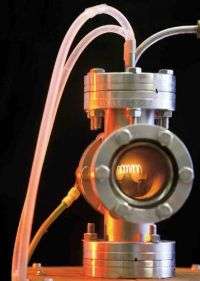
A small twisted wire just like the filament in an incandescent bulb but made of silver forms the basis for the special silver particles. Credit: Sam RentmeesterFMAX
A small twisted wire, just like the filament in an incandescent bulb, but made of silver, forms the basis for the special silver particles. Credit: Sam Rentmeester/FMAX

Researchers at Delft University of Technology in The Netherlands have developed a technique for generating atom clusters made from silver and other metals. Surprisingly enough, these so-called super atoms (clusters of 13 silver atoms, for example) behave in the same way as individual atoms and have opened up a whole new branch of chemistry.
If a silver thread is heated to around 900 degrees Celsius, it will generate vapour made up of silver atoms. The floating atoms stick to each other in groups. Small lumps of silver comprising for example 9, 13 and 55 atoms appear to be energetically stable and are therefore present in the silver mist more frequently that one might assume. Prof. Andreas Schmidt-Ott and Dr. Christian Peineke of TU Delft managed to collect these super atoms and make them suitable for more detailed chemical experiments.

The underlying mechanism governing this stability in super atoms was described in Science by scientists from Virginia Commonwealth University in 2005. They had discovered metal super atoms, but from aluminium. Their aluminium clusters of 13, 23 and 37 atoms reacted in the same way as individual atoms because they comprised electrons that revolved around the atom cluster as a whole. These so-called outer layers were strikingly similar to the outer layers of elements from the periodic table.

The super atoms gave the periodic table a third dimension as it were, according to Schmidt-Ott: 'The chemical properties of the super atoms that have been identified up until now are very similar to those of elements in the periodic table, because their outer layers are much the same. However, we may yet discover super atoms with a different outer layer, giving us another set of completely new properties.'

Schmidt-Ott hopes to find atom clusters with new unique magnetic, optical or electrical properties, which would also be stable enough to create crystals or other solid forms. Potential applications include catalysts in fuel and extra-conductive crystals.

So although super atoms are nothing new, thanks to TU Delft the particles can now be collected in a very pure form and selected according to size, thereby making them suitable for chemical experiments.

Full article can be read in the new edition of TU Delft magazine Delft Outlook. See http://www.delftoutlook.tudelft.nl .

Source: Delft University of Technology
» Next Article in General Science - Chemistry: Researchers use supercomputer to track pathways in myoglobin

would you recommend this story?


User Rating

4.6 out of 5 after 101 total votes
  • not at all
  • 1
  • 2
  • 3
  • 4
  • 5
  • highly

Leave a Comment or

Rank filter

Move the slider to adjust rank threshold, so that you can hide some of the comments.
Posted by 1bigschwantz 07/01/08 12:18
Rank: 3/5 after 4 votes
I wonder if there are any implications for Quantum computing with this finding?
Posted by gopher65 07/01/08 13:10
Rank: 3/5 after 5 votes
We're witnessing the initial baby steps of an entirely new branch of chemistry:D. Awesome.
Posted by googleplex 07/01/08 18:22
Rank: 3.8/5 after 5 votes
It sounds to me more like a molecule of Ag9 and Ag13 etc.
IMHO the word "super atom" implies fusion at the nuclear level. Aren't these just molecules of Silver that have different properties than silver in its natural state? I recall sulphur has very different properties depending on its molecular form.
Posted by Captain_Sakonna 07/01/08 21:51
Rank: 4.7/5 after 3 votes
*gasp* Is dilithium next? */gasp*

Here's the key to the "superatom" concept:

"reacted in the same way as individual atoms because they comprised electrons that revolved around the atom cluster as a whole."

It sounds as if in these "superatoms," the electron structure is completely changed; rather than belonging to any individual parent atom, some or all of the electrons become the property of the cluster as a whole. The electrons then arrange themselves in "shells," or energy levels, around the cluster, as they would around a single atom. It's technically a molecule, but a molecule that mimicks an atom.
Posted by menkaur 07/01/08 23:07
Rank: 1/5 after 1 vote
wow!!!! that's so coooooooooooooool!!!!!
Posted by ShadowRam 07/02/08 09:34
Not rated yet.
Sounds like the Silver equivilent to a Bucky Ball?
Although interesting, I wouldn't call it a 'new atom' unless they are held together by nuclear forces...
Posted by superhuman 07/02/08 11:02
Rank: 1/5 after 1 vote
These are simply molecules made of metal atoms - all metals have loosely bound outer electrons that roam in and on the border of the structure. All the inner electrons are not shared.
Posted by mchrisneglia 07/07/08 17:33
Not rated yet.
The most immediate application I can think of is using the superatoms (specific, vaporized silver allotropes behaving as an amalgam) as a substitute for more expensive elements in reactions. In this way, it's acting as a kind of 'kingpin' atom, to open-up otherwise cost-ineffective but lucrative reactions.

It's a really great discovery. I have no idea how they are going to collect them and keep them stable throughout an otherwise 'normal' chemical reaction.

Science!
Posted by lisbonacid 07/07/08 21:34
Not rated yet.
delocalization. what makes this more than just "metal molecules" is the fact that the nuclei are loosely associating with one another, held by a delocalized electron cloud, resulting in properties similar to that of an atom with the equivalent effective nuclear mass as that of the sum of the cluster. like it says, if crystallization can occur, you've got the potential for cheap heavy catalysts.
Posted by superhuman 07/08/08 10:00
Rank: 5/5 after 1 vote
Delocalized electron cloud is precisely what binds *molecules* not atoms, atoms are composed of nucleons (protons and neutrons) bound by strong forces in nucleus and electrons bound by electrostatic force originating from positive charge of protons in the nucleus.

Those metal molecules are interesting but calling them "super atoms" makes as much sense as calling H2, O2 or N3 molecules super atoms.
Posted by googleplex 07/08/08 12:19
Not rated yet.
Delocalized electron cloud is precisely what binds *molecules* not atoms, atoms are composed of nucleons (protons and neutrons) bound by strong forces in nucleus and electrons bound by electrostatic force originating from positive charge of protons in the nucleus.

Those metal molecules are interesting but calling them "super atoms" makes as much sense as calling H2, O2 or N3 molecules super atoms.

Thanks for clarifying. Only a chemist could call it a superatom and not a physicist. It is "super molecule". Chemists only care about electrons.