Solution to high energy costs could lie underground
July 1, 2008 Solution to high energy costs could lie underground

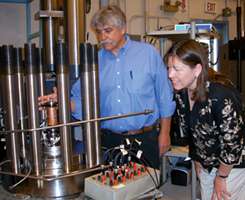
Sandia researchers Steve Bauer and Georgianne Peek look at equipment that will be used to analyze core samples from the potential Iowa aquifer compressed air energy storage site. The data will provide necessary fundamental information used for the design and performance of the underground air storage vessel. (Photo by Chris Burroughs)

Sandia National Laboratories researcher Georgianne Peek thinks a possible solution to high energy costs lies underground. And it’s not coal or oil. It’s compressed air energy storage (CAES).

“Until recently energy has been relatively inexpensive. But now prices are rising dramatically, and we need solutions,” Peek says. “CAES and other storage technologies are not the only answer to our energy needs, but they can be an important part of the solution.”

CAES facilities function like big batteries. Electric motors drive compressors that compress air into an underground geologic formation during off-peak electric use times like evenings and weekends. Then, when electricity is needed most during high-demand times, the precompressed air is used in modified combustion turbines to generate electricity. Natural gas or other fossil fuels are still required to run the turbines, but the process is more efficient. This method uses up to 50 percent less natural gas than standard electricity production.

While the concept of compressed air energy storage is more than 30 years old, only two such plants exist — a 17-year-old facility in McIntosh, Ala., located about 40 miles north of Mobile, and a 30-year-old plant in Germany, both in caverns in salt domes. A third is being developed near Des Moines, Iowa, in an aquifer. In addition, the Public Service Company of New Mexico (PNM) and several other U.S. utilities are considering CAES to help mitigate potential problems associated with the high penetrations of wind generation in their systems.

Sandia is currently managing DOE money to support the design of the Iowa facility, called the Iowa Stored Energy Park (ISEP). Peek is the project manager. Developers include more than 100 municipal utilities in Iowa, Minnesota, and the Dakotas.

ISEP will be a nominal 268 megawatt/13,400 megawatts per hour CAES plant with about 50 hours of storage. It will utilize the abundant wind generation already in Iowa to charge the plant. When ISEP is up and running, it could account for 20 percent of the energy used in a year at a typical municipal Iowa utility and could save cities and their utilities as much as $5 million each year in purchased energy.

Peek says the Iowa project is pretty far along and is expected to be operational by 2012.

“One of the most important tasks that has to be done before a CAES facility can be built is to find a geologic formation that will support it,” Peek says. “ISEP developers are 95 percent sure that they have the right formation, based on the seismic testing at the site, computer modeling, and data from a sister formation.”

This summer multiple core samples from the potential Iowa aquifer CAES site will be taken and sent to Sandia for analysis by a team led by Steve Bauer. The analysis will include collection and assessment of the geologic, hydrologic, and rock physics data in the geomechanics laboratory. The data will provide necessary fundamental information used for the design and performance of the underground air storage vessel.

In 2000 Bauer did similar analysis of rock mechanics of a limestone mine in Norton, Ohio, that was being studied for a potential CAES facility. That project is still under development.

Peek says that PNM is also studying the application of CAES in its New Mexico service territory to help manage its current renewable energy portfolio and foster the growth of renewable energy sources.

“Wind often blows at night,” she says. “As electricity is produced at night from the wind farms, it could be stored and eventually make its way into PNM’s transmission lines during periods of higher need.”

CAES technology development can trace its roots to the early 1960s when evaluation of gas turbine technology for power production began. The technology gained momentum during the next decade due to its promising fuel efficiency and response capabilities to provide load-following and peaking power support.

Now utilities are starting to tie CAES technology to wind power — first with the Iowa plant and soon with possible facilities through the nation, Peek says.

“The wind blows in some areas when electricity is not needed or where the transmission system can’t accept all of the energy,” she says. “Storage enables delivery of the off-peak energy that has been saved in storage to be delivered when it is needed most or has the highest value. Thus, more renewable energy can be delivered than might be possible without storage.”

Source: Sandia National Laboratory


print this article email this article download pdf blog this article bookmark this article     Stumble it Digg this share on Facebook retweet share on Reddit add to delicious
Rate this story - 4.3 /5 (32 votes)

Rank Filter

Move the slider to adjust rank threshold, so that you can hide some of the comments.


Display comments: newest first

  • E_L_Earnhardt - Jul 01, 2008
    • Rank: 2.5 / 5 (2)
    Great news for compressed-air autos!
  • TJ_alberta - Jul 01, 2008
    • Rank: 3 / 5 (3)
    if you happen to park your car near one of the two existing compressed air storage sites...
  • DGBEACH - Jul 02, 2008
    • Rank: 3 / 5 (2)
    Electric motors drive compressors that compress air into an underground geologic formation


    Why not just have these glorified windmills do the actual compression, instead of wasting energy in the conversion?
  • Yogaman - Jul 02, 2008
    • Rank: 2.7 / 5 (3)
    Shouldn't this also be able to level peak energy demand, obviating the need for new power plant construction and thus limiting utility cost growth?
  • Rick69 - Jul 11, 2008
    • Rank: not rated yet
    Yogaman, that point was made in the story.

July 1, 2008 all stories

Comments: 5

4.3 /5 (32 votes)
  • Stumble this up

  • Digg this

  • share this

  • hide
  • Related Stories

  • Reference Genome of Maize Published (w/ Podcast)
    created Nov 19, 2009 | popularity not rated yet | comments 0
  • Scientists unlock clues for tailoring corn plant for food, energy needs
    created Nov 19, 2009 | popularity not rated yet | comments 0
  • One word: bioplastics
    created Nov 17, 2009 | popularity not rated yet | comments 0
  • Fighting climate change by turning CO2 to stone
    created Nov 17, 2009 | popularity not rated yet | comments 0
  • The Future in Two Words: Ionic Liquids
    created Nov 13, 2009 | popularity not rated yet | comments 0


  • hide
  • Relevant PhysicsForums posts

  • Trying to adapt a fuel gage circuit
    created 13 hours ago
  • Pushing the piston.
    created 17 hours ago
  • Do Camcorders/ Video camera have Sensors in them?
    created 22 hours ago
  • Aspiring Engineering major looking for general answers
    created Nov 19, 2009
  • Calculating max load of square tube (steel)
    created Nov 19, 2009
  • Passive Chemical Heating
    created Nov 19, 2009
  • More from Physics Forums - General Engineering

Other News

Intel logo A

Intel wants a chip implant in your brain

Technology / Hi Tech

created 1hour ago | popularity 4.3 / 5 (3) | comments 3

(PhysOrg.com) -- Computer chip maker Intel wants to implant a brain-sensing chip directly into the brains of its customers to allow them to operate computers and other devices without moving a muscle.


The Symbian platform is used on almost 50% of mobiles worldwide

Spotify launches application for Nokia phones

Technology / Software

created 1hour ago | popularity not rated yet | comments 0

Swedish streaming software Spotify announced on Monday the launch of a music application for the Symbian platform, used by the world's biggest mobile phone maker Nokia and other smartphones.


Workers at the Statkraft Osmotic power plant prototype in Tofte

Harnessing the power of salt, Norway tries osmotic power

Technology / Energy

created 2 hours ago | popularity not rated yet | comments 2

After wind, sun, currents and tides, a company is preparing to make clean electricity by harnessing another natural phenomenon, the energy-unleashing encounter of freshwater and seawater.


Microsoft has held talks with Rupert Murdoch's News Corp over removing its news websites from Google, a report said

News Corp, Microsoft hold talks on Google: report

Technology / Internet

created 2 hours ago | popularity 5 / 5 (1) | comments 1

Microsoft has held talks with Rupert Murdoch's News Corp over a possible plan for the software giant to pay the media company to remove its news websites from Google, a report said Monday.


A woman uses her mobile phone near a share prices board in Tokyo

Mobile multimedia revenues tipped to dethrone text

Technology / Telecom

created 1hour ago | popularity not rated yet | comments 0

Multimedia services will surpass text messaging this year as the main source of mobile operators' non-voice revenue in the Asia-Pacific region, industry analyst IDC said Monday.