New paper offers insights into 'blinking' phenomena
July 1st, 2008 New paper offers insights into 'blinking' phenomena

A new paper by a team of researchers led by University of Notre Dame physicist Bolizsár Jankó provides an overview of research into one of the few remaining unsolved problems of quantum mechanics.

More than a century ago, at the dawn of modern quantum mechanics, the Nobel Prize-winning physicist Neils Bohr predicted so-called "quantum jumps." He predicted that these jumps would be due to electrons making transitions between discrete energy levels of individual atoms and molecules. Although controversial in Bohr's time, such quantum jumps were experimentally observed, and his prediction verified, in the 1980s. More recently, with the development of single molecule imaging techniques in the early 1990s, it has been possible to observe similar jumps in individual molecules.

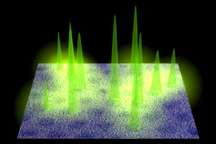
Experimentally, these quantum jumps translate to discrete interruptions of the continuous emission from single molecules, revealing a phenomenon known as florescent intermittency or "blinking."

However, while certain instances of blinking can be directly ascribed to Bohr's original quantum jumps, many more cases exist where the observed fluorescence intermittency does not follow his predictions. Specifically, in systems as diverse as fluorescent proteins, single-light harvesting complexes, single organic fluorophores, and, most recently, individual inorganic nanostructures, clear deviations from Bohr's predictions occur.

As a consequence, virtually all know fluorophores, including fluorescent quantum dots and molecules, exhibit unexplainable episodes of intermittent "blinking" in their emission. The underlying quantum mechanical process responsible for this phenomenon is an enduring mystery in modern chemical physics.

In a paper appearing in today's edition of the journal Nature Physics, Jankó and his colleagues present a "progress report" on the research, including their own, that has been aimed at unlocking the mysteries of these fluorescent molecules or flourophores. They hope the paper will help spark further experimental and theoretical activity to solve the mystery of fluorescence intermittency.

Finding the answer could lead to powerful imaging probes that will enable future researchers to better track disease-related molecules within cells.

"Fluorescent molecules could be of fundamental importance in imaging biological systems and monitoring dynamic processes in vivo," Jankó said. "One of the most attractive types of flourophores today are semiconductor nanocrystal quantum dots (NQD). Their small size, brightness, photostability and highly tunable fluorescent color make them vastly superior to organic dyes."

The blinking phenomenon, however, presents a daunting difficulty in using these dots, especially for such applications as single-molecule biological imaging, where a single NQD is used as a fluorescent label.

If the blinking process could be controlled, quantum dots could, for example, provide better, more stable, multi-color imaging of cancer cells or provide researchers with real-time images of a viral infection, such HIV, within a cell.

"It is very important to elucidate the origin of this phenomenon and to identify ways to control the blinking process," Jankó said.

Jankó's Notre Dame research group already has taken a strong first step toward understanding the phenomenon through research by group member Masaru Kuno, an assistant professor of chemistry and biochemistry at the University. Kuno has discovered that the on- and off-time intervals of intermittent nanocrystal quantum dots follow a universal power law distribution. This discovery has provided Notre Dame researchers and others with the first hints for developing a deeper insight into the physical mechanism behind the vast range of on- and off-times in the intermittency.

Source: University of Notre Dame


print this article email this article download pdf blog this article bookmark this article     Digg this Stumble it share on Facebook share on Reddit add to delicious save to Yahoo! bookmarks
4.3/5 after 26 votes


July 1st, 2008 all stories
Nanotechnology / Nanophysics

Comments: 0
Rank: 4.3/5 after 26 votes

  • Stumble this up

  • Digg this

  • Share it:
  • share on Facebook
  • share on MySpace
  • share on Slashdot
  • rss-newsfeed
  • share on Google
  • share on Reddit
  • add to delicious
  • save to Yahoo! bookmarks
  • share on Windows Live
  • Add to Mixx!
Rating: 4.3/5 after 26 votes

  • Related Stories

  • Researchers discover a potential on-off switch for nanoelectronics
    created Mar 03, 2009 | popularity not rated yet | comments 0
  • Electrons discover their individuality
    created Sep 01, 2008 | popularity not rated yet | comments 0
  • Ultrafast look into atoms and molecules
    created Jun 20, 2008 | popularity not rated yet | comments 0
  • NIST 'Quantum Logic Clock' Rivals Mercury Ion as World's Most Accurate Clock
    created Mar 06, 2008 | popularity not rated yet | comments 0
  • Shuttling Electrons
    created Jun 05, 2006 | popularity not rated yet | comments 0


  • Physicists Demonstrate Quantum Memory with Matter Qubits
    Physicists Demonstrate Quantum Memory with Matter Qubits
    Physics / General Physics
    created 18 hours ago | popularity 4.5 / 5 (11) | comments 1
  • 'Holey' Nanosheets for Wastewater Dye Removal
    Nanotechnology / Nanomaterials
    created Jul 01, 2009 | popularity 5 / 5 (5) | comments 1
  • Jellyfish Robot Swims Like its Biological Counterpart
    Jellyfish Robot Swims Like its Biological Counterpart
    Electronics / Robotics
    created Jun 26, 2009 | popularity 4.4 / 5 (7) | comments 1
  • Could Maxwell's Demon Exist in Nanoscale Systems?
    Could Maxwell's Demon Exist in Nanoscale Systems?
    Physics / General Physics
    created Jun 24, 2009 | popularity 4.4 / 5 (18) | comments 29
  • Living Safely with Robots, Beyond Asimov's Laws
    Living Safely with Robots, Beyond Asimov's Laws
    Electronics / Robotics
    created Jun 22, 2009 | popularity 4.6 / 5 (50) | comments 39
  • Other News

    Harnessing Nanoparticles To Track Cancer Cell Changes

    Nanotechnology / Bio & Medicine

    created 17 hours ago | popularity not rated yet | comments 0

    The more dots there are, the more accurate a picture you get when you connect them. Cancer researchers adopting that philosophy have developed a new imaging technology that could give scientists the ability to simultaneously ...


    A 'quantum of sol' -- how nanotechnology could hold the key to a solar-powered future

    A 'quantum of sol' -- how nanotechnology could hold the key to a solar-powered future

    Nanotechnology / Nanomaterials

    created Jun 30, 2009 | popularity 3.5 / 5 (11) | comments 16

    (PhysOrg.com) -- A new generation of 'nano-structured' millimetre-sized solar cells that could convert the sun's energy to electricity more than twice as efficiently as current technology, is the subject of ...


    Australian researchers are set to begin human trials of a tiny nano-cell that acts as a "Trojan horse" against cancer

    Hi-tech 'Trojan horse' can kill cancer cells: researchers

    Nanotechnology / Bio & Medicine

    created Jun 29, 2009 | popularity 4.6 / 5 (11) | comments 7

    Australian researchers are set to begin human trials of a tiny nano-cell that acts as a "Trojan horse" against cancer cells, a breakthrough they say may curb the need for debilitating chemotherapy.


    'Holey' Nanosheets for Wastewater Dye Removal

    Nanotechnology / Nanomaterials

    created Jul 01, 2009 | popularity 5 / 5 (5) | comments 1

    (PhysOrg.com) -- Researchers have discovered that extremely thin sheets of nickel oxide with hexagonally shaped holes can absorb hazardous dyes from wastewater nearly as well as the best traditional methods, but are recyclable. ...


    Implant bacteria, beware: Researchers create nano-sized assassins

    Implant bacteria, beware: Researchers create nano-sized assassins

    Nanotechnology / Bio & Medicine

    created Jun 26, 2009 | popularity 4.9 / 5 (7) | comments 0

    Staphylococcus epidermidis is quite an opportunist. Commonly found on human skin, the bacteria pose little danger. But S. epidermidis is a leading cause of infections in hospitals. From catheters to prosthetic ...