Pocket-sized magnetic resonance imaging
July 1, 2008 Pocket-sized magnetic resonance imaging

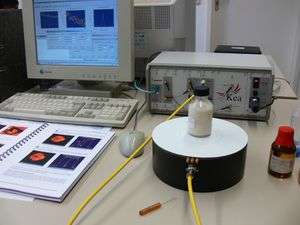
A portable magnetic resonance spectrometer (back right) allows investigations to be performed in the field. The magnet is housed in the circular base (in the foreground). © Fraunhofer IBMT

The term “MRI scan” brings to mind the gigantic, expensive machines that are installed in hospitals. But research scientists have now developed small portable MRI scanners that perform their services in the field: for instance to examine ice cores.

Magnetic resonance imaging yields deep insights – into the atomic structure of a biomolecule, for instance, or into the tissues of a patient's body. Magnetic resonance imaging is one of the most important imaging methods used in medicine. However, MRI scanning has one major disadvantage: The machines are huge and extremely expensive, and almost impossible to transport.

The Magnetic Resonance working group at the Fraunhofer Institute for Biomedical Technology Engineering IBMT in Sankt Ingbert has made magnetic resonance imaging mobile. They collaborated with the New Zealand company Magritek to develop small portable devices. Dr. Frank Volke, head of the Magnetic Resonance working group, explains the core technology: "Instead of the large superconducting magnets that have to be cooled with liquid helium and nitrogen, extra-strong permanent magnets are installed in our devices. There is no need for cooling anymore."

To make this possible, several permanent magnets are so arranged that the magnetic field lines overlap to form a homogeneous field. In this way, the developers have succeeded in developing small, less expensive, and above all portable magnetic resonance spectrometers that can even be powered by batteries.

Physicians and researchers alike can benefit from the mobile pocketsized nuclear magnetic resonance (NMR) devices: The first "Kea NMR moles" are already in use in the Antarctic, helping researchers to study the effects of environmental change by analyzing the structure of ice masses or drilled ice cores.

Nevertheless, they cannot replace clinical MRI scanners for whole human body studies. There are many more potential applications for such devices, including delivering important data – directly and online – during production processes. Industrial manufacturers of sausages, cheese or candies, for instance, can use them to analyze the fat or water content of their food products.

The spectrometers can also be employed to measure the humidity of materials, characterize the molecular structure of polymers, or determine the quality of trees for wood production. Together with Magritek, the Fraunhofer researchers provide technical instruction for users in Germany and Europe and support them with device maintenance.

Source: Fraunhofer-Gesellschaft


print this article email this article download pdf blog this article bookmark this article     Stumble it Digg this share on Facebook retweet share on Reddit add to delicious
Rate this story - 4.1 /5 (17 votes)


July 1, 2008 all stories

Comments: 0

4.1 /5 (17 votes)
  • Stumble this up

  • Digg this

  • share this

  • hide
  • Related Stories

  • Explained: The Discrete Fourier Transform
    created Nov 25, 2009 | popularity not rated yet | comments 0
  • fMRI scans used in murder trial sentencing
    created Nov 25, 2009 | popularity not rated yet | comments 0
  • Most radiation oncologists utilize advanced medical imaging techniques, study suggests
    created Nov 25, 2009 | popularity not rated yet | comments 0
  • Intel wants a chip implant in your brain
    created Nov 23, 2009 | popularity not rated yet | comments 0
  • UCSB physicists move one step closer to quantum computing
    created Nov 20, 2009 | popularity not rated yet | comments 0


  • hide
  • Relevant PhysicsForums posts

  • Laser plasma emission
    created Nov 26, 2009
  • Achromat lens - magnifying LCD
    created Nov 25, 2009
  • Control System
    created Nov 24, 2009
  • Base Isolation Systems in Skyscrapers?
    created Nov 23, 2009
  • More from Physics Forums - General Engineering

Other News

Fujitsu Develops Technology for Low-Temperature Full-Service Direct Formation of Graphene Transistors on Large-Scale Substrates

Fujitsu Develops Technology for Low-Temperature Full-Service Direct Formation of Graphene Transistors on Large-Scale Sub

Technology / Semiconductors

created 16 hours ago | popularity 5 / 5 (7) | comments 2

Fujitsu Laboratories today announced, as a world first, the development of a novel technology for forming graphene transistors directly on the entire surface of large-scale insulating substrates at low temperatures ...


Government delays new ban on Internet gambling

Technology / Internet

created 15 hours ago | popularity 3 / 5 (2) | comments 0

(AP) -- The Treasury Department and the Federal Reserve are giving U.S. financial institutions an additional six months to comply with regulations designed to ban Internet gambling.


Semantic research sets world standards

Semantic research sets world standards

Technology / Computer Sciences

created 22 hours ago | popularity 3.3 / 5 (3) | comments 1

(PhysOrg.com) -- European researchers have created new tools for semantic technology development which are helping to set the next generation of official standards. The tools also unblock some key bottlenecks ...


Teachers begin using cell phones for class lessons

Technology / Hi Tech

created 12 hours ago | popularity 2 / 5 (2) | comments 0

(AP) -- Ariana Leonard's high school students shuffled in their seats, eagerly awaiting a cue from their Spanish teacher that the assignment would begin. "Take out your cell phones," she said in Spanish.


National Taiwan University logo

Cellphone powers back pain chip in Taiwan

Technology / Engineering

created 23 hours ago | popularity 4.3 / 5 (3) | comments 0

Taiwanese researchers have developed a chip to treat backpain that is powered by mobile phone, a member of the team said Friday.