Mars Sample Return: The next step in exploring the Red Planet
July 2, 2008 Mars Sample Return: The next step in exploring the Red Planet

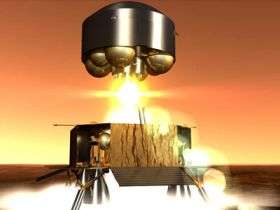
Artist's view of the Mars Sample Return (MSR) ascent module lifting off from Mars' surface with the Martian soil samples. Credits: ESA

ESA and the Centre National d'Etudes Spatiales (CNES) will be co-hosting, in cooperation with NASA and the International Mars Exploration Working Group (IMEWG), an International Conference on 9 and 10 July in the Auditorium of the Bibliothèque Nationale de France in Paris to discuss the next step in the exploration of Mars.

We are still collecting data under NASA's Phoenix, Mars Reconnaissance Orbiter, Mars Exploration Rover and Mars Odyssey missions, as well as under ESA's Mars Express mission, as we prepare for even more exciting missions to come, notably NASA's Mars Science Laboratory and ESA's ExoMars. Mars exploration is continuing at a steady pace and future missions will integrate scientific payloads and technologies that will eventually serve the ultimate goal of carrying out a manned mission to Mars.

The international community has for a long time agreed that the next imperative step, one which will exponentially increase our knowledge and understanding of the Red Planet and its environment, is a Sample Return Mission.

International cooperation is increasingly being regarded as an enabling element of space exploration, especially when it comes to challenging endeavours.

These two factors – the compelling next step in the exploration of Mars and international cooperation – prompted the IMEWG to decide to set up an ad hoc international committee to study an international architecture for a Mars Sample Return (MSR) mission concept.

After several months of collective work by scientists and engineers from several countries worldwide, the "iMARS" group is ready to publish the outcome of its deliberations and the envisioned common architecture for a future international MSR mission.

The International Mars Sample Return Conference will thus bring together members of the scientific and industrial communities as well as representatives of space agencies around the world to discuss the status and prospects for Mars exploration over the coming decades. The Conference will feature keynote addresses from scientist Steve Squyres of Cornell University, principal investigator under the MER mission, and Jean-Pierre Bibring of the Institut d'Astrophysique Spatiale, principal investigator for a key instrument on Mars Express.

The European and international Media are invited to attend this two-day gathering, where they will have the opportunity to hear the current international thinking on Mars Sample Return and to interact with key players in the global endeavour of exploring and understanding Mars – which remains the ultimate goal of human space exploration.

Source: European Space Agency


print this article email this article download pdf blog this article bookmark this article     Stumble it Digg this share on Facebook retweet share on Reddit add to delicious
Rate this story - 3.4 /5 (5 votes)


July 2, 2008 all stories

Comments: 0

3.4 /5 (5 votes)
  • Stumble this up

  • Digg this

  • share this

  • hide
  • Related Stories

  • Russia hopes nuclear ship will fly humans to Mars
    created Oct 29, 2009 | popularity not rated yet | comments 0
  • Panel says NASA should skip moon, fly elsewhere (Update)
    created Oct 23, 2009 | popularity not rated yet | comments 0
  • Volunteers wanted for simulated 520-day Mars mission
    created Oct 20, 2009 | popularity not rated yet | comments 0
  • Migrating Microbes
    created Oct 15, 2009 | popularity not rated yet | comments 0
  • Scientists work to free Mars rover Spirit
    created Oct 13, 2009 | popularity not rated yet | comments 0


  • hide
  • Relevant PhysicsForums posts

  • The shape of our solar system's orbits.
    created 16 hours ago
  • Above or Below the Line of Nodes
    created 20 hours ago
  • Supernova vs. Nova?
    created Nov 07, 2009
  • Supernova's Gamma Rays and Comets
    created Nov 06, 2009
  • More from Physics Forums - General Astronomy

Other News

Deep creep means milder, more frequent earthquakes along Southern California's San Jacinto fault

Deep creep means milder, more frequent earthquakes along Southern California's San Jacinto fault

Space & Earth / Earth Sciences

created 2 hours ago | popularity 4 / 5 (1) | comments 0

With an average of four mini-earthquakes per day, Southern California's San Jacinto fault constantly adjusts to make it a less likely candidate for a major earthquake than its quiet neighbor to the east, the ...


Success in 'space elevator' competition (AP)

Success in 'space elevator' competition (Update 3)

Space & Earth / Space Exploration

created Nov 05, 2009 | popularity 4.3 / 5 (33) | comments 50

(AP) -- A robot powered by a ground-based laser beam climbed a long cable dangling from a helicopter on Wednesday to qualify for prize money in a $2 million competition to test the potential reality of the ...


'Dropouts' pinpoint earliest galaxies

'Dropouts' pinpoint earliest galaxies

Space & Earth / Astronomy

created Nov 06, 2009 | popularity 4.1 / 5 (9) | comments 12

Astronomers, conducting the broadest survey to date of galaxies from about 800 million years after the Big Bang, have found 22 early galaxies and confirmed the age of one by its characteristic hydrogen signature ...


Space hotel taking bookings for 2012 opening

Space hotel taking bookings for 2012 opening

Space & Earth / Space Exploration

created Nov 05, 2009 | popularity 4.4 / 5 (20) | comments 11

(PhysOrg.com) -- The first orbiting space hotel is on track to open for its first customers in 2012, but hurry, as bookings are filling fast.


In a Galaxy Far, Far Away...

In a Galaxy Far, Far Away...

Space & Earth / Astronomy

created Nov 06, 2009 | popularity 4.8 / 5 (4) | comments 11

(PhysOrg.com) -- Astronomers have published the discovery of the farthest known object in the cosmos: a star that exploded when the universe was only 630 million years old -- only 4.6% of its current age. ...