A front-row seat at this summer's physics extravaganza
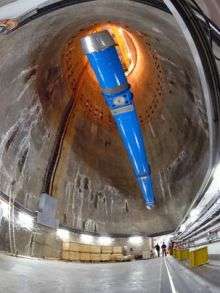
Nearly 20 years in the making, the largest particle accelerator in the world will start running in Switzerland this summer, offering scientists a glimpse of particles that have never been seen before.
MIT has a team of about 40 scientists and students preparing for the debut of the Large Hadron Collidor (LHC), which is expected to start up in August. Thousands of physicists from around the world are collaborating on the project, based at CERN, and MIT has the largest American university group working on one of the collider's four detectors, known as the CMS (compact muon solenoid) detector.
Once the $10 billion accelerator starts up, particles will zoom around the 27-kilometer loop at nearly the speed of light, creating controlled collisions that scientists hope will reveal the elusive Higgs boson and other novel particles.
"You don't know what you'll find behind the door because you've never seen it. We're going to open the door and step in and see what's there," says associate professor of physics Christoph Paus, the leader of the MIT group working on the CMS detector.
The elusive Higgs boson
Finding the Higgs boson, first theorized by Peter Higgs and others in 1964, would provide the final missing piece of the Standard Model of Particle Physics. According to the model, the Higgs boson is the particle that gives all other particles their mass, but that theory has never been experimentally proven.
Once the accelerator is turned on, there will be 100 billion protons streaming around the ring at any given time. When the protons crash into each other, they annihilate themselves, producing a lot of energy and smaller particles. The higher the energy of the collision, the heavier particles are produced.
Each collision can produce a variety of outcomes. The Higgs boson is predicted to appear very rarely--about once every 10 million collisions. And the bosons last only one-hundredth of an attosecond before decaying into other particles (one attosecond is to a second what one second is to the age of the entire universe).
"You don't get to see them. All you get to see is the semi-stable particles that decay afterward," says Steven Nahn, assistant professor physics and a leader of the CMS team. However, it is possible to detect a Higgs boson by measuring those decay particles.
"Imagine if you have two buses that have collided: You see how the pieces came apart, and you can try to reconstruct what was there," says Nahn.
'A whole zoo of particles'
Though finding the Higgs boson would be extremely significant, it's not the only thing scientists are looking for.
"The real hope is that we will see much more than just Higgs. There is a whole zoo of particles we're hoping to see," said Bolek Wyslouch, MIT professor of physics and one of the leaders of the project.
Scientists say the LHC, which generates seven times more energy than the next largest accelerator, is virtually guaranteed to produce new particles. That's because of Einstein's equation, E=mc^2, which correlates mass and energy. Huge amounts of energy (up to 14 tera electron volts) should translate to heavier particles.
The detectors could also help scientists study the interactions between quarks and leptons, which give rise to protons and neutrons.
The accelerator will produce about 40 million collisions per second, which generates far too much data to be analyzed. A software program will quickly scan the data and cull the most interesting information to store for further analysis--about 100 collisions per second.
"It's like looking for diamonds," said Wyslouch. "You dig up all the dirt, and then you sift through the dirt. You throw most of it away, but every once in a while you see a diamond."
Final preparations
The accelerator is located on the outskirts of Geneva near the French border, lying below farmland at depths ranging from 60 to 120 meters.
Right now, the entire apparatus is being cooled to 1.9 Kelvin above absolute zero, a process that takes several weeks and is necessary to create superconducting magnets, which generate the force needed to get the protons to flow at such high speeds.
In August, scientists will start injecting the proton beams, trying to get them to flow in a circle. After a few weeks, they will inject proton beams in the opposite direction to start creating collisions. Barring any setbacks, they could start gathering data this fall, according to Paus.
If all goes well, he said, scientists might have proof of the existence of Higgs boson by mid to late 2009.
But other novel phenomena could appear even sooner, says Nahn. "We're taking such a giant leap that something new and exciting could appear very quickly," he says.
Other MIT faculty in the CMS group are physics professor Wit Busza and associate physics professor Gunther Roland.
Source: MIT


