Atomic Tug of War

July 2nd, 2008 Trajectory Animation

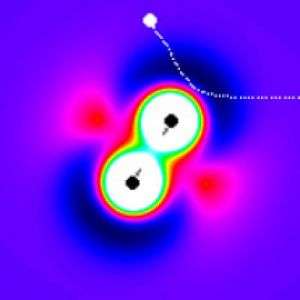
Still of Trajectory 3: forward scattering, clockwise rotation. Credit: Eckart Wrede

A new form of energy-transfer, reported today in Nature (3 July 2008) may have implications for the study of reactions going on in the atmosphere, and even for those occurring in the body.

Imagine a simple molecule consisting of two atoms as being like two balls attached together by a spring. If an incoming atom strikes one side of the molecule, the spring compresses and you would expect the molecule to jump backwards – remember Newton's cradle? (http://en.wikipedia.org/wiki/Newton's_cradle)

However, research by Dr Stuart Greaves in the Chemistry department at the University of Bristol, suggests that, contrary to expectations, in certain conditions the molecule jumps forwards, not backwards.

Greaves and his colleagues studied fast hydrogen atoms colliding with supersonically cooled deuterium-deuterium molecules. On the occasions when the collision did not result in a chemical reaction, the hydrogen atoms scatter.

In these 'inelastic' processes, the scattering of the hydrogen atom is normally backwards. But in this case, the team found that the inelastic scattering process led mainly to forward scattering – the opposite of what was expected.

Stuart Greaves said: "The reaction under study is the simplest chemical reaction possible and yet it still continues to surprise us, even after 80 years of scientific investigation. Our work provides another vital piece of the jigsaw for understanding the mechanics of chemical reactions, such as those going on in the atmosphere."

The explanation of what is happening is that even if the hydrogen atom flies past the deuterium-deuterium molecule in a 'grazing collision', this can tug on the deuterium atom nearest to it, thereby extending the bond connecting the two deuterium atoms, which causes the molecule to move forwards.

Link to animations: http://www.dur.ac.uk/eckart.wrede/QCT/inelastic/traj.php?product=4&traj=1

Citation: Vibrational excitation through tug-of-war inelastic collisions, by Stuart J. Greaves, Eckart Wrede, Noah T. Goldberg, Jianyang Zhang, Daniel J. Miller & Richard N. Zare. Nature, 3 July, Vol 454, p. 88.

Source: University of Bristol


print this article email this article download pdf blog this article bookmark this article     Digg this Stumble it share on Facebook share on Reddit add to delicious save to Yahoo! bookmarks
4.4/5 after 38 votes

Rank Filter

Move the slider to adjust rank threshold, so that you can hide some of the comments.


Display comments: newest first

  • superhuman - Jul 02, 2008
    • Rank: 1.5 / 5 (6)
    "A new form of energy-transfer" it is not.
  • Mombo_Dogface - Jul 03, 2008
    • Rank: 3.8 / 5 (5)
    superhuman, could you explain? If your going to make comments please elaborate. My 5 year old could make those statements.
  • Latrosicarius - Jul 03, 2008
    • Rank: 4.3 / 5 (4)
    So, the nucleus of each atom is being attracted to the other?

    Whatever happend to proton-proton repusion?
  • Ragtime - Jul 03, 2008
    • Rank: 3 / 5 (2)
    superhuman, could you explain?
    Superhuman is right at the point, these simulations are using well known quantum mechanics models, here's nothing new from physical point of view. This mechanism is known for years as "anomalous nonelastic scattering".

    Such approach is bulvarizing science, thus dissipating the readers attention by the same way, like the "child surgery" ads mentioned above.

July 2nd, 2008 all stories
Physics / General Physics

Comments: 4
Rank: 4.4/5 after 38 votes

  • Stumble this up

  • Digg this

  • Share it:
  • share on Facebook
  • share on MySpace
  • share on Slashdot
  • rss-newsfeed
  • share on Google
  • share on Reddit
  • add to delicious
  • save to Yahoo! bookmarks
  • share on Windows Live
  • Add to Mixx!
Rating: 4.4/5 after 38 votes


  • Physicists Demonstrate Quantum Memory with Matter Qubits
    Physicists Demonstrate Quantum Memory with Matter Qubits
    Physics / General Physics
    created Jul 03, 2009 | popularity 4.4 / 5 (17) | comments 1
  • 'Holey' Nanosheets for Wastewater Dye Removal
    Nanotechnology / Nanomaterials
    created Jul 01, 2009 | popularity 5 / 5 (5) | comments 1
  • Jellyfish Robot Swims Like its Biological Counterpart
    Jellyfish Robot Swims Like its Biological Counterpart
    Electronics / Robotics
    created Jun 26, 2009 | popularity 4.4 / 5 (8) | comments 1
  • Could Maxwell's Demon Exist in Nanoscale Systems?
    Could Maxwell's Demon Exist in Nanoscale Systems?
    Physics / General Physics
    created Jun 24, 2009 | popularity 4.4 / 5 (18) | comments 29
  • Living Safely with Robots, Beyond Asimov's Laws
    Living Safely with Robots, Beyond Asimov's Laws
    Electronics / Robotics
    created Jun 22, 2009 | popularity 4.6 / 5 (54) | comments 40
  • Other News

    Physical reality of string theory demonstrated

    Physics / General Physics

    created 6 hours ago | popularity 4.7 / 5 (20) | comments 14

    String theory has come under fire in recent years. Promises have been made that have not been lived up to. Leiden (The Netherlands) theoretical physicists have now for the first time used string theory to describe a physical ...


    UQ researchers break the law -- of physics

    UQ researchers break the law -- of physics

    Physics / General Physics

    created 11 hours ago | popularity 4.6 / 5 (16) | comments 5

    (PhysOrg.com) -- Two UQ Science researchers have proved two famous physical laws that have been widely used for the past 25 years do not always work.


    Physicist takes a quantum leap

    Physics / General Physics

    created 2 hours ago | popularity not rated yet | comments 0

    (PhysOrg.com) -- A University of Queensland physicist is seeking answers to a persistent problem throughout human history: how do I compute things? None, however, have had the same impact as what we today know as simply the ...


    Scientists create first electronic quantum processor

    Scientists create first electronic quantum processor

    Physics / General Physics

    created Jun 28, 2009 | popularity 4.8 / 5 (56) | comments 45

    A team led by Yale University researchers has created the first rudimentary solid-state quantum processor, taking another step toward the ultimate dream of building a quantum computer.


    Science journals

    How to Spot an Influential Paper Based on its Citations

    Physics / General Physics

    created Jul 04, 2009 | popularity 4 / 5 (11) | comments 6

    (PhysOrg.com) -- At first it may seem that the number of citations received by a published scientific paper is directly related to that paper's quality of content. The higher the quality, the more people read ...