Rubber 'snake' could help wave power get a bite of the energy market
July 3, 2008 Rubber 'snake' could help wave power get a bite of the energy market

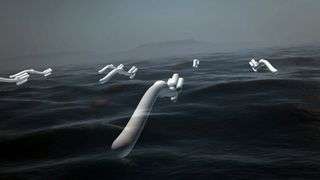
The Anaconda device could be used in groups of 20 or more.

A device consisting of a giant rubber tube may hold the key to producing affordable electricity from the energy in sea waves.

Invented in the UK, the 'Anaconda' is a totally innovative wave energy concept. Its ultra-simple design means it would be cheap to manufacture and maintain, enabling it to produce clean electricity at lower cost than other types of wave energy converter. Cost has been a key barrier to deployment of such converters to date.

Named after the snake of the same name because of its long thin shape, the Anaconda is closed at both ends and filled completely with water. It is designed to be anchored just below the sea's surface, with one end facing the oncoming waves.

A wave hitting the end squeezes it and causes a 'bulge wave'* to form inside the tube. As the bulge wave runs through the tube, the initial sea wave that caused it runs along the outside of the tube at the same speed, squeezing the tube more and more and causing the bulge wave to get bigger and bigger. The bulge wave then turns a turbine fitted at the far end of the device and the power produced is fed to shore via a cable.

Because it is made of rubber, the Anaconda is much lighter than other wave energy devices (which are primarily made of metal) and dispenses with the need for hydraulic rams, hinges and articulated joints. This reduces capital and maintenance costs and scope for breakdowns.

The Anaconda is, however, still at an early stage of development. The concept has only been proven at very small laboratory-scale, so important questions about its potential performance still need to be answered. Funded by the Engineering and Physical Sciences Research Council (EPSRC), and in collaboration with the Anaconda's inventors and with its developer (Checkmate SeaEnergy), engineers at the University of Southampton are now embarking on a programme of larger-scale laboratory experiments and novel mathematical studies designed to do just that.

Using tubes with diameters of 0.25 and 0.5 metres, the experiments will assess the Anaconda's behaviour in regular, irregular and extreme waves. Parameters measured will include internal pressures, changes in tube shape and the forces that mooring cables would be subjected to. As well as providing insights into the device's hydrodynamic behaviour, the data will form the basis of a mathematical model that can estimate exactly how much power a full-scale Anaconda would produce.

When built, each full-scale Anaconda device would be 200 metres long and 7 metres in diameter, and deployed in water depths of between 40 and 100 metres. Initial assessments indicate that the Anaconda would be rated at a power output of 1MW (roughly the electricity consumption of 2000 houses) and might be able to generate power at a cost of 6p per kWh or less. Although around twice as much as the cost of electricity generated from traditional coal-fired power stations, this compares very favourably with generation costs for other leading wave energy concepts.

"The Anaconda could make a valuable contribution to environmental protection by encouraging the use of wave power," says Professor John Chaplin, who is leading the EPSRC-funded project. "A one-third scale model of the Anaconda could be built next year for sea testing and we could see the first full-size device deployed off the UK coast in around five years' time."

Source: Engineering and Physical Sciences Research Council


print this article email this article download pdf blog this article bookmark this article     Stumble it Digg this share on Facebook retweet share on Reddit add to delicious
Rate this story - 4.5 /5 (46 votes)

Rank Filter

Move the slider to adjust rank threshold, so that you can hide some of the comments.


Display comments: newest first

  • Icester - Jul 03, 2008
    • Rank: 2 / 5 (3)
    I wonder what the life cycle is on these? Do they last 1 year, 5 years, 30 years? How densely could they be deployed? A lot of unanswered questions, but it sounds promising...
  • earls - Jul 03, 2008
    • Rank: 1 / 5 (2)
    Great concept. Now apply the physics to the quantum level.
  • Arikin - Jul 04, 2008
    • Rank: 1 / 5 (1)
    At 200 metres long and 7 metres in diameter I wouldn't want to hit one in a boat. Marking them would be required.

    Depending on how deep these are moored you are blocking off access to the area around them. Location will be important.
  • jeffsaunders - Jul 04, 2008
    • Rank: 1 / 5 (1)
    Not to forget the changes in current flow and siltation caused by these and other devices.

    I am more concerned with the long term effects on the oceans than short term energy gains.
  • DGBEACH - Jul 04, 2008
    • Rank: not rated yet
    Waves are not as predictable or consistent as the tides are.
    Places such as the Bay of Fundy would produce electricity much more dependably, and as such would be a better investment.(20-50ft rise/fall)

    Generation "Bays" could be constructed to mimic places such as Fundy pretty much anywhere along the coastal areas, producing MMWatts just from the tidal motion.It would be quiet, dependable, and cheap to run.

July 3, 2008 all stories

Comments: 5

4.5 /5 (46 votes)
  • Stumble this up

  • Digg this

  • share this

  • hide
  • Related Stories

  • Hylas payload shipped to India
    created Nov 06, 2009 | popularity not rated yet | comments 0
  • New Digital 'Electronics' Concept May Continue Moore's Law
    created Nov 05, 2009 | popularity not rated yet | comments 0
  • Electron self-injection into an evolving plasma bubble
    created Nov 02, 2009 | popularity not rated yet | comments 0
  • STMicroelectronics and ARM Team Up to Power Next-Generation Home Entertainment
    created Oct 28, 2009 | popularity not rated yet | comments 0
  • First hyperlens for sound waves created
    created Oct 25, 2009 | popularity not rated yet | comments 0


  • hide
  • Relevant PhysicsForums posts

Other News

Software cos. eye key patent case in Supreme Court (AP)

Software cos. eye key patent case in Supreme Court

Technology / Business

created 16 minutes ago | popularity not rated yet | comments 0

(AP) -- With the technology industry looking on, the Supreme Court on Monday will explore what types of inventions should be eligible for a patent in a pivotal case that could undermine such legal protections ...


Microsoft websites were the most visited in September

Microsoft websites top spots in September: comScore

Technology / Internet

created 19 hours ago | popularity 2 / 5 (4) | comments 0

Industry tracker comScore on Friday released a study showing that Internet users in September spent more time at Microsoft websites that at any other online properties.


Hacker illustration

Brazil blackouts result of cyber hacking: report

Technology / Internet

created 19 hours ago | popularity 3 / 5 (3) | comments 0

Massive power outages in Brazil in 2005 and 2007 that impacted millions were caused by cyber hackers attacking control systems, the US television network CBS said Sunday.


airpod

Car That Runs on Compressed Air Questioned by Critics (w/ Video)

Technology / Energy

created Nov 03, 2009 | popularity 3.8 / 5 (18) | comments 26

(PhysOrg.com) -- As electric cars begin breaking into the short-distance vehicle market, one French company thinks that it has an alternative to the electric vehicle: a car that runs on compressed air. Motor ...


Sahara

Will Europe Be Powered by the Sahara

Technology / Energy

created Nov 04, 2009 | popularity 4 / 5 (20) | comments 24

(PhysOrg.com) -- Europe has long been interested in developing alternative energy sources. And, one of the more interesting places that some Europeans are looking for solar power is the Sahara. With the vast ...