New tracking system boosts pilot safety
July 3, 2008 New tracking system boosts pilot safety

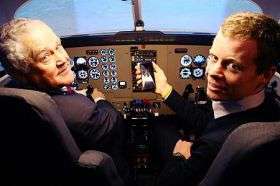
Manager of professional programmes at the School of Aviation, Frank Sharp, with James McCarthy, designer of the system that is a new safety feature in training aircraft.

Pilots will no longer be out of sight as they fly cross-country thanks to a new tracking system developed by Massey University mechatronics graduate and a former staff member.

James McCarthy and Don Sandbrook developed the Spidertracks system to combat radar blackspots – areas where no radar coverage exists – meaning planes can now be located at all times.

Mr McCarthy worked with the University’s School of Aviation to trial the system in its earlier stages and now, in a significant commitment to safety, the School has bought five units.

The palm-sized Spidertracks unit picks up a global positioning systems (GPS) signal giving the plane’s position, transmits it to the Iridium satellite network and beams it down to servers in Australia and Wellington.

From there the signal travels via the web to the operations base. In real-time, the route of the craft is overlaid onto Google Earth maps. Updates on the position of the plane appear every few minutes for as long as there is a power supply to the Spidertrack unit.

School general manager Captain Ashok Poduval says buying the system is a major step in enhancing safety for any a student pilot who is lost or in difficulty due to unexpected bad weather.

The units will be used in selected aircraft as student pilots fly through parts of the country where there is no radar cover. Until now the position of the training planes flying outside of controlled airspace – much of New Zealand – would have been worked out from a flight plan submitted by the pilot, showing the intended route before departure.

Spidertracks is different from all other satellite tracking systems because Mr Sandbrook discovered a way to integrate a GPS receiver and satellite transmitter into one unit, without the need for external antennae – the first time this had been done.

Captain Poduval says the new tracking equipment also adds training value.

“The system keeps a record of all flights flown so instructors can print out details of the track flown by a student and use this for post-flight debriefing.”

Spidertracks is now used by helicopter, fixed wing and land-based operations, in more than 25 countries.

Source: Massey University


print this article email this article download pdf blog this article bookmark this article     Stumble it Digg this share on Facebook retweet share on Reddit add to delicious
Rate this story - 4.5 /5 (2 votes)


July 3, 2008 all stories

Comments: 0

4.5 /5 (2 votes)
  • Stumble this up

  • Digg this

  • share this

  • hide
  • Related Stories

  • Naval Research Laboratory's ANDE-2 launched aboard Space Shuttle Endeavour
    created Jul 17, 2009 | popularity not rated yet | comments 0
  • Even the Antarctic winter cannot protect Wilkins Ice Shelf
    created Jun 13, 2008 | popularity not rated yet | comments 0
  • New research project captures traffic data using GPS-enabled cell phones
    created Feb 10, 2008 | popularity not rated yet | comments 0
  • Hurricane Dean tracked from space
    created Aug 21, 2007 | popularity not rated yet | comments 0
  • Huge waves that hit Reunion Island tracked from space
    created May 16, 2007 | popularity not rated yet | comments 0


  • hide
  • Relevant PhysicsForums posts

  • I wanna build a robot!
    created 3 hours ago
  • Finding Max Moment for triangular load
    created 19 hours ago
  • Dehumidifier from a walk-in freezer unit?
    created Nov 10, 2009
  • Cloak of invisiblity , what kind of applications can it be usefull for
    created Nov 09, 2009
  • More from Physics Forums - General Engineering

Other News

Iowa State engineers develop 3-D software to give doctors, students a view inside the body

Iowa State engineers develop 3-D software to give doctors, students a view inside the body

Technology / Software

created 1hour ago | popularity not rated yet | comments 0

James Oliver picked up an Xbox game controller, looked up to a video screen and used the device's buttons and joystick to fly through a patient's chest cavity for an up-close look at the bottom of the heart.


Creating 3D models with a simple webcam

Creating 3D models with a simple webcam (w/ Video)

Technology / Computer Sciences

created 26 minutes ago | popularity not rated yet | comments 0

(PhysOrg.com) -- Constructing virtual 3D models usually requires heavy and expensive equipment, or takes lengthy amounts of time. A group of researchers at the University of Cambridge, Qi Pan, Dr Gerhard Reitmayr ...


Google logo

Google Latitude adds location history, alerts you when friends are nearby

Technology / Software

created 1hour ago | popularity not rated yet | comments 0

Google Latitude to find your nearby friends, you're in luck: Google updated Latitude with location history and alerts for when your friends are nearby. If you don't love your every step tracked -- well, it's ...


Palm Pre

Palm's webOS hasn't gotten the attention it deserves

Technology / Software

created 5 hours ago | popularity not rated yet | comments 1

Lost in the recent deluge of smart-phone news -- Apple's iPhone store hitting 100,000 applications, and the launches of the new Droid phone and the BlackBerry Storm, among other things -- have been the efforts ...


Google Go

Google Go gets going (w/ Video)

Technology / Software

created 9 hours ago | popularity 4.8 / 5 (4) | comments 4

(PhysOrg.com) -- Google has introduced its new experimental programming language Go, which aims to combine speedy application development through simplified coding with high-speed program execution.