Mercury's surface dominated by volcanism and iron-deficiency
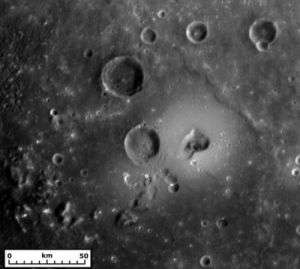
Volcanism has played a more extensive role in shaping the surface of Mercury than scientists had thought. This result comes from multispectral imaging data gathered in January 2008 by MESSENGER, the latest spacecraft to visit the Sun's innermost planet.
MESSENGER data has also identified and mapped surface rock units that correspond to lava flows, volcanos, and other geological features. At the same time, the spacecraft's suite of instruments has confirmed an apparent planet-wide iron deficiency in Mercury's surface rocks.
MESSENGER (short for MErcury Surface, Space ENvironment, GEochemistry, and Ranging) is the first spacecraft to visit Mercury since NASA's Mariner 10 made three flyby passes in 1974 and 1975. MESSENGER, which is operated for NASA by the Applied Physics Laboratory of Johns Hopkins University in Baltimore, will make two more Mercury flybys (Oct. 6, 2008 and Sep. 29, 2009) before going into orbit around the planet, March 18, 2011.
Mercury and MESSENGER form the subject of 11 papers in a special section devoted to the January flyby in the July 4, 2008, issue of the scientific journal Science.
Mark S. Robinson of Arizona State University is the lead author for a paper in the issue which spotlights data on composition variations in Mercury's surface rocks using their multispectral colors. Robinson, a professor of geology in ASU's School of Earth and Space Exploration, part of the College of Liberal Arts and Sciences, is a co-investigator on the MESSENGER geology science team. Besides Robinson, the multispectral paper has 12 additional co-authors from other institutions.
"We have now imaged half of the part of Mercury that was never seen by Mariner 10," says Robinson. "The picture is still incomplete, but we'll get the other half on October 6th." Back in 1974-75, the orbital trajectory that let Mariner to make three passes at Mercury limited it to photographing less than half the planet's surface. This left the rest of Mercury unknown until MESSENGER's arrival in January let scientists begin to fill in the gaps.
Lava plains
MESSENGER's big-picture finding, says Robinson, is the widespread role played by volcanism. While impact craters are common, and at first glance Mercury still resembles the Moon, much of the planet has been resurfaced through volcanic activity.
"For example, according to our color data the Caloris impact basin is completely filled with smooth plains material that appears volcanic in origin," Robinson explains. "In shape and form these deposits are very similar to the mare basalt flows on the Moon. But unlike the Moon, Mercury's smooth plains are low in iron, and thus represent a relatively unusual rock type."
The Caloris plains, he adds, cover at least a million square kilometers (390,000 square miles), or big enough to engulf Arizona, Nevada, and California put together. The plains' size implies the existence of large sources of magma in Mercury's upper mantle.
Multispectral imaging also shows that besides lava flows, Caloris has "red spots," which also appear volcanic. "Red spots have diffuse boundaries and sometimes lie centered on rimless depressions," Robinson says. "Right now they look to be caused by explosive, pyroclastic eruptions."
In addition, Robinson notes, three major rock units stand out in MESSENGER's multispectral imaging.
"We mapped the new hemisphere using moderate resolution images of 5 kilometers [3 miles] per pixel," he says. "As on the Mariner hemisphere, we saw three major units defined by their colors. These units are relatively high-reflectance smooth plains, average cratered terrain, and low-reflectance material."
Where's the iron?
The low-reflectance material is particularly enigmatic, says Robinson. "It's an important and widespread rock that occurs deep in the crust as well as at the surface, yet it has very little ferrous iron in its silicate minerals."
That, he says, makes it unusual. "You expect to find low-reflectance volcanic rocks having a high abundance of iron-bearing silicate minerals, but that's not the case here." One possible solution, he says, is that iron is actually present but invisible to MESSENGER's spectrometers because it's hidden within the chemical structure of minerals such as ilmenite.
Solving the paradox should help scientists unravel Mercury's history. "If you want to understand how a planet has evolved," Robinson explains, "you need to know about the minerals in its crust and mantle. Unfortunately, we are not going to be able to drill into Mercury for a long time to come. All we can do is study its volcanic rocks in detail. They give a glimpse into the planet's mantle."
"Right now," says Robinson, "it looks as if Mercury formed with a deficiency in ferrous iron. But we'll know more about its bulk composition, and thus its history, once MESSENGER gets into orbit in 2011. That's when the surface rocks can be studied much more closely, using the full set of instruments."
Source: Arizona State University


