Want to fly? Don't copy the birds and the bees
July 6, 2008 Want to fly? Don't copy the birds and the bees

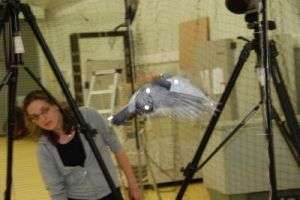
Karin Jespers studies the flight of a racing pigeon. Reflective tape, similar to that used on safety clothing, allows cameras to calculate where dots are on a pigeon's wings. Credit: Structure and Motion Laboratory, Royal Veterinary College

Since earliest recorded history, and presumably beyond, humans have always wanted to fly. First attempts involved imitation of winged creatures around them, and unfailingly ended in disaster.

No workable flying machines have ever looked particularly similar to nature's fliers, and today there is little comparison between a top of the range military chopper and the humble bumblebee, despite similar flight patterns. In an era in which engineers are increasingly exploiting designs from nature, understanding this paradox is becoming ever more important.

Dr Jim Usherwood, from the Royal Veterinary College, has studied the reasons behind these differences in aerodynamics and concluded that scientists should, in this instance, be more hesitant before imitating nature. He will be presenting his results on Sunday 6th July at the Society for Experimental Biology's Annual Meeting in Marseille.

Dr Usherwood believes the reason that flying creatures don't look like man made machines is all to do with the need to flap. "Animals' wings, unlike propellers, have to keep stopping and starting in order produce lift (animals have forgotten to invent propellers, just as they forgot wheels)," he explains.

"Think of vigorous waving, or perhaps exuberant rattling of a cocktail shaker - this takes a fair amount of power to overcome inertia. So, the idea is that both wing shape and how wings are used can be understood better if the effort of flapping is remembered, which explains why vultures don't look like gliders, and most winged creatures, from insects to pigeons, fly so inefficiently."

His research has centred on creatures as diverse as dragonflies and quails. Currently he is investigating the compromise winged creatures face between meeting aerodynamic requirements and overcoming inertia in order to generate lift, by loading wings of racing pigeons with lead fishing weights. He believes that lessons from all of these studies lead to the same conclusion.

"My work should act as a reminder to be cautious in copying nature. There is lots of interest in making MAVs/UAVs (micro/unmanned air vehicles) that flap, which may present all sorts of advantages in terms of maneuverability, speed and so on. However, there is a tendancy to presume that biology is efficient, and I would say that, even at very small sizes, if you want to hover efficiently, be a helicopter not a flapper…"

Source: Society for Experimental Biology


print this article email this article download pdf blog this article bookmark this article     Stumble it Digg this share on Facebook retweet share on Reddit add to delicious
Rate this story - 3.8 /5 (16 votes)

Rank Filter

Move the slider to adjust rank threshold, so that you can hide some of the comments.


Display comments: newest first

  • Seto - Jul 06, 2008
    • Rank: 5 / 5 (1)
    The point is not to copy the nature because it's efficient, but to observe nature for ideas because it has been around for... a while. Birds and other flying animals are (or more accurately were) a great source of inspiration, but it's the principles that have to be discovered, not techniques. We humans operate at a different scale - who have ever heard of a bird carrying 150 people over the Atlantic?
  • Valentiinro - Jul 06, 2008
    • Rank: 2 / 5 (1)
    Gandalf heard of it. How about that?
  • General_Misconception - Jul 06, 2008
    • Rank: 4 / 5 (1)
    who have ever heard of a bird carrying 150 people over the Atlantic?


    Right, it's called the Reynolds number, and it's not a "paradox," as the text calls it. Also, the last sentence is misleading. At very small sizes, airfoils (yes, even helicopter blades) are inefficient in that their lift to drag ratio is small.
  • JohnsonJ - Jul 08, 2008
    • Rank: not rated yet
    I'm puzzled as to why we think that anything in nature needs to adhere to any standard we've defined as efficient or proper? Our arrogance and self-delusion in this area is baffling and is a big part of why we continue to wander seemingly lost as a species instead of flying high as we are capable of. i.e. We can fly 150 people across the planet but can't feed most of our population, can't stop killing each other, and can't stave off disease.

    Efficiency is a human concept that has relevance only in the world we've created and live in. In the parent existence it has no value. There are limitless examples of things that animals and nature can accomplish that we can't begin to comprehend. Our historic cycle of scientific exploration, learning, and self-contradiction have repeatedly demonstrated that although our science is an excellent stand-in in the absence of an alternate understanding....we really don't know what we are talking about. We've become masters at observing patterns and drawing conclusions from those patterns but miss the essence of purpose completely.

    It seems to me that birds are part of a grander design that doesn't require efficiency but relies on 'balance'. The means of transport employed by them are perfect for the role the species needs to play in this design and we can learn a great deal from this alone.

    But then again, I'm human too...and likely don't know what I'm talking about either! :)

July 6, 2008 all stories

Comments: 4

3.8 /5 (16 votes)
  • Stumble this up

  • Digg this

  • share this

  • hide
  • Related Stories


Other News

Beyond sunlight: Explorers census 17,650 ocean species between edge of darkness and black abyss

Beyond sunlight: Explorers census 17,650 ocean species between edge of darkness and black abyss (w/ Video)

Biology / Plants & Animals

created 12 hours ago | popularity 5 / 5 (7) | comments 0

Census of Marine Life scientists have inventoried an astonishing abundance, diversity and distribution of deep sea species that have never known sunlight - creatures that somehow manage a living in a frigid ...


Rare Charles Darwin book found on toilet bookshelf (AP)

Rare Charles Darwin book found on toilet bookshelf

Biology / Other

created 11 hours ago | popularity 4.5 / 5 (2) | comments 1

(AP) -- An auction house says it is selling a rare first edition of Charles Darwin's "On the Origin of Species" found in a family's guest lavatory in southern England.


Bigger not necessarily better, when it comes to brains

Bigger not necessarily better, when it comes to brains

Biology / Plants & Animals

created Nov 17, 2009 | popularity 4.5 / 5 (19) | comments 11

(PhysOrg.com) -- Tiny insects could be as intelligent as much bigger animals, despite only having a brain the size of a pinhead, say scientists at Queen Mary, University of London.


Extinct goat Myotragus balearicus

Extinct goat was cold-blooded

Biology / Plants & Animals

created Nov 18, 2009 | popularity 4.9 / 5 (34) | comments 10

(PhysOrg.com) -- An extinct goat that lived on a barren Mediterranean island survived for millions of years by reducing in size and by becoming cold-blooded, which has never before been discovered in mammals.


Right-handed chimpanzees provide clues to the origin of human language

Biology / Plants & Animals

created Nov 16, 2009 | popularity 2.5 / 5 (2) | comments 7

Most of the linguistic functions in humans are controlled by the left cerebral hemisphere. A study of captive chimpanzees at the Yerkes National Primate Research Center (Atlanta, Georgia), reported in the January 2010 issue ...