First DNA molecule made almost entirely of artificial parts
July 7, 2008 DNA

Enlarge

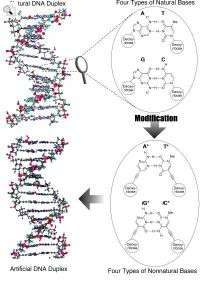
Scientists are reporting synthesis of the world's first DNA molecule made almost of entirely artificial parts. The discovery could be used in the fields of gene therapy and other futuristic high-tech advances, such as nano-sized computers. Courtesy of Masahiko Inouye

Chemists in Japan report development of the world's first DNA molecule made almost entirely of artificial parts. The finding could lead to improvements in gene therapy, futuristic nano-sized computers, and other high-tech advances, they say. Their study is scheduled for the July 23 issue of the Journal of the American Chemical Society.

In the new study, Masahiko Inouye and colleagues point out that scientists have tried for years to develop artificial versions of DNA in order to extend its amazing information storage capabilities.

As the genetic blueprint of all life forms, DNA uses the same set of four basic building blocks, known as bases, to code for a variety of proteins used in cell functioning and development. Until now, scientists have only been able to craft DNA molecules with one or a few artificial parts, including certain bases.

The researchers used high-tech DNA synthesis equipment to stitch together four entirely new, artificial bases inside the sugar-based framework of a DNA molecule. This resulted in unusually stable, double-stranded structures resembling natural DNA.

Like natural DNA, the new structures were right-handed and some easily formed triple-stranded structures. The unique chemistry of these structures and their high stability offer unprecedented possibilities for developing new biotech materials and applications, the researchers say.

Link: http://dx.doi.org/10.1021/ja801058h

Source: American Chemical Society


Rate this story - 4.4 /5 (44 votes)

Rank Filter

Move the slider to adjust rank threshold, so that you can hide some of the comments.


Display comments: newest first

  • thales - Jul 07, 2008
    • Rank: 3 / 5 (4)
    Triple-stranded DNA? Shades of "The Fifth Element."

  • Deano - Jul 09, 2008
    • Rank: not rated yet
    "Triple-stranded" artificial DNA? Wow. I wonder if that would be an actual improvement on the original two-stranded DNA. Imagine if it really IS an improvement in one way or another. Improving on our most basic of building blocks for every living thing on this Earth. As far as I know, DNA as it's structured as now, is the best possible way nature found to store and re-distibute information, with it's own style of commands to set forth making life with that information. It's been tried-and-true, tested and re-tested, trial-and-error, all that stuff. The way DNA is now is a result of millions of years and an unimaginable number of attempts at building life. It works. Imagine if we can improve on it simply bu adding a third strand or something else just as easily imagined. We can now re-arrange the structure. What if DNA is just the most basic way of creating life, and it really is ready to be improved upon? My mind goes crazy with the prospect that we might be able to take a shortcut in the quest to master DNA design/understanding, by simply playing around with the way a DNA strand is built. It very well could be that DNA is completely improvable, and very easy to do so as long as we can master the process of manipulating the molecules, and from what it says in this article, it looks like we're half-way there if not further. Imagine that. What could we do? What improvements could be made? If we COULD store many more times information than the present way does in a single DNA structure, what would that do? What does it mean? Super-creatures? More detailed creatures? If long eyelashes are written into present-form DNA structures, what would extra information accomplish? Longer lashes with a smoother surface? Longer lashes with STRIPES? Could we then add space in our brains to store more random-access-memory capabilities? By simply adding certain extra info in the brain section of the DNA instructions, could we be able to remember many different things at the same time and not realize how complex that notion is, like it's second nature to us? Better than we could now? Storing more information on a DNA structure, or re-tooling how it is laid-out, sends my mind spinning. The possiblitites seem endless to me. Could we actually infuse metallic structuring in with human flesh as it is today? Could we make ourselves impenitrable by mixing carbon-fiber molecule iformation in with our skin molecule information - on the same DNA structure? We might have to do that particular thing a different way, say for instance adding extra structures that act as fusing DNA for both skin and metal. However it's done, it all seems possible now with this new way of messing with the DNA. Just - wow. Then of course there is the "If we COULD, SHOULD we?" question. Should the military be allowed to have info like this? Could it be used against us? All the fears we already have with possible cloning and gene manipulation (blonde-haired, blue-eyed, high-foreheaded Nazi clones), PLUS now the added possiblity of DNA mutation and the molecule-infusing like I brought up here in this commentary, like adding metal with skin or deepening our brain capabilities. More to worry about, but lots more to dream about too.

July 7, 2008 all stories

Comments: 2

4.4 /5 (44 votes)

  • hide
  • Related Stories

  • Switchable Nanostructures Made with DNA
    created Dec 21, 2009 | popularity not rated yet | comments 0
  • PLoS Genetics 2009 maize genome collection
    created Nov 19, 2009 | popularity not rated yet | comments 0
  • Searching for Alien Life, on Earth
    created Oct 05, 2009 | popularity not rated yet | comments 0
  • Scientists Build Nanostructures out of Single DNA Strands
    created Sep 08, 2009 | popularity not rated yet | comments 0
  • Tumors Feel the Deadly Sting of Nanobees
    created Aug 28, 2009 | popularity not rated yet | comments 0


Other News

Energy from light and water: New photocatalytic method for the clean production of hydrogen from water

Chemistry / Materials Science

created 19 hours ago | popularity 4.5 / 5 (13) | comments 9 | with audio podcast

(PhysOrg.com) -- Hydrogen-powered fuel cells and solar energy are the best hope for a more environmentally friendly and resource-sparing energy supply in the future. A combination of the two is considered to be particularly ...


New approach to treating breast and prostate cancers

Chemistry / Biochemistry

created 17 hours ago | popularity 2.5 / 5 (2) | comments 0

In a new approach to developing treatments for breast cancer, prostate cancer and enlarged hearts, Loyola University Chicago Stritch School of Medicine researchers are zeroing in on a workhorse protein called RSK.


New research rejects 80-year theory of 'primordial soup' as the origin of life

Chemistry / Biochemistry

created Feb 02, 2010 | popularity 4.3 / 5 (36) | comments 26 | with audio podcast

For 80 years it has been accepted that early life began in a 'primordial soup' of organic molecules before evolving out of the oceans millions of years later. Today the 'soup' theory has been over turned in a pioneering paper ...


It looks, feels and tastes like chicken, but it's made of soy

It looks, feels and tastes like chicken, but it's made of soy

Chemistry / Biochemistry

created Feb 04, 2010 | popularity 4.5 / 5 (18) | comments 14 | with audio podcast

Sure, some delicacies might taste just like chicken, but they usually feel and look much different. Soy meat alternatives, such as the soy burger, have become more popular recently, with increased sales of ...


Compound could become important new antidepressant

Chemistry / Other

created Feb 04, 2010 | popularity 4.9 / 5 (11) | comments 7 | with audio podcast

Chemists at Oregon State University have discovered and synthesized a new compound that in laboratory and animal tests appears to be similar to, but may have advantages over one of the most important antidepressant medications ...