Birds migrate together at night in dispersed flocks
A new analysis indicates that birds don't fly alone when migrating at night. Some birds, at least, keep together on their migratory journeys, flying in tandem even when they are 200 meters or more apart.
The study, from researchers at the University of Illinois and the Illinois Natural History Survey, appears this month in Integrative and Comparative Biology. It is the first to confirm with statistical data what many ornithologists and observers had long suspected: Birds fly together in loose flocks during their nocturnal migration.
Researchers have spent decades trying to determine how birds migrate at night, when most bird migration occurs. But nighttime tracking of tiny flying objects a quarter mile to a half mile up is no easy task. They have used stationary light beams, radar-mounted tracking spot lamps and long-range radar to try to figure out what is going on in the night sky. Some have even watched birds cross the face of the moon.
Decades of such observations suggested that birds travel together at night, but not in compact flocks as they do during the day, said principal investigator Ronald Larkin, a professor of animal biology, who conducted the new study with Robert Szafoni. Larkin is a wildlife ecologist with the Illinois Natural History Survey, where Szafoni also worked as a research scientist. Sfazoni currently is an affiliate of the INHS.
Previous studies "sometimes very strongly suggested that the birds were flying tens of meters apart and yet somehow keeping together," Larkin said. But the evidence for this was "indirect and suggestive," he said.
Even if it could be established that the birds were flying in groups, Larkin said, no one knew whether they were simply being swept along together passively or whether they were actively, intentionally, traveling together.
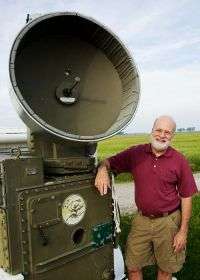
In the new analysis, the researchers took a fresh look at bird-flight data Larkin had collected in the 1970s and '80s using low-power-density tracking radar. The radar directs microwaves in a narrow cone – a "pencil-beam" that can be pointed at virtually any target within range.
"If there is a bird target here, you can see it on the radar display as an echo," Larkin said. "You throw a switch and it locks onto the target, it tracks the target, and wherever the bird flies, the radar points at it."
The radar kept track of a target's distance (from the radar), altitude and direction of travel over time. It also provided data used to calculate the frequency of a target's wing beats. Since the radar could also track flying insects and other arthropods, the wing beat data would be important for distinguishing birds from bugs.
In collecting the data, Larkin, Szafoni and colleagues had used the radar in a new way. Once the radar operator had identified a flying object that might be a bird and began tracking its flight, he or she looked for other objects entering the radar's beam. If another potential target appeared, the radar could follow it for a few seconds before switching back to the first. By repeatedly switching back and forth between two targets, the operator could potentially detect the discrete flight details of two birds at a time.
Determining whether two birds were actively traveling together was tricky, Larkin said.
"Even back in the 1970s it hit me that you can have two birds flying absolutely parallel in the same direction and at the same height, but they can be flying at such a different speed that one of them gains on the other and they're just, you know, automobiles passing on the expressway," he said. "They're simply taking the same route and not keeping together."
Similarly, two animals may be going at similar speeds but at a slightly varying angle to one another.
"After a while they would be kilometers apart," Larkin said. This would be clear evidence that the birds were not traveling together.
After analyzing dozens of trials, the researchers determined that a significant proportion of the pairs of birds they had tracked were flying at the same altitude, at the same speed and in the same direction. Some of these birds were quite far apart, more than 200 meters away from each other – a distance of nearly two football fields – and yet they were traveling together.
To determine whether the birds were just being swept passively along by prevailing winds or whether they were actively staying together, the researchers analyzed the flight patterns of insects and other arthropods occupying the same air space at the same time. These tiny creatures would be at the mercy of the wind and so would give the researchers a reliable picture of the pattern of air currents.
That analysis demonstrated that the birds were following their own course and were not simply being blown along by the wind.
"To me, that's the marvelous thing – that they're flying in social groups in the middle of the night in the middle of the air, over territory most of them have never been over before," Larkin said.
Source: University of Illinois at Urbana-Champaign


