Pioneer Develops World's First 16-Layer Optical Disc
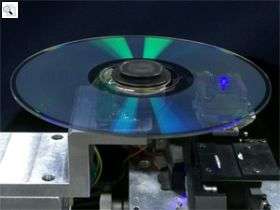
July 7, 2008 Pioneer's 16-layer optical disc

Enlarge

Pioneer's 16-layer optical disc

Pioneer Corporation has succeeded in developing a 16-layer read-only optical disc with a capacity of 400 gigabytes for the first time in the world.

Its per-layer capacity is 25 gigabytes, which is the same as that of a Blu-ray Disc (BD). This multilayer technology will also be applicable to multilayer recordable discs.

For multilayer optical discs, it has been difficult to obtain clear signals from each recording layer in a stable manner due to crosstalk from adjacent layers and transmission loss.

Utilizing the optical disc production technology that it has developed in the DVD field, Pioneer solved these problems by, among other things, using a disc structure that can reduce crosstalk from adjacent layers, resulting in a 16-layer optical disc that can playback high-quality signals from every layer.

As for the read-out system, Pioneer achieved stability in the playback of recorded signals by employing a wide-range spherical aberration compensator and light-receiving element that can read out weak signals at a high signal-to-noise ratio in the optical pick-up mechanism.

Since the optical specifications of the objective lens, such as NA (Numerical Aperture), are the same as those for the existing BD discs, it is possible to maintain compatibility between the new 16-layer optical disc and the BD discs.

Pioneer will present the details of this research at the International Symposium on Optical Memory and Optical Data Storage 2008 (ISOM/ODS2008) to be held in Hawaii from July 13.

Source: Pioneer


print this article email this article download pdf blog this article bookmark this article     Stumble it Digg this share on Facebook retweet share on Reddit add to delicious
Rate this story - 4.4 /5 (29 votes)

Rank Filter

Move the slider to adjust rank threshold, so that you can hide some of the comments.


Display comments: newest first

  • Mercury_01 - Jul 07, 2008
    • Rank: 0.9 / 5 (7)
    Oh wow, I hate it 16 times as much! The only amazing thing here is that we still use this godforsaken media format. CDs are blaspheming abomination to music all over the world. I hope the scientist who made this loses his whole creedence collection to a wayward grain of sand. Chances are he wont have to. The "protective" cases they sell us to put Cds in are enough to do the job nicely over a coupe of years. And they expect us not to download free music?
  • Nikola - Jul 07, 2008
    • Rank: 3 / 5 (3)
    Mercury_01 - I'd have to agree somewhat. Spinning media's days are numbered. I wouldn't mind seeing a holographic data cube that could store a petabyte. Stacking layer after layer of optical media to increase capacity seems a little trite even with a 400GB capacity. Let's move on to solid state.
  • Star_Gazer - Jul 07, 2008
    • Rank: 2.5 / 5 (2)
    So the dual layer dvd-r costs about four times as of regular dvd-r.. with the cost of single bd-r hovering around $20, dual layer bd-r is estimated at $80.. stack that 8 times.. $640 per disk. for 400GB ($1.60 per GB) and will not be available 2-3 years from now.

    The price of the 16GB SD card is $50 ($3.13 per GB) costing twice as much, with prices dropping by 50% per year.

    Conclusion: Death of optical media is near.. Unless the holographic storage will get realized soon!
  • bobwinners - Jul 07, 2008
    • Rank: 4.5 / 5 (2)
    Hey, the perfect installation media for the next version of Windows!!
  • nypinstripes - Jul 08, 2008
    • Rank: not rated yet
    Totally Farcicle statement on behalf of Panasonic's PR/Marketing team. Obviously someone here hasn't done their homework. First off it's been more than 2 years since optware/toshiba announced their hvd optical discs could successfully hold 10TB of data per disc. Soon after a Russian company whose name I forget claimed to produce a hundred layer red-laser optical disc, I bet the people at panasonic either counted on the fact that nobody would search for the validity of their claim or that they actually didn't look to see if what they were claiming was even true, google it and find out.
  • Zig158 - Jul 16, 2008
    • Rank: not rated yet
    Star Gazer I can't agree more!

July 7, 2008 all stories

Comments: 6

4.4 /5 (29 votes)
  • Stumble this up

  • Digg this

  • share this

  • hide
  • Related Stories


  • hide
  • Relevant PhysicsForums posts

Other News

A system of space solar power system (SSPS)

Japan eyes solar station in space as new energy source

Technology / Energy

created 2 hours ago | popularity 5 / 5 (3) | comments 3

It may sound like a sci-fi vision, but Japan's space agency is dead serious: by 2030 it wants to collect solar power in space and zap it down to Earth, using laser beams or microwaves.


Software cos. eye key patent case in Supreme Court (AP)

Software cos. eye key patent case in Supreme Court

Technology / Business

created 3 hours ago | popularity 5 / 5 (1) | comments 0

(AP) -- With the technology industry looking on, the Supreme Court on Monday will explore what types of inventions should be eligible for a patent in a pivotal case that could undermine such legal protections ...


Campaigners are stepping up efforts to curb online tracking

Advertisers face resistance to on-line tracking

Technology / Internet

created 1hour ago | popularity not rated yet | comments 0

Campaigners are stepping up efforts to curb online tracking of Internet use by firms that deliver adverts tailored to the specific interests of consumers, as polls reveal widespread unease with the practice.


Microsoft websites were the most visited in September

Microsoft websites top spots in September: comScore

Technology / Internet

created 22 hours ago | popularity 2 / 5 (4) | comments 0

Industry tracker comScore on Friday released a study showing that Internet users in September spent more time at Microsoft websites that at any other online properties.


Hacker illustration

Brazil blackouts result of cyber hacking: report

Technology / Internet

created 22 hours ago | popularity 3 / 5 (3) | comments 0

Massive power outages in Brazil in 2005 and 2007 that impacted millions were caused by cyber hackers attacking control systems, the US television network CBS said Sunday.