New Biodiversity Maps Will Help to Guide Conservation Measures in East Africa
July 7, 2008
New Biodiversity Maps Will Help to Guide Conservation Measures in East Africa

Enlarge

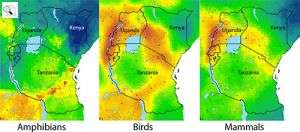
Hot and cool spots for biodiversity emerge from overlapped ranges of all East Africa’s amphibians, birds and mammals. Photo Credit: Jetz lab/UCSD

Conservation biologists from UC San Diego are collaborating with scientists from the African Conservation Centre and other institutions to map patterns of biodiversity and land use in East Africa in unprecedented detail. Their maps, combined with climate models, will project how climate change will alter biodiversity and help to shape policy for setting aside conservation easements.

Wildlife, people and livestock have weathered past variation in climate by shifting their seasonal migration patterns though the varied of ecological zones in the Great Rift Valley, which runs through the center of Kenya and Tanzania.

“When you go from the bottom of the rift, it’s almost desert. By the time you get up to the top, no more than 15-20 km away, it’s rainforest,” said David Western, adjunct professor of biology at UCSD, director of the African Conservation Centre in Nairobi and former director of Kenya Wildlife Service. “Previously this was communal land where people moved with the seasons and they moved with changing climates.”

Now, as climate change is expected to shift the balance between habitats in this region, increased farming has fragmented the landscape, Western said. “It’s removed the highland grazing for both livestock and wildlife. The crop residues can keep the livestock going, but it’s a complete lockout for wildlife.”

The project will identify areas that, if protected, would allow both wildlife and pastoralists to move to more favorable conditions as climate shifts. “What we want to do is identify key pathways where, working with landowners, you can actually keep the land open, through a conservation easement,” Western said.

To determine how the centers of biological richness are likely to shift, UCSD biology assistant professor Walter Jetz and Daniel Kissling, a postdoctoral fellow, have mapped the ranges of 2,700 species of birds, mammals, amphibians and reptiles across all of Kenya, Tanzania, Uganda, Rwanda and Burundi.

For each species, they have plotted an ‘ecological envelope.’ “Within those boundaries, we are likely to encounter those species,” Jetz said. “With the distribution map, we can determine the species’ climatic niche.”

The next step, Jetz said, is to revise their maps using satellite images and field notes, to a finer scale. Their current maps are drawn to a 100 kilometer resolution. “You need some refinement if you want to be able to make predictions, so we are taking global maps and refining them to the scale of actual conservation decision-making: to a 10 or 20 km resolution,” Jetz said.

Jetz’s group’s maps of animal diversity will be combined with those for plants and human land use to gain a fuller picture of how ranges and interactions between species are likely to shift under different climate changes. A plant and an animal may respond differently to the same climate shift, for example, causing their ranges to diverge until the two species no longer co-exist.

At a recent meeting at the University of York in the UK, participants in the project agreed to join their completed distribution maps in a single database, and to combine that multilayered map with two climate models – one based on the minimum expected change and another that anticipates larger climate shifts – to develop six future ecological scenarios for East Africa: two each for the years 2025, 2055 and 2085. These scenarios will inform decisions about setting aside additional reserves in Kenya and Tanzania.

“The organization David Western represents has close ties to the stakeholders in Kenya, and therefore there is hope that some of the findings will actually be implemented,” Jetz said. “We sense a clear willingness in Kenya and Tanzania to put more reserves in place to mitigate the impacts of global change. For that they are looking to scientists for guidance. So we have a situation where good science can lead to significant basic insights and also make a difference for the people and their wildlife. We are very excited to be involved.

Source: University of California, San Diego


Rank 5 /5 (1 vote)
Tags

Relevant PhysicsForums posts
  • Do some geologists actually act a lot like Randy Marsh?
    createdFeb 11, 2012
  • Discrepancy between oxygen and carbon-dioxide levels
    createdFeb 09, 2012
  • where gems are found in the world
    createdFeb 09, 2012
  • Wind Waves in Reservoir ~ Wind run-up and Wind set-up
    createdFeb 08, 2012
  • Balance of oxygen in the atmosphere
    createdFeb 01, 2012
  • The case for a methanol-based economy
    createdJan 30, 2012
  • More from Physics Forums - Earth

More news stories

Time of year important in projections of climate change effects on ecosystems

(PhysOrg.com) -- Does it matter whether long periods of hot weather, such as last year's heat wave that gripped the U.S. Midwest, happen in June or July, August or September?

Space & Earth / Environment

created 43 minutes ago | popularity 5 / 5 (1) | comments 0 | with audio podcast

Scientists discover reason for Mt. Hood's non-explosive nature

(PhysOrg.com) -- For a half-million years, Mount Hood has towered over the landscape, but unlike some of its cousins in Oregon’s Cascade Mountains and many other volcanoes around the Pacific “Rim ...

Space & Earth / Earth Sciences

created 1 hour ago | popularity 5 / 5 (1) | comments 0 | with audio podcast

Missing dark matter located: Intergalactic space is filled with dark matter

Researchers at the University of Tokyo’s Institute for the Physics and Mathematics of the Universe (IPMU) and Nagoya University used large-scale computer simulations and recent observational data of gravitational ...

Space & Earth / Astronomy

created 1 hour ago | popularity 4.2 / 5 (5) | comments 6 | with audio podcast

Planck mission steps closer to the cosmic blueprint

(PhysOrg.com) -- ESA's Planck mission has revealed that our Galaxy contains previously undiscovered islands of cold gas and a mysterious haze of microwaves. These results give scientists new treasure to mine ...

Space & Earth / Astronomy

created 10 hours ago | popularity 5 / 5 (8) | comments 2 | with audio podcast

Scientists say Obama Mars cuts to hit research (Update)

The United States will scale back Mars exploration under a proposed budget by President Barack Obama released Monday that has some scientists fuming over the risk of a NASA brain-drain.

Space & Earth / Space Exploration

created 7 hours ago | popularity 5 / 5 (3) | comments 23


First-of-its-kind stem cell study re-grows healthy heart muscle in heart attack patients

Results from a Cedars-Sinai Heart Institute clinical trial show that treating heart attack patients with an infusion of their own heart-derived cells helps damaged hearts re-grow healthy muscle.

Discovery paves way for salmonella vaccine

(Medical Xpress) -- An international research team led by a University of California, Davis, immunologist has taken an important step toward an effective vaccine against salmonella, a group of increasingly antibiotic-resistant ...

Smoking bans lead to less, not more, smoking at home: study

Smoking bans in public/workplaces don't drive smokers to light up more at home, suggests a study of four European countries with smoke free legislation, published online in Tobacco Control.

Ovarian cancer arises in fallopian tube of knockout mice

(Medical Xpress) -- The most deadly form of "ovarian" cancer arises in the fallopian tubes – not the ovaries – of knockout mice that lack two genes associated with the disease, said researchers led by Baylor College ...

UK cases of progressive sight loss condition set to rise a third by 2020

New cases of the progressive sight loss condition, known as age-related macular degeneration, or AMD for short, are set to rise by a third in the UK over the next decade, reveals research published online in the British Jo ...

Medical school link to wide variations in pass rate for specialist exam

Wide variations in doctors' pass rates, for a professional exam that is essential for one type of specialty training, seem to be linked to the particular medical school where the student graduated, indicates research published ...