Can you hear me now?
July 7, 2008
Can you hear me now?

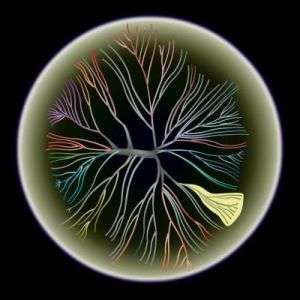
The phylogenetic tree, which shows the evolutionary relationship between all Monosiga tyrosine kinases, reveals that only a handful of them are related to human tyrosine kinases (yellow background). Graphic: Courtesy of Dr. Gerard Manning, Salk Institute for Biological Studies

When it comes to cellular communication networks, a primitive single-celled microbe that answers to the name of Monosiga brevicollis has a leg up on animals composed of billions of cells. It commands a signaling network more elaborate and diverse than found in any multicellular organism higher up on the evolutionary tree, researchers at the Salk Institute for Biological Studies have discovered.

Their study, which will be published during the week of July 7-11 in the online edition of the Proceedings of the National Academy of Science, unearthed the remarkable count of 128 tyrosine kinase genes, 38 more than found in humans.

These kinases transmit essential signals for cell growth, stasis, and death. Though their activity is tightly regulated in normal cells, out-of-control kinases are a major cause of cancer. Many successful cancer drugs — such as Gleevec, which is used for the treatment of leukemia, — specifically target wayward tyrosine kinases.

This treasure trove of diverse and novel tyrosine kinases took the study's lead author Gerard Manning, who heads the Razavi-Newman Center for Bioinformatics, by surprise since it was long thought that tyrosine kinases are restricted to multicellular animals where they handle communication between cells.

"We were absolutely stunned," says Manning. "Based on past work, we had expected maybe a handful of these kinases but instead discovered that this primitive organism has a record number of them. Two other essential parts of the tyrosine kinase network - PTP and SH2 genes - are also more numerous than in any other genome, showing that it is the whole network that is elaborated here."

The 100 trillion cells in our bodies require elaborate communication systems to coordinating their activities. Tyrosine kinases, extremely well-studied enzymes that act as receivers for external cues such as a growth signals and relay their message within cells by attaching tiny phosphate groups to proteins, are a vital part or this communication system.

At first glance, Monosiga brevicollis, which belongs to the group of choanoflagellates — microscopic, aquatic organisms that occupy the grey area between fungal and animal kingdoms — has little in common with multicellular animals that need to co-ordinate the activities of billions of cells. But its distinctive architecture – a collar of tentacle surrounding a whip-like tail known as flagellum – has the same basic structure as "collar cells" that aggregate to form sponges, which are considered the most primitive multicellular organisms or metazoans.

Because of their key evolutionary position, M. brevicollis was selected as a representative choanoflagellate for whole genome sequencing. "Choanoflagellates are like 'first cousins' of animals and their genome allows us a glimpse into the evolutionary origin of animals," says Manning.

The Monosiga kinases are more divergent than anything previously seen in animals, which may help scientists understand the fundamentals of how all tyrosine kinase signaling works. Despite their extreme diversity, Monosiga kinases time and again arrive at the same solution to a problem, as do animal kinases, but using a distinct method for instance to create a sensor structure that emerges from the cell, or to target a kinase to a specific part of the cell. "This convergent evolution suggests that there are only a limited number of ways build a functional network from these components," says Manning.

With all this new information, one obvious question remains unanswered: what is a single-celled organism doing with all this communications gear? "We don't have a clue!" says Manning, "but this discovery is the first step in finding out."

Source: Salk Institute

4.8 /5 (20 votes)  

Filter


Move the slider to adjust rank threshold, so that you can hide some of the comments.


Display comments: newest first

superhuman
Jul 07, 2008

Rank: not rated yet
>It commands a signaling network more elaborate and diverse than found in any multicellular organism higher up on the evolutionary tree

More tyrosine kinases does not mean more elaborate signaling network, it means more elaborate tyrosine kinase family. To compare networks all their elements would have to be compared not just one part.

It is to be expected that various organisms modify their proteome to serve specific needs - after all thats what evolution is all about.
thales
Jul 08, 2008

Rank: not rated yet
I know we're all thinking it, so I'll start the topic thread: could this be a precursor to or primitive form of distributed intelligence?

Discuss.
Rank 4.8 /5 (20 votes)
Tags

Relevant PhysicsForums posts

More news stories

A mitosis mystery solved: How chromosomes align perfectly in a dividing cell

Although the process of mitotic cell division has been studied intensely for more than 50 years, Whitehead Institute researchers have only now solved the mystery of how cells correctly align their chromosomes during symmetric ...

Biology / Cell & Microbiology

created 3 hours ago | popularity 5 / 5 (4) | comments 0 | with audio podcast

The proteins ensuring genome protection

Researchers from the University of Geneva (UNIGE), Switzerland, have discovered the crucial role of two proteins in developing a cell 'anti-enzyme shield'. This protection system, which operates at the level of molecular ...

Biology / Cell & Microbiology

created 3 hours ago | popularity 5 / 5 (2) | comments 0 | with audio podcast

Researchers find extensive RNA editing in human transcriptome

In a new study published online in Nature Biotechnology, researchers from BGI, the world's largest genomics organization, reported the evidence of extensive RNA editing in a human cell line by analysis of RNA-seq data, demons ...

Biology / Biotechnology

created 3 hours ago | popularity 5 / 5 (3) | comments 0 | with audio podcast

Entire genome of extinct human decoded from fossil

(PhysOrg.com) -- In 2010, Svante Pääbo and his colleagues presented a draft version of the genome from a small fragment of a human finger bone discovered in Denisova Cave in southern Siberia. The ...

Biology / Biotechnology

created Feb 07, 2012 | popularity 4.7 / 5 (59) | comments 48 | with audio podcast

Why are there so few fish in the Earth's oceans?

(PhysOrg.com) -- A Stony Brook University researcher has found that, contrary to popular belief, there are not plenty of fish in the sea.

Biology / Plants & Animals

created Feb 08, 2012 | popularity 4.3 / 5 (17) | comments 27 | with audio podcast


Google might launch Drive for cloud storage soon

(PhysOrg.com) -- Google's next big move, according to the Wall Street Journal, is a cloud storage service called Drive. Hardly first to the plate, Google is simply catching up to introducing its cloud reposi ...

Scientists discover molecular secrets of 2,000-year-old Chinese herbal remedy

For roughly two thousand years, Chinese herbalists have treated Malaria using a root extract, commonly known as Chang Shan, from a type of hydrangea that grows in Tibet and Nepal. More recent studies suggest that halofuginone, ...

New method to examine batteries -- MRI from the inside

There is an ever-increasing need for advanced batteries for portable electronics, such as phones, cameras, and music players, but also to power electric vehicles and to facilitate the distribution and storage of energy derived ...

Lab study raises questions over nano-particle impact

Tests involving chickens have raised questions about the impact on health from engineered nano-particles, the ultra-fine grains commonly used in drugs and processed foods, scientists said on Sunday.

Injured boomers beware: Know when to see doctor

(AP) -- It happened to nurse Jane Byron years after an in-line skating fall, business owner Haralee Weintraub while doing "men's" push-ups, and avid cyclist Gene Wilberg while lifting a heavy box.

Starve a virus, feed a cure? Findings show how some cells protect themselves against HIV

A protein that protects some of our immune cells from the most common and virulent form of HIV works by starving the virus of the molecular building blocks that it needs to replicate, according to research published online ...