NASA sets date for final shuttle mission in 2010
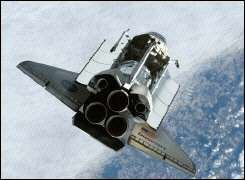
Following a detailed, integrated assessment, NASA selected target launch dates for the remaining eight space shuttle missions on the current manifest in 2009 and 2010.
The manifest includes one flight to the Hubble Space Telescope, seven assembly flights to the International Space Station, and two station contingency flights, planned to be completed before the end of fiscal year 2010.
The agency previously selected Oct. 8 and Nov. 10 as launch dates for Atlantis' STS-125 mission to service Hubble and Endeavour's STS-126 / ULF-2 mission to supply the space station and service both Solar Alpha Rotary Joints on the port and starboard end of its truss backbone that supports equipment and solar arrays.
The approved target dates are subject to change based on processing and other launch vehicle schedules. They reflect the agency's commitment to complete assembly of the station and to retire the shuttle fleet as transition continues to the new launch vehicles, including Ares and Orion.
SHUTTLE FLIGHTS IN 2009
Feb. 12 -- Discovery (STS-119 / 15A) will kick off a five-flight 2009 with its 36th mission to deliver the final pair of U.S. solar arrays to be installed on the starboard end of the station's truss. The truss serves as the backbone support for external equipment and spare components, including the Mobile Base System. Lee Archambault will command the 14-day flight that will include four planned spacewalks. Joining him will be pilot Tony Antonelli and mission specialists John Phillips, Steve Swanson, Joseph Acaba, Richard Arnold and Japan Aerospace Exploration Agency astronaut Koichi Wakata. Wakata will replace Sandy Magnus on the station as a flight engineer. STS-119 marks the 28th shuttle flight to the station.
May 15 -- Endeavour (STS-127 / 2JA) sets sail on its 23rd mission with the Japanese Kibo Laboratory's Exposed Facility and Experiment Logistics Module Exposed Section, the final permanent components of the Japan Aerospace Exploration Agency’s contribution to the station program. During the 15-day mission, Endeavour's crew will perform five spacewalks and deliver six new batteries for the P6 truss, a spare drive unit for the Mobile Transporter and a spare boom assembly for the Ku-band antenna. Mark Polansky will be Endeavour's commander with Doug Hurley as pilot. Mission specialists will be Christopher Cassidy, Tom Marshburn, Dave Wolf, Tim Kopra and Canadian Space Agency astronaut Julie Payette. Kopra will become a station flight engineer replacing Koichi Wakata, who will return home with the STS-127 crew. It will be the 29th shuttle flight to the station.
July 30 -- Atlantis (STS-128 / 17A) launches on its 31st flight, an 11-day mission carrying science and storage racks to the station. In the payload bay will be a Multi-Purpose Logistics Module holding science and storage racks. Three spacewalks are planned to remove and replace a materials processing experiment outside the European Space Agency's Columbus module and return an empty ammonia tank assembly. The mission includes the rotation of astronaut Nicole Stott for Tim Kopra, who will return to Earth with the shuttle crew. The remaining crew members have yet to be named. STS-128 marks the 30th shuttle flight dedicated to station assembly and outfitting.
Oct. 15 -- Discovery's (STS-129 / ULF-3) 37th mission will focus on staging spare components outside the station. The 15-day flight includes at least three spacewalks. The payload bay will carry two large External Logistics Carriers holding two spare gyroscopes, two nitrogen tank assemblies, two pump modules, an ammonia tank assembly, a spare latching end effector for the station's robotic arm, a spare trailing umbilical system for the Mobile Transporter and a high-pressure gas tank. Canadian Space Agency astronaut Bob Thirsk will return home aboard Discovery with its crew, which has yet to be named. STS-129 marks the 31st shuttle mission devoted to station assembly.
Dec. 10 -- Endeavour (STS-130 / 20A) will close 2009 with its 24th mission to deliver the final connecting node, Node 3, and the Cupola, a robotic control station with six windows around its sides and another in the center that provides a 360-degree view around the station. At least three spacewalks are planned during the 11-day mission. The 32nd station assembly mission by a shuttle does not yet have a crew named.
SHUTTLE FLIGHTS IN 2010
Feb. 11 -- Atlantis (STS-131 / 19A) begins its 32nd mission as the first flight in 2010, carrying a Multi-Purpose Logistics Module filled with science racks that will be transferred to laboratories of the station. The 11-day mission will include at least three spacewalks to attach a spare ammonia tank assembly outside the station and return a European experiment that has been outside the Columbus module. It will be the 33rd shuttle mission to the station. The crew has yet to be named.
April 8 -- Discovery's (STS-132 / ULF-4) 38th mission will carry an integrated cargo carrier to deliver maintenance and assembly hardware, including spare parts for space station systems. In addition, the second in a series of new pressurized components for Russia, a Mini Research Module, will be permanently attached to the bottom port of the Zarya module. The Russian module also will carry U.S. pressurized cargo. The first Russian Mini Research Module to go to the station is scheduled to launch on a Russian rocket in the summer of 2009.
Additionally, at least three spacewalks are planned to stage spare components outside the station, including six spare batteries, a boom assembly for the Ku-band antenna and spares for the Canadian Dextre robotic arm extension. A radiator, airlock and European robotic arm for the Russian Multi-purpose Laboratory Module also are payloads on the flight. The laboratory module is scheduled for launch on a Russian rocket in 2011. The mission marks the 34th mission to the station. The STS-132 crew has yet to be named.
May 31 -- Endeavour's (STS-133 / ULF-5) 25th mission will carry critical spare components that will be placed on the outside of the station. Those will include two S-band communications antennas, a high-pressure gas tank, additional spare parts for Dextre and micrometeoroid debris shields. At least three spacewalks are planned to be carried out by the crew, which has yet to be named. The 15-day mission will be the 35th to the station.
Source: NASA


