Carbon Nanotube Windmills Powered by 'Electron Wind'
July 8, 2008 By Lisa Zyga feature
Carbon Nanotube Windmills Powered by 'Electron Wind'

Enlarge

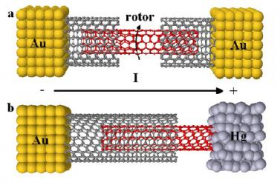
The proposed (a) nanomotor and (b) nanodrill, where the red inner CNT rotates due to an electron wind. The nanomotor is attached to gold electrodes, which act as electron reservoirs, while the nanodrill has one end contacted to a mercury electrode. Credit: S.W.D. Bailey, et al.

Theoretical physicists from Lancaster University in the UK have designed a nanomotor that operates by a novel mechanism: an electron wind.

As Steven Bailey, Ilias Amanatidis, and Colin Lambert explain in a recent issue of Physical Review Letters, the new drive mechanism could be useful for future NEMS (nanoelectromechanical structures) technologies.

“[Previously,] thoughts have been directed towards ‘pushing’ the motor to make it turn, whereas our suggestion harnesses an intrinsic property of the device: the change in momentum of electrons or phonons, for example,” Bailey told PhysOrg.com.

The researchers describe the proposed nanomotor as a carbon nanotube (CNT) windmill, although the device looks more like a telescope than the conventional spinning blades of a windmill. It consists of a double-walled CNT, where the outer tube is clamped to two external electrodes, and the shorter inner tube is free to move and rotate. In a version called the CNT drill, the outer tube is clamped to just one electrode, while one end of the free inner tube is in contact with a mercury electrode, but is still free to rotate. The devices are called windmills because they’re powered by an applied dc voltage between the electrodes, which produces a “wind” of electrons.

As it moves through the CNT, the flow of electrons acquires angular momentum, producing a tangential force that causes the inner nanotube to rotate. The researchers calculated that the electron wind can produce a force that significantly exceeds the inter-wall friction – sometimes by as much as three orders of magnitude. Depending on the applied voltage, the rotating inner tube can reach CNT breakdown velocities of up to 8,000 meters per second.

The electron-wind-powered nanomotor could have a range of applications. For instance, by using a voltage pulse to make the inner tube rotate at a specific angle, it could be used as a switch or memory element in nanoscale magnetic memory devices; or, by putting the CNT in contact with a reservoir of atoms or molecules, the nanomotor could act as a nanofluidic pump.

The physicists also suggest that the motor could be powered in different ways. In one possibility, the electrodes could be replaced with reservoirs of atoms or molecules. Then, an applied pressure difference could drive the atoms or molecules across the CNT, and their angular momentum could cause the inner tube to rotate. Similarly, a temperature difference between the ends of the CNT could create a flux of phonons that could also drive the motor.

Other CNT-based nanomotors have been developed, including multi-walled CNTs with a similar structure to the CNT windmill. However, these previous designs have been powered by electrostatic forces that require metallic plates and gates, which aren’t needed in the new design. The researchers hope that the efficiency and simplicity of the CNT windmills will provide advantages over electrostatic and other nanomotors in the future.

“The capability to engineer nanoscale motors is at the same stage as that of microscale motors in the 1990s,” Bailey said. “The manufacturing techniques to deal with the very low dimensions are always playing catch up with experimental groups, which are making very rapid progress, and we predict that to test out the CNT windmill will not require much change to established procedures within these groups. Indeed, there should be much less construction involved in making the nanomotor devices. The engineering simplicity of the CNT windmill will be the greatest advantage in the future.”

More information: Bailey, S.W.D; Amanatidis, I.; and Lambert, C.J. “Carbon Nanotube Electron Windmills: A Novel Design for Nanomotors.” Physical Review Letters 100, 256802 (2008).

Copyright 2008 PhysOrg.com.
All rights reserved. This material may not be published, broadcast, rewritten or redistributed in whole or part without the express written permission of PhysOrg.com.

4.7 /5 (65 votes)  

Filter


Move the slider to adjust rank threshold, so that you can hide some of the comments.


Display comments: newest first

earls
Jul 08, 2008

Rank: 4.1 / 5 (7)
THIS IS AN AMAZING DEVELOPMENT!!

Big images on Physorg!

Oh, and the nanomotors are cool too. ;)
flashgordon
Jul 08, 2008

Rank: 4.8 / 5 (4)
They've been struggling with carbon nanotubes and buckyballs for awhile now even though theoretically, the bucky-chemistry was so enticing; this along with some other software developments which have allowed the development of micro-stm/afm's suggests this pathway may get to Drexlerian/Feynman nanotech sooner than dna-nanotech . . . not to mention . . . quite possibly, sooner than some would think;
thales
Jul 08, 2008

Rank: 5 / 5 (5)
Depending on the applied voltage, the rotating inner tube can reach CNT breakdown velocities of up to 8,000 meters per second.


That's UNBELIEVABLY fast. The diameter of a carbon nanotube is almost 1 nanometer, so the circumference is approximately 3.14 nm. 8,000 meters per second = 8,000 billion nanometers per second. So, this comes out to 152.9 trillion RPM [(8 trillion nm/3.14 nm)* 60 seconds].

Feel free to check those numbers, but I think they're right. I wonder if that's some kind of record for a man-made device.
thales
Jul 08, 2008

Rank: 5 / 5 (4)
I was thinking about it, and 152.9 trillion RPM is the same as 2.55 terahertz. Sources of terahertz radiation are prized. From another physorg story at:
http://www.physor...859.html

"The ability of Terahertz rays to penetrate efficiently through paper, clothing, cardboard, plastic and many other materials makes them ideal for use in many applications. For example, a device emitting T-rays could be used to image concealed weapons, detect chemical and biological agents through sealed packages, see tumors without causing any harmful side effects, and spot defects within materials such as cracks in the Space Shuttle's foam insulation."
AdseculaScientiae
Jul 08, 2008

Rank: 4 / 5 (4)
We are looking forward to your very own article then, Neil!

Bring it on.
alfredh
Jul 08, 2008

Rank: 4 / 5 (3)
This might be a stupid observation, but could charged particles from lets say a radioactive source create the "wind" to rotate the "windmill". Maybe even generate power, nuff them together might make it useful.
superhuman
Jul 09, 2008

Rank: 5 / 5 (3)
Keep in mind this is only a theory at the moment, no working prototype has been built. Also the article suggest that 8000 meters per second is the speed at which the nanotube breaks and not a calculated speed of the motor.

As far as I can understand from the article electrons exert force on the rotor when they "bounce" of the carbon carbon bonds in a helical nanotube. The carbon carbon bonds can be visualized as turbine vanes.

Voltage to speed ratio could be controlled by choosing tubes with different helical angle.

Heat dissipation will probably be a problem for higher speeds.

As for isotope "wind" powering a "windmill" yes it is possible but it makes more sense to use radioisotope thermoelectric generators instead http://en.wikiped...enerator
zbarlici
Jul 09, 2008

Rank: 3 / 5 (3)
i heard that nanotech can be as toxic as asbestos.. especially when it gets aged and all the tubes flake off... i`m not sure if its a true fact or not but that`s pretty scary.

Anyone care to shed some light?
Bonkers
Jul 09, 2008

Rank: 4 / 5 (1)
things that are sharp at a cell-sized level have biological effects even if made from benign materials.
thales
Jul 09, 2008

Rank: 3 / 5 (1)
Keep in mind this is only a theory at the moment, no working prototype has been built. Also the article suggest that 8000 meters per second is the speed at which the nanotube breaks and not a calculated speed of the motor.


Superhuman is right, this speed is effectively the upper limit for the motor.

Voltage to speed ratio could be controlled by choosing tubes with different helical angle.


This is a good idea, and it occurred to me that different helical angles or maybe a different construction to strengthen the tube could allow it to rotate at even higher speeds. It also makes sense that the energy transfer could go the other way: exposure to terahertz radiation makes the tubes spin. This would be a DIRECT transfer of EM energy to kinetic! Now, if the tubes could be strengthened to withstand even higher speeds, they could conceivably be revved up to produce infrared radiation (which is the next step higher than terahertz). Then, I'm pretty sure simple exposure to the sun would convert the solar infrared energy to kinetic energy.
googleplex
Jul 09, 2008

Rank: 3 / 5 (3)
Without doubt these materials are highly toxic to organisms. That said it appears the possibilities are endless with nano tech. It will probably go through the usual steps of warnings, mass implementation, scientific proof of harm, haz mat clean up. Commerce always takes precedence over safety.
New materials are always assumed safe until proven otherwise.
IMHO the toxicity rule of thumb is simple. Substances which we have evolved to live with are safe. Exotic substances are generally unsafe. Nanotech is akin to viruses and prions in terms of toxicity.
IMHO safe use is in sealed applications e.g computer processors and memory.
Unsafe uses are un-sealed applications e.g. paint that you put onto a wall of your house and breath in particles every day.
There is a reason we have 50% (arguable) chance of cancer in our life time. Let's not make it 90% by being stupid!


Soylent
Jul 12, 2008

Rank: 5 / 5 (2)
There is a reason we have 50% (arguable) chance of cancer in our life time.


Yes, we stopped senseless tribal wars that once killed ~50% of men, we started cooking food, we defeated starvation with farming and trade, we defeated deficiencies in vital nutrients by learning to diagnose them, we invented antibiotics, got rid of small pox.

We got rid of or diminished most other causes of death except for cancer, leaving it as a major bottleneck. It is a game of whack-a-mole; each time you reduce one cause of death the lifespan creeps up and a new bottleneck appears.
Rank 4.7 /5 (65 votes)
Relevant PhysicsForums posts

More news stories

'Dark plasmons' transmit energy

Microscopic channels of gold nanoparticles have the ability to transmit electromagnetic energy that starts as light and propagates via "dark plasmons," according to researchers at Rice University.

Nanotechnology / Nanophysics

created 11 hours ago | popularity 5 / 5 (5) | comments 0 | with audio podcast

Nanotube therapy takes aim at breast cancer stem cells

Wake Forest Baptist Medical Center researchers have again proven that injecting multiwalled carbon nanotubes (MWCNTs) into tumors and heating them with a quick, 30-second laser treatment can kill them.

Nanotechnology / Bio & Medicine

created 16 hours ago | popularity 5 / 5 (1) | comments 0 | with audio podcast

Inspired by steel, nanomanufacturing gets wear-resistant carbide tip

(PhysOrg.com) -- Scientists at the University of Pennsylvania, the University of Wisconsin-Madison and IBM Research - Zurich have fabricated an ultrasharp silicon carbide tip possessing such high strength ...

Nanotechnology / Nanophysics

created 21 hours ago | popularity 5 / 5 (3) | comments 1 | with audio podcast

New kind of solar cell could capture significantly more energy than current cells

New solar cells could increase the maximum efficiency of solar panels by over 25%, according to scientists from the University of Cambridge.

Nanotechnology / Nanophysics

created Feb 08, 2012 | popularity 4.5 / 5 (11) | comments 14 | with audio podcast

New technology platform for molecule-based electronics

Researchers at the Nano-Science Center at the University of Copenhagen have developed a new nano-technology platform for the development of molecule-based electronic components using the wonder material graphene. At the same ...

Nanotechnology / Nanomaterials

created 18 hours ago | popularity 5 / 5 (2) | comments 0


Fighting crimes against biodiversity: How to catch a killer weed

Invasive species which have the potential to destroy biodiversity and influence global change could be tracked and controlled in the same way as wanted criminals, according to new research from Queen Mary, University of London.

A novel method for simultaneously measuring blood pressure and arterial stiffness

Arterial stiffness due to is a major contributor to cardiovascular disease but is very difficult to measure. It also can influence blood pressure readings since these rely on the time taken for arteries to return to normal ...

Study finds that red blood cell transfusion decreases fatigue in women with acute postpartum anemia

In a study to be presented today at the Society for Maternal-Fetal Medicine's annual meeting, The Pregnancy Meeting ™, in Dallas, Texas, researchers will report findings that show that in women with acute postpartum ...

Study weighs risks and benefits of birthing facilities

In a study to be presented today at the Society for Maternal-Fetal Medicine's annual meeting, The Pregnancy Meeting ™, in Dallas, Texas, researchers will report findings that indicate that the risk of obstetric intervention ...

Study finds in women with prior cesarean, optimal gestational age for elective delivery is week 39

In a study to be presented today at the Society for Maternal-Fetal Medicine's annual meeting, The Pregnancy Meeting, in Dallas, Texas, researchers will report findings that indicate that for women with prior delivery via ...

4.5 million Americans living with total knee replacement

New research presented at the 2012 Annual Meeting of the American Academy of Orthopaedic Surgeons (AAOS) found that more than 4.5 million Americans are living with a total knee replacement (TKR), as the number of TKR surgeries ...