Duckweed genome sequencing has global implications
July 8th, 2008 Duckweed Collection

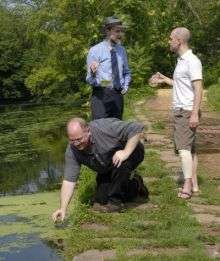
Professors Randall Kerstetter, Joachim Messing and Todd Michael collecting duckweed samples from the Delaware and Raritan Canal in New Jersey. Credit: Carl Blesch, Rutgers University

Three plant biologists at Rutgers' Waksman Institute of Microbiology are obsessed with duckweed, a tiny aquatic plant with an unassuming name. Now they have convinced the federal government to focus its attention on duckweed's tremendous potential for cleaning up pollution, combating global warming and feeding the world.

This enterprise builds upon Rutgers' burgeoning energy and environmental research and the important contributions Waksman Institute scientists have already made to plant genomics, including the sequencing of rice, sorghum and corn.

At the behest of the Rutgers scientists and their colleagues from five other institutions, the U.S. Department of Energy (DOE) will channel resources at its national laboratories into sequencing the genome of the lowly duckweed. The DOE's Joint Genome Institute announced on July 2 that its Community Sequencing Program will support the genomic sequencing of duckweed (Spirodela polyrhiza) as one of its priority projects for 2009 directed toward new biomass and bioenergy programs.

According to the researchers, duckweed plants can extract nitrogen and phosphate pollutants from agricultural and municipal wastewater. They can reduce algae growth, coliform bacterial counts and mosquito larvae on ponds, while concentrating heavy metals, capturing or degrading toxic chemicals, and encourage the growth of other aquatic animals such as frogs and fowl. These plants produce biomass faster than any other flowering plant, serve as high-protein feed for domestic animals and show clear potential as an alternative for biofuel production.

Todd Michael, a member of the Waksman Institute and an assistant professor of plant biology and pathology at Rutgers, The State University of New Jersey, led the multi-institutional initiative to have the DOE's Joint Genome Institute perform high-throughput sequencing of this smallest, fastest growing and simplest of flowering plants.

"The Spirodela genome sequence could unlock the remarkable potential of a rapidly growing aquatic plant for absorbing atmospheric carbon dioxide, ecosystem carbon cycling and biofuel production," said Michael, who is also a member of the faculty of the School of Environmental and Biological Sciences.

His collaborators in this undertaking include professors Randall Kerstetter and Joachim Messing of the Waksman Institute, and scientists at Brookhaven National Laboratory, the Institut für Integrative Biologie (Switzerland), the University of Jena (Germany), Kyoto University (Japan) and Oregon State University.

The DOE's Joint Genome Institute is operated by the University of California and includes five national laboratories – Lawrence Berkeley, Lawrence Livermore, Los Alamos, Oak Ridge and Pacific Northwest – and the Stanford Human Genome Center.

With the passage of the Energy Policy Act of 2005 and recent increases in food prices worldwide, the drive to develop sustainable feedstocks and processing protocols for biofuel production has intensified. The search for new biomass species has revealed the potential of duckweed species in this regard as well as for bioremediation and environmental carbon capture.

Source: Rutgers University


print this article email this article download pdf blog this article bookmark this article     Digg this Stumble it share on Facebook share on Reddit add to delicious save to Yahoo! bookmarks
4.6/5 after 10 votes


July 8th, 2008 all stories
Biology /

Comments: 0
Rank: 4.6/5 after 10 votes

  • Stumble this up

  • Digg this

  • Share it:
  • share on Facebook
  • share on MySpace
  • share on Slashdot
  • rss-newsfeed
  • share on Google
  • share on Reddit
  • add to delicious
  • save to Yahoo! bookmarks
  • share on Windows Live
  • Add to Mixx!
Rating: 4.6/5 after 10 votes

  • Related Stories

  • Virus-resistant grapevines
    created Jul 02, 2009 | popularity not rated yet | comments 0
  • Little-known marine decomposers attract the attention of genome sequencers
    created Jun 29, 2009 | popularity not rated yet | comments 0
  • Sequencing effort to chart ants and their ecosystem
    created Jun 26, 2009 | popularity not rated yet | comments 0
  • Study pinpoints novel cancer gene and biomarker
    created Jun 24, 2009 | popularity not rated yet | comments 0
  • Plant microbe shares features with drug-resistant pathogen
    created Jun 16, 2009 | popularity not rated yet | comments 0


  • Physicists Demonstrate Quantum Memory with Matter Qubits
    Physicists Demonstrate Quantum Memory with Matter Qubits
    Physics / General Physics
    created Jul 03, 2009 | popularity 4.4 / 5 (17) | comments 1
  • 'Holey' Nanosheets for Wastewater Dye Removal
    Nanotechnology / Nanomaterials
    created Jul 01, 2009 | popularity 5 / 5 (5) | comments 1
  • Jellyfish Robot Swims Like its Biological Counterpart
    Jellyfish Robot Swims Like its Biological Counterpart
    Electronics / Robotics
    created Jun 26, 2009 | popularity 4.4 / 5 (8) | comments 1
  • Could Maxwell's Demon Exist in Nanoscale Systems?
    Could Maxwell's Demon Exist in Nanoscale Systems?
    Physics / General Physics
    created Jun 24, 2009 | popularity 4.4 / 5 (18) | comments 29
  • Living Safely with Robots, Beyond Asimov's Laws
    Living Safely with Robots, Beyond Asimov's Laws
    Electronics / Robotics
    created Jun 22, 2009 | popularity 4.6 / 5 (52) | comments 40
  • Other News

    California water plan aims to save Puget Sound orcas

    Biology / Ecology

    created 5 hours ago | popularity not rated yet | comments 0

    A plan to restore salmon runs on California's Sacramento River also could help revive killer whale populations 700 miles to the north in Puget Sound, as federal scientists struggle to protect endangered species in a complex ...


    Scientists 'rebuild' giant moa using ancient DNA

    Biology / Plants & Animals

    created Jul 01, 2009 | popularity 5 / 5 (10) | comments 12

    (PhysOrg.com) -- Scientists have performed the first DNA-based reconstruction of the giant extinct moa bird, using prehistoric feathers recovered from caves and rock shelters in New Zealand.


    Pacific Giant Salamander (Dicamptodon tenebrosus)

    Salamanders, regenerative wonders, heal like mammals, people

    Biology / Microbiology

    created Jul 01, 2009 | popularity 4.9 / 5 (19) | comments 10

    The salamander is a superhero of regeneration, able to replace lost limbs, damaged lungs, sliced spinal cord -- even bits of lopped-off brain. But it turns out that remarkable ability isn't so mysterious after ...


    Genetically modified trees

    Anti-biotech groups obstruct forest biotechnology

    Biology / Biotechnology

    created Jun 30, 2009 | popularity 3.7 / 5 (7) | comments 5

    The potential of forest biotechnology to help address significant social and environmental issues is being "strangled at birth" by the rigid opposition of some groups and regulations that effectively preclude ...


    Super-sleepers could help super-sizers!

    Super-sleepers could help super-sizers!

    Biology / Plants & Animals

    created Jun 29, 2009 | popularity 5 / 5 (2) | comments 4

    Burrowing frogs can survive buried for several years without food or water. Scientists have discovered that the metabolism of their cells changes radically during the dormancy period allowing the frogs to ...