Powering up microwave amplifiers for a wireless world
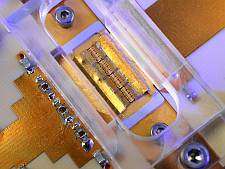
Four years ago, Europe trailed the rest of the world in microwave amplifier research and development. Now, however, European-designed transistors and amplifiers equal or outperform the competition worldwide. Today’s information-rich, wireless world depends on microwave amplifiers that operate efficiently and linearly at high power and high frequencies, so it is crucial that Europe is at the forefront of such research.
Europe’s rapid advance into the front ranks of microwave amplifier research and development was stimulated to a large degree by European researchers in the TARGET project.
TARGET was a four-year effort that linked researchers and laboratories across Europe into an agile and aggressive research and development community.
Guided and energised by TARGET, formerly uncoordinated European research into microwave amplifier development has become “ambitious, highly successful, and collaborative”, says TARGET’s scientific coordinator, Gottfried Magerl at the Technical University of Vienna.
The EU-funded project’s first challenge was to coordinate the efforts and expertise of 49 core laboratories, research centres, and businesses scattered across 16 countries.
The TARGET team tackled the problem in part by using sophisticated software to create a virtual research centre. Wherever they are, members can communicate readily with each other and access a common pool of software, documents and data.
This virtual community was supplemented by frequent face-to-face meetings, tutorials, and research collaborations.
The result, says Magerl, “is a very special kind of team spirit that is still alive”.
TARGET’s network coordinator, Sue Ivan at the telecommunications Research Center in Vienna, adds that the project grew into the largest international research co-operation in civilian microwave engineering history.
Real research in a virtual lab
TARGET researchers found early on that measuring devices and analytic software in different laboratories produced different readings from the same component.
This surprising discovery motivated them to go to great lengths to ensure that the nine co-operating laboratories used comparable equipment and analytic tools and so could produce equivalent results.
In addition, the labs were linked together via a shared computer interface and a powerful design language, XML, which let them manage and share mathematical models, research protocols and the resulting data.
The result was a Europe-wide virtual laboratory in which researchers can quickly and seamlessly perform all the steps needed to design, fabricate, and assess the performance of new components, amplifiers, and systems.
“The steps may be made by several different labs, situated maybe in Vienna, Torino, Lille, and Rome,” says Magerl. “Yet you think you get your results from one expert lab.”
Expanded horizons, award-winning results
Although the TARGET team’s central focus was on designing better microwave power amplifiers, they soon realised that for the programme to succeed, they needed a broader vision.
In the end, they developed expertise in a full spectrum of activities, from the fabrication and characterisation of basic semiconductor devices to the design of entire broadband transmission systems.
Spurred by the realisation that the field needed better tools for modelling the non-linear behaviour of components, sub-systems and complete amplifiers, TARGET researchers developed so much expertise in the area that they have literally written ‘the book’ on the subject, to be published in October 2008.
Before TARGET, European manufacturers of Gallium nitride amplifiers trailed their North American and Asian competitors in terms of power output across the frequency spectrum.
But in just four years, the manufacturers have doubled the power of their amplifiers, matching or exceeding their competitors, especially at the high frequencies needed for heavy data loads.
Building on the foundation of their coordinated virtual labs and modelling expertise, TARGET’s connected labs quickly began to turn out amplifiers that were both powerful and efficient – intrinsically competing qualities that rarely appear together.
In 2005, they produced a six-watt amplifier that operated at close to 60% efficiency, and which garnered an international prize.
Magerl explains that the combination of a high efficiency and a linear response, although extremely hard to achieve, is a key issue.
“For mobile phones it decides battery lifetime and quality of service,” he says. “For base stations it decides operational costs.”
TARGET, which received funding from the EU's Sixth Framework Programme for research, resulted in 35 joint research projects, 63 journal papers, and 340 conference presentations, among other achievements.
“TARGET has become a brand name in the microwave community,” says Magerl.
TARGET’s researchers feel that the combination of precise measurement, powerful models, and fast turn-around times can now allow manufacturers to produce better and more creative designs, while reducing the time it takes for an idea to move from a perceived need to a finished product.
TARGET researchers hope that the level of expertise developed through the project will be its legacy to the European research and development community.
“We think that we achieved more than just the sum of our efforts,” says Magerl. “TARGET can serve as a showcase of how to convince competitors to co-operate and to create a win-win situation.”
Source: ICT Results


