MIT instrument studies edge of sun's bubble
July 8, 2008 Helioshpere

Enlarge

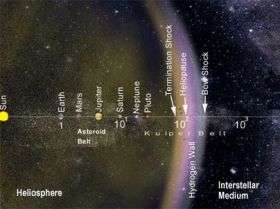
The scale of the heliosphere and nearby galactic neighborhood. The solar system and its nearby galactic neighborhood are illustrated here on a logarithmic scale extending (from < 1 to) 1 million Astornomical Units (AU). Image / NASA/JPL

The Voyager 1 and 2 spacecraft have traveled beyond the edges of the bubble in space where the sun's constant outward wind of particles and radiation slams into the interstellar medium that pervades our galaxy. The first scientific reports on what the Voyagers found there appears this week in the journal Nature.

The deep-space probes, which were designed mainly to study the outer planets Jupiter, Saturn, Uranus and Neptune, have now traveled more than 8 billion miles away from the Earth.

Voyager 1 is now more than 94 Astronomical Units away (one AU is the average distance from the Earth to the sun, or 93 million miles), and Voyager 2 is more than 84 AU. Because they are leaving the solar system on paths that are about 45 degrees apart, the data reveals details about the shape of the bubble created by the solar wind. The fact that they crossed the edge of the solar outflow--a region called the boundary shock--at different distances out from the sun proved that this bubble is squashed rather than being a symmetrical sphere.

Some of the data that revealed this boundary region comes from a set of magnetic field sensors developed and built at MIT back in the 1970s, based on an earlier MIT instrument sent on Explorer 1 in 1961. John Richardson, Principal Research Scientist at MIT's Kavli Institute for Astrophysics and Space Science, is a co-author of the two Nature papers, and John Belcher, professor of physics at MIT and former principal investigator for the Voyager Plasma Science instrument, is a co-author of one of them.

"We have never made direct measurements in the interstellar medium, the material between the stars," Belcher says, "because the sun's supersonically expanding atmosphere blows a bubble in the local interstellar medium whose radius is 100 times the distance from the sun to the Earth."

"It's starting to feel the interstellar wind," Richardson says of the fast-receding spacecraft, which is already more than three times as far from the sun as the solar system's outermost planets. "The interstellar wind is coming at us at 26 km per second," he says.

Sometime about a decade from now, Belcher says, Voyager 2 "will be through the shocked solar wind and into the interstellar medium proper. This is the material out of which the sun condensed, which has never been explored before."

Nobody knows much about that interstellar medium, such as what the density of hydrogen atoms is in that incredibly tenuous vacuum. "We will be able to deduce that better" once Voyager reaches it, Richardson says. "We'll also get a first look at cosmic rays that haven't been influenced by the sun's magnetic field, once we get outside," and thus learn more about the origins of these extremely fast-moving particles, he says. "That's one of our major scientific goals."

On a personal note, Belcher said that the creators of the MIT plasma instrument all wrote their names inside it before it was sent to be attached to the spacecraft. "My father had a 7th grade education, my generation was the first in the family to go to college," he says, "and my name is on a spaceship that will eventually reach the stars and probably last longer than the Earth itself!"

An earlier report on what Voyager 2 found was presented at a scientific meeting last December.

Source: MIT


print this article email this article download pdf blog this article bookmark this article     Stumble it Digg this share on Facebook retweet share on Reddit add to delicious
Rate this story - 4.6 /5 (9 votes)

Rank Filter

Move the slider to adjust rank threshold, so that you can hide some of the comments.


Display comments: newest first

  • bobwinners - Jul 08, 2008
    • Rank: not rated yet
    Ah. ok. Interstellar wind of how many atoms per cubic foot? I'm guessing it is really stretching it to call this a 'wind'. Particularly, since no one knows the density or speed of this 'wind'.
  • slash - Jul 09, 2008
    • Rank: not rated yet
    In relation to what is this interstellar wind's speed measured? Relative to the sun? Relative to the cluster of stars the sun is part of? The milky way? Or maybe just the Voyager space probes - in which case I wonder, will it be the same for both of them?

    A physical speed requires a point of origin and a direction to be meaningful. Neither is provided.

    Next issue: what is the 'bow shock' meant to be? When I read the article, judging by the choice of words I get the impression of a turbulent ion storm (Star Trek anyone?). But thinking about the density of particles out there I don't believe it could be noticed by unaugmented human senses!

    I'd prefer articles like this would be worded more appropriately and not this sensationalist style.

    It's very hard to get a clear picture of the actual facts when the authors do everything to put them out of relation or cover them up alltogether!

July 8, 2008 all stories

Comments: 2

4.6 /5 (9 votes)
  • Stumble this up

  • Digg this

  • share this

  • hide
  • Related Stories

  • Fantastic Voyage
    created Nov 02, 2009 | popularity not rated yet | comments 0
  • Scientists Explore Galactic Frontier, Release First-Ever All-Sky Map (w/ Video)
    created Oct 15, 2009 | popularity not rated yet | comments 0
  • Flashback to Neptune's Moon Triton (w/ Video)
    created Aug 26, 2009 | popularity not rated yet | comments 0
  • Novel diamond-like films on board NASA satellite
    created Feb 16, 2009 | popularity not rated yet | comments 0
  • NASA spacecraft ready to explore outer solar system
    created Oct 06, 2008 | popularity not rated yet | comments 0


  • hide
  • Relevant PhysicsForums posts

  • The shape of our solar system's orbits.
    created Nov 07, 2009
  • Above or Below the Line of Nodes
    created Nov 07, 2009
  • Supernova vs. Nova?
    created Nov 07, 2009
  • Supernova's Gamma Rays and Comets
    created Nov 06, 2009
  • More from Physics Forums - General Astronomy

Other News

Deep creep means milder, more frequent earthquakes along Southern California's San Jacinto fault

Deep creep means milder, more frequent earthquakes along Southern California's San Jacinto fault

Space & Earth / Earth Sciences

created 14 hours ago | popularity 4.7 / 5 (3) | comments 0

With an average of four mini-earthquakes per day, Southern California's San Jacinto fault constantly adjusts to make it a less likely candidate for a major earthquake than its quiet neighbor to the east, the ...


Success in 'space elevator' competition (AP)

Success in 'space elevator' competition (Update 3)

Space & Earth / Space Exploration

created Nov 05, 2009 | popularity 4.3 / 5 (33) | comments 50

(AP) -- A robot powered by a ground-based laser beam climbed a long cable dangling from a helicopter on Wednesday to qualify for prize money in a $2 million competition to test the potential reality of the ...


In a Galaxy Far, Far Away...

In a Galaxy Far, Far Away...

Space & Earth / Astronomy

created Nov 06, 2009 | popularity 4.8 / 5 (5) | comments 17

(PhysOrg.com) -- Astronomers have published the discovery of the farthest known object in the cosmos: a star that exploded when the universe was only 630 million years old -- only 4.6% of its current age. ...


'Dropouts' pinpoint earliest galaxies

'Dropouts' pinpoint earliest galaxies

Space & Earth / Astronomy

created Nov 06, 2009 | popularity 4.2 / 5 (10) | comments 13

Astronomers, conducting the broadest survey to date of galaxies from about 800 million years after the Big Bang, have found 22 early galaxies and confirmed the age of one by its characteristic hydrogen signature ...


Space hotel taking bookings for 2012 opening

Space hotel taking bookings for 2012 opening

Space & Earth / Space Exploration

created Nov 05, 2009 | popularity 4.4 / 5 (21) | comments 11

(PhysOrg.com) -- The first orbiting space hotel is on track to open for its first customers in 2012, but hurry, as bookings are filling fast.