Open clusters like Orion have low fertility rate
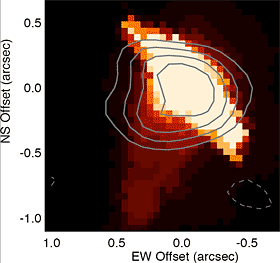
A detailed survey of stars in the Orion Nebula has found that fewer than 10 percent have enough surrounding dust to make Jupiter-sized planets, according to a report by astronomers at the University of California, Berkeley, the California Institute of Technology (Caltech) and the Harvard-Smithsonian Center for Astrophysics.
Because stars like the sun probably formed in hot open clusters like Orion, the finding suggests that sun-like stars have a low probability of forming planets, or at least, planets the size of Jupiter or larger.
"We think that most stars in the galaxy are formed in dense, Orion-like regions, so this implies that systems like ours may be the exception rather than the rule," said lead author Joshua Eisner, a Miller postdoctoral fellow at UC Berkeley. This is consistent with the results of current planet searches, which are finding that only about 6 percent of stars surveyed have planets the size of Jupiter or larger.
The study by Eisner, Caltech astronomer John M. Carpenter and their colleagues will appear in the August 10 print edition of The Astrophysical Journal.
The Orion Nebula is a brilliant cluster only a million years old and glowing with the light of newly formed stars like a jewel in the sword of the hunter Orion. The cluster is also very dense, Eisner said, with 1,000 stars packed into a region several light years on a side. For comparison, in the neighborhood of the sun, there's only one star within that volume of space.
Four billion years ago, however, the sun may have been in a dense, open cluster like Orion. Because open clusters like Orion eventually become gravitationally unbound, they disperse over the course of billions of years, and as a result, the sun's birth neighbors are long gone.
Studying star clusters like the Orion Nebula Cluster "helps our understanding of the typical mode of star and planet formation," Eisner said.
The new findings come from some of the first observations of a radio telescope array jointly operated by UC Berkeley, Caltech, the University of Maryland and the University of Illinois and located at Cedar Flat in eastern California's Inyo Mountains near the city of Bishop. The Combined Array for Research in Millimeter Astronomy (CARMA) was created in 2004 by relocating the nine 6-meter telescopes of the Berkeley-Illinois-Maryland Association (BIMA) array from Hat Creek, Calif., and the six 10-meter telescopes of Caltech's Owens Valley Radio Observatory (OVRO) millimeter-wave array to Cedar Flat. The 15-dish array conducted its first observations in 2006.
The CARMA array observes at millimeter wavelengths, which is ideal for piercing the clouds of dust and gas surrounding young stars to see their dense, dusty disks. Eisner and his colleagues also used the Submillimeter Array (SMA) atop Mauna Kea in Hawaii for this study. The combination of CARMA and the SMA enabled the sensitivity and high image quality needed to observe the dusty disks in Orion.
The astronomers' observations of Orion's central region of more than 250 known stars showed that only about 10 percent emit 1.3-millimeter wavelength radiation typically emitted by a warm disk of dust. Even fewer - less than 8 percent of stars surveyed - were judged to have dust disks with masses greater than one-hundredth the mass of the sun, a mass thought to be the lower limit for formation of Jupiter-sized planets. The average mass of a protoplanetary disk in the region was only one-thousandth of a solar mass, the researchers calculated.
Eisner noted that previous surveys he and Carpenter have conducted of other young, open clusters that are older or younger than Orion show an evolutionary trend in the average masses of disks in the different regions. Older clusters tend to show less dust, perhaps because much of it has already gathered into planets.
Previous surveys of another lower-density, star-forming region - the Taurus cluster - showed that more than 20 percent of its stars have enough mass to form planets. The difference is probably related to the tightly packed, hot stars of the Orion cluster, said Carpenter, a senior research astronomer and deputy director of OVRO.
"Somehow, the Orion cluster environment is not conducive to forming high mass disks or having them survive long, presumably due to the ionization field from the hot, massive OB stars , which you might expect would photoevaporate dust and lead to small disk masses," he said.
Many of the stars in Orion imaged by CARMA had been photographed earlier by the Hubble Space Telescope and were dubbed proplyds, short for protoplanetary disks. While Hubble saw the dust disks silhouetted against the star, CARMA directly detected emissions from the dust itself.
"CARMA is an ideal instrument for this type of study, with its 15 telescopes providing the fine resolution needed to resolve protoplanetary disks so that we can determine their structure and measure their masses more precisely," Eisner said.
Carpenter noted that future improvements to the CARMA array could allow detection of even smaller disks capable of giving rise to sub-Jupiter planets. To detect even smaller disks able to form large Earth-like planets, or super-Earths, will require a more extensive array, such as the Atacama Large Millimeter Array (ALMA) now being built in Chile.
Coauthors on the journal paper are Richard L. Plambeck of UC Berkeley, graduate student Stuartt A. Corder of Caltech and Chunhua Qi and David Wilner of the Harvard Smithsonian Center for Astrophysics, which operates the Submillimeter Array.
Source: UC Berkeley


