NASA's Phoenix Lander Delivers Soil-Chemistry Sample
July 8, 2008 NASA's Phoenix Lander Delivers Soil-Chemistry Sample

Enlarge

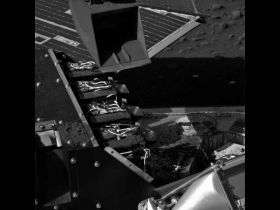
The lander's Robotic Arm scoop positioned over the Wet Chemistry Lab Cell 1 delivery funnel on Sol 41. Image credit: NASA/JPL-Caltech/University of Arizona/Texas A&M University

NASA's Phoenix Mars Lander used its Robotic Arm to deliver a second sample of soil for analysis by the spacecraft's wet chemistry laboratory, data received from Phoenix on Sunday night confirmed.

Results from testing this sample will be compared in coming days to the results from the first Martian soil analyzed by the wet chemistry laboratory two weeks ago. That laboratory is part of Phoenix's Microscopy, Electrochemistry and Conductivity Analyzer.

The main activity on the lander's schedule for today is testing a method for scraping up a sample of icy material and getting it into the scoop at the end of the Robotic Arm. Photography before, during and after the process will allow evaluation of this method.

If the test goes well, the science team plans to use this method for gathering the next sample to be delivered to Phoenix's bake-and-sniff instrument, the Thermal and Evolved-Gas Analyzer.

Source: NASA


print this article email this article download pdf blog this article bookmark this article     Stumble it Digg this share on Facebook retweet share on Reddit add to delicious
Rate this story - 4.5 /5 (17 votes)


July 8, 2008 all stories

Comments: 0

4.5 /5 (17 votes)
  • Stumble this up

  • Digg this

  • share this

  • hide
  • Related Stories

  • Weathering System Cuts Product Testing Time
    created Sep 28, 2009 | popularity not rated yet | comments 0
  • Phoenix Lander Finishes Soil Delivery to Onboard Labs
    created Oct 22, 2008 | popularity not rated yet | comments 0
  • Phoenix Gets Bonus Soil Sample
    created Oct 20, 2008 | popularity not rated yet | comments 0
  • Next Mars Soil Scoop Slated for Last of Lander's Wet Lab Cells
    created Sep 10, 2008 | popularity not rated yet | comments 0
  • Analysis Begins on Deepest Martian Soil Sample
    created Sep 02, 2008 | popularity not rated yet | comments 0


  • hide
  • Relevant PhysicsForums posts

  • The shape of our solar system's orbits.
    created Nov 07, 2009
  • Above or Below the Line of Nodes
    created Nov 07, 2009
  • Supernova vs. Nova?
    created Nov 07, 2009
  • Supernova's Gamma Rays and Comets
    created Nov 06, 2009
  • More from Physics Forums - General Astronomy

Other News

Scientists seek safe carbon dioxide storage for 'greener' power generation (w/ Video)

Space & Earth / Environment

created 15 minutes ago | popularity not rated yet | comments 0

The U.S. Department of Energy (DOE) has announced plans to fund research at the University of Alabama at Birmingham (UAB) School of Engineering on technologies that would help reduce greenhouse gas emissions through the capture ...


Antarctica glacier retreat creates new carbon dioxide store

Antarctica glacier retreat creates new carbon dioxide store

Space & Earth / Earth Sciences

created 3 hours ago | popularity 5 / 5 (1) | comments 1

Large blooms of tiny marine plants called phytoplankton are flourishing in areas of open water left exposed by the recent and rapid melting of ice shelves and glaciers around the Antarctic Peninsula. This ...


Success in 'space elevator' competition (AP)

Success in 'space elevator' competition (Update 3)

Space & Earth / Space Exploration

created Nov 05, 2009 | popularity 4.3 / 5 (33) | comments 53

(AP) -- A robot powered by a ground-based laser beam climbed a long cable dangling from a helicopter on Wednesday to qualify for prize money in a $2 million competition to test the potential reality of the ...


In a Galaxy Far, Far Away...

In a Galaxy Far, Far Away...

Space & Earth / Astronomy

created Nov 06, 2009 | popularity 4.8 / 5 (5) | comments 15

(PhysOrg.com) -- Astronomers have published the discovery of the farthest known object in the cosmos: a star that exploded when the universe was only 630 million years old -- only 4.6% of its current age. ...


'Dropouts' pinpoint earliest galaxies

'Dropouts' pinpoint earliest galaxies

Space & Earth / Astronomy

created Nov 06, 2009 | popularity 4.2 / 5 (10) | comments 13

Astronomers, conducting the broadest survey to date of galaxies from about 800 million years after the Big Bang, have found 22 early galaxies and confirmed the age of one by its characteristic hydrogen signature ...