FLASH Imaging Redux: Nano-Cinema is Born
July 8, 2008
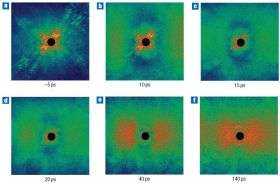
Soft X-rays from the FLASH laser capture the action as a tiny silicon nitride wafer explodes.
Flash imaging of nanoscale objects undergoing ultrafast changes is now a technical possibility, according to a recent paper published in the June 22 edition of Nature Photonics. The results are a direct precursor to research that will be conducted using SLAC’s Linac Coherent Light Source (LCLS).
The experiments, carried out by a team of researchers that included SLAC scientists Sebastien Boutet, Janos Hajdu and Mike Bogen, used the Free-Electron Laser in Hamburg (FLASH laser) at Deutsches Elektronen-Synchrotron (DESY) in Germany.
To create the images, an artificial sample—a silicon nitride wafer less than one thousandth the width of a human hair and etched with a simple nanoscale pattern—was shot with an optical laser, which ultimately caused the tiny wafer to explode. But less than a few billionths of a second (picoseconds) after the first laser—before the sample actually had a chance to disintegrate—a second, soft X-ray laser captured an image of the sample as the disintegration process began.
By repeating the experiment with slight variations in timing between the two lasers, the researchers captured a sequence of images that follow the changes occurring in the sample as it explodes.
Similar to FLASH, the LCLS at SLAC will create ultrafast pulses of coherent X-ray laser light. Pulses from the LCLS, however, will fall in the hard X-ray range, which has a much shorter wavelength, enabling single-shot imaging of even smaller objects, on the scale of individual molecules.
Source: by Brad Plummer, SLAC
-
Shaken, not heated: The ideal recipe for manipulating magnetism
Feb 01, 2012 |
4.8 / 5 (4) |
0
-
Scientists X-ray key enzyme of common pathogen crystallized in living cells
Jan 30, 2012 |
5 / 5 (1) |
0
-
Many bodies make one coherent burst of light: Researchers see superfluorescence from solid-state material
Jan 30, 2012 |
4.8 / 5 (4) |
5
-
PhET simulations provide interactive learning tools
Jan 26, 2012 |
not rated yet |
0
-
World's most powerful X-ray laser creates two-million-degree matter
Jan 25, 2012 |
5 / 5 (15) |
2
-
Engineers build first sub-10-nm carbon nanotube transistor
Feb 01, 2012 |
4.9 / 5 (32) |
30
-
Something old, something new: Evolution and the structural divergence of duplicate genes
Jan 31, 2012 |
4.6 / 5 (7) |
1
-
The hidden nanoworld of ice crystals: Revealing the dynamic behavior of quasi-liquid layers
Jan 30, 2012 |
5 / 5 (4) |
1
-
Stock market network reveals investor clustering
Jan 27, 2012 |
3.9 / 5 (23) |
8
-
Of microchemistry and molecules: Electronic microfluidic device synthesizes biocompatible probes
Jan 26, 2012 |
5 / 5 (2) |
0
-
What would happen when a jet travelling at Mach 10 experiences engine failure
5 hours ago
-
Rust from my microwave ruined a nice bowl of soup and also my day
7 hours ago
-
gas leaks in space
10 hours ago
-
Weight required to balance a boom stand?
12 hours ago
-
Questions about Equivalence principle & Einstein Elevator?
13 hours ago
-
Kinetic energy of gas
15 hours ago
- More from Physics Forums - General Physics
More news stories
Explained: Sigma
It's a question that arises with virtually every major new finding in science or medicine: What makes a result reliable enough to be taken seriously? The answer has to do with statistical significance -- but ...
Feb 09, 2012 |
5 / 5 (19) |
76
Quantum physicist explains $100K offer for proof scaled-up quantum computing is impossible
(PhysOrg.com) -- MIT researcher Scott Aaronson has certainly riled the physics community with his offer this past Friday, of $100,000 to anyone who can prove that scaled-up quantum computing is impossible. ...
Diamond light, brighter than the sun
Its the size of five football pitches and generates light 10 billion times brighter than the sun. As the Diamond Light Source celebrates its tenth anniversary this year, Penny Bailey visits one of the ...
Feb 07, 2012 |
4.4 / 5 (9) |
18
|
Physicists 'record' magnetic breakthrough
An international team of scientists has demonstrated a revolutionary new way of magnetic recording which will allow information to be processed hundreds of times faster than by current hard drive technology.
Feb 07, 2012 |
4.6 / 5 (43) |
14
|
Hints of the Higgs - papers are submitted
Back in December 2011, the ATLAS and CMS experiments at CERN presented some exciting results that provided tantalising hints of the Higgs boson.
Feb 08, 2012 |
4.3 / 5 (8) |
10
Scientists discover molecular secrets of 2,000-year-old Chinese herbal remedy
For roughly two thousand years, Chinese herbalists have treated Malaria using a root extract, commonly known as Chang Shan, from a type of hydrangea that grows in Tibet and Nepal. More recent studies suggest that halofuginone, ...
New method to examine batteries -- MRI from the inside
There is an ever-increasing need for advanced batteries for portable electronics, such as phones, cameras, and music players, but also to power electric vehicles and to facilitate the distribution and storage of energy derived ...
A mitosis mystery solved: How chromosomes align perfectly in a dividing cell
Although the process of mitotic cell division has been studied intensely for more than 50 years, Whitehead Institute researchers have only now solved the mystery of how cells correctly align their chromosomes during symmetric ...
Starve a virus, feed a cure? Findings show how some cells protect themselves against HIV
A protein that protects some of our immune cells from the most common and virulent form of HIV works by starving the virus of the molecular building blocks that it needs to replicate, according to research published online ...
Researchers find extensive RNA editing in human transcriptome
In a new study published online in Nature Biotechnology, researchers from BGI, the world's largest genomics organization, reported the evidence of extensive RNA editing in a human cell line by analysis of RNA-seq data, demons ...
The proteins ensuring genome protection
Researchers from the University of Geneva (UNIGE), Switzerland, have discovered the crucial role of two proteins in developing a cell 'anti-enzyme shield'. This protection system, which operates at the level of molecular ...