New Spray Improves Plants' Cold Tolerance
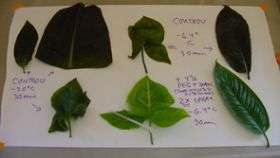
Studies indicate a spray co-developed by a University of Alabama scientist increases plants’ tolerance of cold temperatures by several degrees.
The spray, which is not yet commercially available, can improve plants’ cold tolerance between 2.2 and 9.4 degrees Fahrenheit, depending upon the species, according to Dr. David Francko, a professor of botany who co-developed the spray and who serves as dean of The University of Alabama graduate school and assistant vice president for academic affairs.
Research results indicate the spray, which the developers have named Freeze-Pruf, is effective on a variety of plants, including palms, tropical houseplants, bananas, citrus plants and flowers. Commercial growers, including those growing edible bananas in south Alabama, would benefit from the longer growing season that a more cold tolerant plant would provide.
“It moves your temperature zone about 200 miles, so it’s highly significant,” Francko said of the spray’s impact on banana plants. “For growers in the Mobile area, for example, treated plants would sustain the same damage that someone in Orlando would have who’s not treating their plants.”
Francko, who developed the spray along with Kenneth Wilson, Quinn Li and Alejandra Equiza, all from Miami (Ohio) University, envisions the spray also appealing to backyard gardeners looking to protect flowers from a late frost and nursery owners looking to cash in on an approved appearance for their high dollar ornamentals.
A patent application on the product, a novel mixture that combines five ingredients in a water-based spray formula, was filed earlier this year. The inventors are working with UA’s Office for Technology Transfer on the possibility of licensing the product to a company for commercial production or, alternatively, forming a UA spin-off venture to commercialize the technology.
“Each ingredient has a different function, but when you put them all together you get an effect that is larger than any single component, alone,” Francko said. “It’s non-toxic, it’s cheap, and the idea is to apply it once per season.” Each of the ingredients in Freeze-Pruf is already used, for other reasons, in various foods or in food production.
Francko, who received widespread media attention, including a national television appearance alongside Martha Stewart, following his 2003 publication of “Palms Won’t Grow Here and Other Myths,” called cold tolerance products “one of the holy grails of horticulture.
“There are a number of existing patents designed to improve cold tolerance,” Francko said, “but the best that is out there gets you about 1 to 2 degrees centigrade, or 2 to 4 degrees Fahrenheit, of freeze protection.”
And the existing sprays, Francko says, typically protect plants in weather only as low as the mid to upper 20s Fahrenheit. “Our spray works all the way down to below zero Fahrenheit, depending on the plant you’re working on. It really does take advantage of the plant’s genetic pre-adaptation and improves it.”
Plants naturally use two mechanisms in attempts to survive cold, said Francko, former chair of the department of botany at Miami University in Ohio. Similar to how a vehicle’s radiator contains a cryoprotectant which prevents it from freezing, plants have a built-in non-toxic version which allows cells to “super cool” below the normal temperature at which water freezes. Secondly, Francko said, even when ice does form within some plants, another natural mechanism enables them to sometimes survive ice crystal damage.
“Anything that you do to improve plant cold tolerance, you want to enhance those two mechanisms,” Francko said. “Nothing in our formulation is part of the normal pathway that a plant uses to acclimate to the cold. So, we are adding extra capacity to what the plant normally can do, not replacing or diminishing that native capacity,” said Francko.
Freeze-Pruf lowers both the temperature at which damage first becomes noticeable in plants as well as the temperature that would normally kill the plant, according to the research results. “It protects both the foliage and the flower,” Francko said.
The formula was scientifically tested in the laboratory and in the field, using both visual damage and the results of photosynthetic assays to measure foliar and flower damage. The photosynthetic assay was a biochemical analysis to check the spray’s effectiveness at the sub-cellular level.
The spray is already cost effective, Francko said, and researchers are exploring possible ways to perfect it so even smaller quantities of spray would bring similar results.
Source: University of Alabama


