Fossil feathers preserve evidence of color
July 9th, 2008 Striped Fossil Feather and Recent Woodpecker Feather

Enlarge

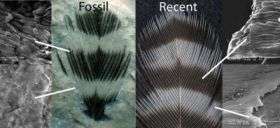
Striped fossil feather and recent woodpecker feather. Under the scanning electron microscope there are melanosomes in the dark but not the light areas (left arrows) of the fossil. For comparison, melanosomes from a broken black feather and a white feather are shown (right arrows). Credit: J.Vinther/Yale

The traces of organic material found in fossil feathers are remnants of pigments that once gave birds their color, according to Yale scientists whose paper in Biology Letters opens up the potential to depict the original coloration of fossilized birds and their ancestors, the dinosaurs.

Closer study of a number of fossilized bird feathers by Yale PhD student Jakob Vinther revealed that organic imprints in the fossils — previously thought to be carbon traces from bacteria — are fossilized melanosomes, the organelles that contain melanin pigment.

"Birds frequently have spectacularly colored plumage which are often used in camouflage and courtship display," said Vinther. "Feather melanin is responsible for rusty-red to jet-black colors and a regular ordering of melanin even produces glossy iridescence. Understanding these organic remains in fossil feathers also demonstrates that melanin can resist decay for millions of years."

Working with Yale paleontologist Derek E. G. Briggs and Yale ornithologist Richard O. Prum, Vinther analyzed a striped feather found in 100 million-year-old rocks from the Lower Cretaceous Period in Brazil. The team used a scanning electron microscope to show that dark bands of the feather preserved the arrangement of the pigment-bearing structures as a carbon residue — organized much as the structures are in a modern feather. The light bands showed only rock surface.

In another fossil of a bird from the Eocene Epoch — 55 million years ago — in Denmark there were similar traces in the feathers surrounding the skull. That fossil also preserved an organic imprint of the eye and showed structures similar to the melanosomes found in eyes of modern birds.

"Many other organic remains will presumably prove to be composed of melanin," said Vinther. He expects that fur of ancient mammals and skin from dinosaurs preserved as organic imprints will likely be the remains of the melanin.

"Now that we have demonstrated that melanin can be preserved in fossils, scientists have a way to reliably predict, for example, the original colors of feathered dinosaurs," said Prum, who is the William Robertson Coe Professor of Ornithology and chair of the Department of Ecology and Evolutionary Biology, as well as curator of ornithology at Yale's Peabody Museum of Natural History.

Source: Yale University


print this article email this article download pdf blog this article bookmark this article     Digg this Stumble it share on Facebook share on Reddit add to delicious save to Yahoo! bookmarks
4.8/5 after 12 votes


July 9th, 2008 all stories
Biology /

Comments: 0
Rank: 4.8/5 after 12 votes

  • Stumble this up

  • Digg this

  • Share it:
  • share on Facebook
  • share on MySpace
  • share on Slashdot
  • rss-newsfeed
  • share on Google
  • share on Reddit
  • add to delicious
  • save to Yahoo! bookmarks
  • share on Windows Live
  • Add to Mixx!
Rating: 4.8/5 after 12 votes

  • Related Stories

  • Mummified dinosaur skin yields up new secrets
    created Jul 01, 2009 | popularity not rated yet | comments 0
  • Nickel isotope may be methane producing microbe biomarker
    created Jun 22, 2009 | popularity not rated yet | comments 0
  • The mystery of particles
    created Jun 19, 2009 | popularity not rated yet | comments 0
  • Geologists demonstrate extent of ancient ice age
    created Jun 16, 2009 | popularity not rated yet | comments 0
  • Mars mission could ease Earth's energy supply crisis
    created Jun 09, 2009 | popularity not rated yet | comments 0


  • Physicists Demonstrate Quantum Memory with Matter Qubits
    Physicists Demonstrate Quantum Memory with Matter Qubits
    Physics / General Physics
    created Jul 03, 2009 | popularity 4.4 / 5 (17) | comments 1
  • 'Holey' Nanosheets for Wastewater Dye Removal
    Nanotechnology / Nanomaterials
    created Jul 01, 2009 | popularity 5 / 5 (5) | comments 1
  • Jellyfish Robot Swims Like its Biological Counterpart
    Jellyfish Robot Swims Like its Biological Counterpart
    Electronics / Robotics
    created Jun 26, 2009 | popularity 4.4 / 5 (8) | comments 1
  • Could Maxwell's Demon Exist in Nanoscale Systems?
    Could Maxwell's Demon Exist in Nanoscale Systems?
    Physics / General Physics
    created Jun 24, 2009 | popularity 4.4 / 5 (18) | comments 29
  • Living Safely with Robots, Beyond Asimov's Laws
    Living Safely with Robots, Beyond Asimov's Laws
    Electronics / Robotics
    created Jun 22, 2009 | popularity 4.6 / 5 (52) | comments 40
  • Other News

    California water plan aims to save Puget Sound orcas

    Biology / Ecology

    created 14 hours ago | popularity not rated yet | comments 0

    A plan to restore salmon runs on California's Sacramento River also could help revive killer whale populations 700 miles to the north in Puget Sound, as federal scientists struggle to protect endangered species in a complex ...


    Scientists 'rebuild' giant moa using ancient DNA

    Biology / Plants & Animals

    created Jul 01, 2009 | popularity 5 / 5 (10) | comments 12

    (PhysOrg.com) -- Scientists have performed the first DNA-based reconstruction of the giant extinct moa bird, using prehistoric feathers recovered from caves and rock shelters in New Zealand.


    Pacific Giant Salamander (Dicamptodon tenebrosus)

    Salamanders, regenerative wonders, heal like mammals, people

    Biology / Microbiology

    created Jul 01, 2009 | popularity 5 / 5 (20) | comments 11

    The salamander is a superhero of regeneration, able to replace lost limbs, damaged lungs, sliced spinal cord -- even bits of lopped-off brain. But it turns out that remarkable ability isn't so mysterious after ...


    Genetically modified trees

    Anti-biotech groups obstruct forest biotechnology

    Biology / Biotechnology

    created Jun 30, 2009 | popularity 3.7 / 5 (7) | comments 5

    The potential of forest biotechnology to help address significant social and environmental issues is being "strangled at birth" by the rigid opposition of some groups and regulations that effectively preclude ...


    Super-sleepers could help super-sizers!

    Super-sleepers could help super-sizers!

    Biology / Plants & Animals

    created Jun 29, 2009 | popularity 5 / 5 (2) | comments 4

    Burrowing frogs can survive buried for several years without food or water. Scientists have discovered that the metabolism of their cells changes radically during the dormancy period allowing the frogs to ...