Big brains arose twice in higher primates
July 9, 2008
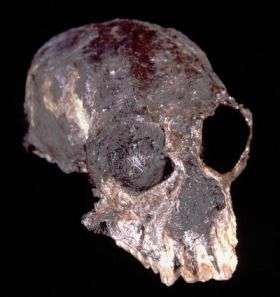
Fossil Chilecebus from South America. Credit: John Weinstein, The Field Museum
After taking a fresh look at an old fossil, John Flynn, Frick Curator of Paleontology at the American Museum of Natural History, and colleagues determined that the brains of the ancestors of modern Neotropical primates were as small as those of their early fossil simian counterparts in the Old World. This means one of the hallmarks of primate biology, increased brain size, arose independently in isolated groups—the platyrrhines of the Americas and the catarrhines of Africa and Eurasia.
"Primatologists have long suspected that increased encephalization may have arisen at different points in the primate evolutionary tree, but this is the first clear demonstration of independent brain size increase in New and Old World anthropoids," says Flynn of the paper that appeared in the Museum's publication Novitates this June. Encephalization is the increase in brain size relative to body size. Animals with large encephalization quotients (E.Q.'s) are those with bigger brains relative to their body size in comparison to the average for an entire group. Most primates and dolphins have high E.Q.'s relative to other mammals, although some primates (especially apes and humans) have higher E.Q.'s than others.
At the heart of the new paper is the development of more accurate equations for estimating body size in platyrrhines, or New World "monkeys." Most fossils are fragments of skulls or teeth so, to help in estimating their body size (and then E.Q.), Flynn and colleagues collected 80 measurements of the skulls, jaws, and teeth of 17 different species of living New World monkeys that ranged across the full spectrum of body sizes. This study is one of the first to estimate body size with platyrrhines instead of their better-studied counterparts from the Old World, and this detailed analysis uses new statistical approaches to tease out which characteristics correlate best with body size. The goal is to apply this equation to fossilized specimens.
Chilecebus, found high in the Andes and described by Flynn and collaborators in 1995 in Nature, is one such fossil. The skull dates to 20 million years ago and is the oldest and most complete well-dated primate skull from the New World. In the Novitates paper, Flynn and colleagues more accurately estimate that Chilecebus weighed about 583 grams and had an E.Q. of only 1.11—a much smaller relative brain size than any living New or Old World anthropoid, which have E.Q.'s ranging from 1.39-2.44 (and even higher for humans).
"The result is clear: early fossil members of both the New World and Old World anthropoid lineages had small brain sizes, thus the larger brain sizes seen in both groups today must have arisen independently," says Flynn. "Documenting that large brains evolved separately several times within Primates will enhance understanding of the timing and pathways of brain expansion and its effects on skull growth and shape, and may lead to new insights into the genetic controls on encephalization."
Eric Delson, the Chair of Anthropology at Lehman College, City University of New York and a Research Associate at the Museum, concurs. "This work confirms that brain size increase may be one of the common characteristics of all primates," he says. "The relatively small brain of Chilecebus contrasts with that of the slightly younger (16.5 million years ago), larger brained fossil Killikaike found in Argentina and described two years ago. It is probable that brain size also increased independently in the lemurs of Madagascar, as well as in the apes (of which humans are the extreme case) and the cercopithecid monkeys of Africa and Asia."
Source: American Museum of Natural History
-
Mental gyms reap younger minds
Feb 02, 2012 |
3 / 5 (2) |
0
-
Could brain size determine whether you are good at maintaining friendships?
Feb 02, 2012 |
3 / 5 (11) |
9
-
Shrew whiskers inspire ground-breaking robot design
Jan 23, 2012 |
4.7 / 5 (6) |
11
-
Weird gadgets at CES: Motorized unicycle, anyone?
Jan 16, 2012 |
2.4 / 5 (5) |
1
-
Planned actions improve the way we process information
Jan 16, 2012 |
not rated yet |
0
-
Engineers build first sub-10-nm carbon nanotube transistor
Feb 01, 2012 |
4.9 / 5 (31) |
30
-
Something old, something new: Evolution and the structural divergence of duplicate genes
Jan 31, 2012 |
4.6 / 5 (7) |
1
-
The hidden nanoworld of ice crystals: Revealing the dynamic behavior of quasi-liquid layers
Jan 30, 2012 |
5 / 5 (3) |
1
-
Stock market network reveals investor clustering
Jan 27, 2012 |
3.9 / 5 (23) |
8
-
Of microchemistry and molecules: Electronic microfluidic device synthesizes biocompatible probes
Jan 26, 2012 |
5 / 5 (1) |
0
More news stories
The power of estrogen -- male snakes attract other males
A new study has shown that boosting the estrogen levels of male garter snakes causes them to secrete the same pheromones that females use to attract suitors, and turned the males into just about the sexiest ...
16 hours ago |
4.8 / 5 (6) |
1
|
Grass to gas: Researchers' genome map speeds biofuel development
Researchers at the University of Georgia have taken a major step in the ongoing effort to find sources of cleaner, renewable energy by mapping the genomes of two originator cells of Miscanthus x giganteus, a large perenn ...
13 hours ago |
3.8 / 5 (5) |
0
|
Miami battling invasion of giant African snails
No one knows how they got there. But an invasion of African giant snails has southern Florida in a panic over potential crop damage, disease and general yuckiness surrounding the slimy gastropods.
20 hours ago |
4 / 5 (1) |
4
Experts reveal how plants don't get sunburn
(PhysOrg.com) -- Experts at the University of Glasgow have discovered how plants survive the harmful rays of the sun.
16 hours ago |
4.8 / 5 (5) |
0
|
Protein libraries in a snap
(PhysOrg.com) -- A Rice University undergraduate will depart with not only a degree but also a possible patent for his invention of an efficient way to create protein libraries, an important component of biomolecular ...
19 hours ago |
4.8 / 5 (4) |
1
|
Anonymous knocks CIA website offline (Update)
The website of the Central Intelligence Agency was inaccessible on Friday after the hacker group Anonymous claimed to have knocked it offline.
Google users warned of threat to smartphone wallets
Users of Google smartphone wallets were being warned on Friday that there is a way to crack pass codes intended to thwart thieves from going on illicit shopping sprees.
New error-correcting codes guarantee the fastest possible rate of data transmission
Error-correcting codes are one of the triumphs of the digital age. Theyre a way of encoding information so that it can be transmitted across a communication channel such as an optical fiber o ...
Humans may have helped the decline of African rainforests 3000 years ago
(PhysOrg.com) -- Large areas of rainforests in Central Africa mysteriously disappeared over three thousand years ago, to be replaced by savannas. The prevailing theory has been that the cause was a change ...
New power source discovered
(PhysOrg.com) -- Researchers at the Massachusetts Institute of Technology (MIT) and RMIT University have made a breakthrough in energy storage and power generation.
Small modular reactor design could be a 'SUPERSTAR'
(PhysOrg.com) -- Though most of today's nuclear reactors are cooled by water, we've long known that there are alternatives; in fact, the world's first nuclear-powered electricity in 1951 came from a reactor ...
Jul 09, 2008
Rank: 1 / 5 (2)