Researchers find new mode of gene regulation in mammals
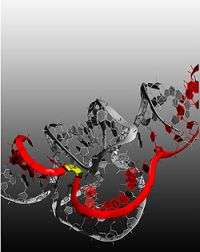
Researchers at the University of California, Santa Cruz, have discovered a type of gene regulation never before observed in mammals--a "ribozyme" that controls the activity of an important family of genes in several different species.
The findings, published July 9 in the journal Nature, describe a new and surprising role for the so-called hammerhead ribozyme, an unusual molecule previously associated with obscure virus-like plant pathogens called viroids. The UCSC researchers found the ribozyme embedded within certain genes in mice, rats, horses, platypuses, and several other mammals. The genes are involved in the immune response and bone metabolism.
"The unique thing about these ribozymes is that they control the expression of the genes they're embedded in," said Monika Martick, a UCSC postdoctoral researcher and first author of the Nature paper.
A ribozyme, or "RNA enzyme," is an RNA molecule that can catalyze a chemical reaction. RNA is better known for its ability to encode genetic information, while most biological reactions are carried out by enzymes made of protein. Scientists are discovering, however, that RNA is a remarkably versatile type of molecule.
"RNA can function in the biology of organisms in more ways than we tend to give it credit for," said coauthor Lucas Horan, a graduate student in molecular, cell, and developmental biology at UCSC.
When a gene is activated or "expressed," its DNA sequence on the chromosome is transcribed into an RNA molecule called a messenger RNA. The messenger RNA sequence is then translated into the amino acid sequence of a protein molecule, and the protein then carries out the gene's function in the cell.
In the genes studied by Martick and Horan, the messenger RNA contains sequences that assemble to form an active hammerhead ribozyme. The hammerhead ribozyme is a self-cleaving molecule that essentially cuts itself in two. This self-cleaving action in the messenger RNAs effectively turns off the genes by preventing protein translation. Presumably, another mechanism exists to turn on the genes by stopping the self-cleaving action of the ribozyme.
"We don't know what the switch is to shut off the action of the ribozyme, but we assume there is one," Martick said.
She and her coauthors are all affiliated with UCSC's Center for the Molecular Biology of RNA, directed by Harry Noller, Sinsheimer professor of molecular biology. As a graduate student working with William Scott, professor of chemistry and biochemistry, Martick had determined the three-dimensional structure of the hammerhead ribozyme (see earlier press release at press.ucsc.edu/text.asp?pid=907).
Scott and his research group have been working on the structure and mechanism of the hammerhead ribozyme since before his arrival at UCSC in 1998. "This is the most remarkable and unexpected discovery I have seen during that time," he said.
For the new study, Martick teamed up with Horan, a graduate student in Noller's lab. Scott and Noller are both coauthors of the Nature paper.
"Monika clued me in that she had found something interesting, and we decided to try to figure out what was going on," Horan said. "She had just finished her Ph.D., and I was working on something else, but we got some preliminary data and it turned out to be a very fruitful collaboration; it's the kind of interaction that the RNA Center is meant to stimulate."
Martick performed the initial searches that turned up the hammerhead ribozyme sequences in the mouse and rat genomes. Then she and Horan did more exhaustive searches of the genomic sequences of other organisms, using the UCSC Genome Browser and other databases. They found the ribozyme in related genes in the mouse, rat, horse, and platypus, and in unknown genes in five other mammals.
"We used to think the hammerhead ribozyme was restricted to obscure plant viruses, but it now looks like it is featured much more prominently in mammalian biological systems," Scott said.
Laboratory experiments showed that the messenger RNAs containing the embedded sequences form an active ribozyme and that the ribozyme decreases gene activity in mammalian cells.
"This mode of gene regulation hadn't been seen before in mammals," Horan said. "Because it occurs in such a wide variety of organisms, including the platypus, it must have been around since the early mammalian ancestors."
The researchers did not find the ribozyme sequence in the corresponding human genes, however, suggesting that a different mechanism regulates those genes in humans.
"These genes are involved in the immune response and in bone metabolism, so they are being intensively studied on two fronts," Martick said. "It's important to understand how that system is regulated and if the rodent system is regulated differently from the human system."
Source: University of California - Santa Cruz


