Moon water discovered: Dampens Moon-formation theory
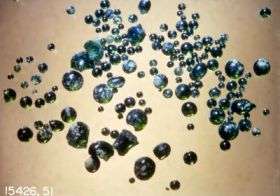
July 9, 2008 Watery Glasses

Enlarge

Researchers analyzed lunar volcanic glasses, such these gathered by the Apollo 15 mission, and used a new analytic technique to detect water. The discovery strongly suggests that water has been a part of the moon since its early existence -- and perhaps since it was first created. Credit: NASA

Using new techniques, scientists have discovered for the first time that tiny beads of volcanic glasses collected from two Apollo missions to the Moon contain water. The researchers found that, contrary to previous thought, water was not entirely vaporized in the violent events that formed the Moon. The new study suggests that the water came from the Moon's interior and was delivered to the surface via volcanic eruptions over 3 billion years ago. The finding calls into question some critical aspects of the "giant impact" theory of the Moon's formation and may have implications for the origin of possible water reservoirs at the Moon's poles. The research is published in the July 10, 2008, issue of Nature.

It is believed that the Moon was formed when a Mars-size body collided with Earth some 4.5 billion years ago. This "giant impact" melted both objects and sent molten debris into orbit around the Earth, some of which coalesced to form the Moon. Under this scenario, the heat from the giant impact would have vaporized the light elements.

Over the past forty years there have been significant efforts to determine the content and origin of the volatile contents in the lunar samples. There is reliable evidence that the Moon's interior contains sulfur, some chlorine, fluorine, and carbon. Yet the evidence for indigenous H2O has remained elusive, consistent with the general consensus that the Moon is dry.

The research team, with scientists from Brown University, Carnegie Institution for Science, and Case Western Reserve University, took advantage of new methods for analyzing lunar samples to detect tiny amounts of water. Co-author of the paper, Erik Hauri of the Carnegie's Department of Terrestrial Magnetism, developed new techniques that can detect extremely minute quantities of water in glasses and minerals by the technology called secondary ion mass spectrometry (SIMS). These technical advances were made in collaboration with engineers from Cameca Instruments (France), who manufactured the NanoSIMS instrument used to make these challenging measurements.

"For the past four decades, the limit for detecting water in lunar samples was about 50 parts per million (ppm) at best," explained Hauri. "We developed a way to detect as little as 5 ppm of water. We were really surprised to find a great deal more in these tiny glass beads, up to 46 ppm."

One glass bead told the tale of what happened. The researchers found that the volatiles decreased from the tiny sphere's core to its rim—a difference that indicates that some 95% of the water was lost during the volcanic activity. James Van Orman, a former Carnegie postdoc now at Case Western Reserve University, was one of the team members who wrote the numerical model. "We looked at many factors over a wide range of cooling rates that would affect all the volatiles simultaneously and came up with the right mix. A droplet cooling at a rate of about 3° F to 6° F per second over 2 to 5 minutes between the time of eruption and when the material was quenched or rapidly cooled matched the profiles for all the volatiles, including the loss of about 95% of the water," he said.

The researchers estimated that there was originally about 750 ppm of water in the magma at the time of eruption. "Since the Moon was thought to be perfectly dehydrated, this is a giant leap from previous estimates," continued Hauri. "It suggests the intriguing possibility that the Moon's interior might have had as much water as the Earth's upper mantle. But even more intriguing: If the Moon's volcanoes released 95% of their water, where did all that water go?"

Since the Moon's gravity is too feeble to retain an atmosphere, the researchers speculate that some of the water vapor from the eruptions was probably forced into space, but some may also have drifted toward the cold poles of the Moon where ice may be present in permanently shadowed craters. Several previous lunar missions have suggested the presence of ice at both poles. Unless it is very deep, lunar groundwater is unlikely to exist since the Sun heats most of the Moon's surface to over 200°F (100°C).

Lead author of the study, Alberto Saal of Brown University remarked: "Beyond the evidence for the presence of water in the interior of the Moon, which I found extremely exciting, I learned that the contributions from scientists from other disciplines has the potential to produce unexpected results. Such a scientist is able not only to ask questions that no one has asked before, but also can challenge hypotheses that are embedded in the thinking of the scientists working in the field for many years. Our case is a typical example. When I suggested we measure volatiles in lunar material, everyone I talked to thought that such proposal was a futile endeavor. We 'knew' the Moon was dry."

Many scientists have believed the Moon's polar ice, if there, originated from impacts of water-rich meteoroids and comets that struck the Moon's surface over its history. The new study suggests that some of this water could have come from lunar volcanic eruptions. Verifying that water is at the Moon's poles is one goal of the NASA Lunar Reconnaissance Orbiter mission, due to launch later this year. And it is the primary objective of the Lunar Crater Observation and Sensing Satellite with a 2009 launch date. Verification of water on the Moon's surface is an important step in progress toward an eventual manned lunar outpost.

Source: Carnegie Institution


print this article email this article download pdf blog this article bookmark this article     Stumble it Digg this share on Facebook retweet share on Reddit add to delicious
Rate this story - 4.7 /5 (66 votes)

Rank Filter

Move the slider to adjust rank threshold, so that you can hide some of the comments.


Display comments: newest first

  • thales - Jul 09, 2008
    • Rank: 1.3 / 5 (22)
    In the six hundredth year of Noah's life, in the second month, on the seventeenth day of the month, on the same day all the fountains of the great deep burst open, and the floodgates of the sky were opened.
    - Genesis 7:11
  • Sean_W - Jul 09, 2008
    • Rank: 3.3 / 5 (16)
    Paul Bunyan is said to have driven whales out of the Great Lakes by attempting to harness them for hauling logs.

    So what.
  • Truth - Jul 09, 2008
    • Rank: 3.5 / 5 (16)
    Actually, Zeus lit a fire and sent smoke signals to his friend Sasquatch so that together they could have a fish fry...but his wife hit him over the head with a bible and told him to go make a moon instead...
  • Truth - Jul 09, 2008
    • Rank: 2.5 / 5 (14)
    okay, this is not about the moon but about those horrible pictures on the right showing unfortunate kids with deformed faces...how low will these so-called "charities" go in an attempt to get your cash??? And how low will physorg.com go in accepting these horrendous ads for "charities" that have been proven to be bogus money machines?? I thought lawyers were the bottom-feeders of society, but now....I just don't know...
  • Mercury_01 - Jul 09, 2008
    • Rank: 3 / 5 (11)
    Yeah, Im tired of looking at those ugly bastards. Oh, and by the way, it was Marduk who slain the mighty Tiamat that created the moon.

    tiamat is said to be the mars sized object that struck the earth. They say the rest of her is in the asteroid belt, and that the moon is the largest chunk left over fom the collision.

    this is based on the epic of gilgamesh, and even if you dont believe in the work of zacharia sitchin, (which I dont believe 75% of it) the text is a thought provoking read. It talks of these "gods" setting up temples on the earth, creating man out of the blood of one of the gods who was sacraficed. This part, I havent excluded as truth.
  • OckhamsRazor - Jul 09, 2008
    • Rank: 3.6 / 5 (14)
    In the six hundredth year of Noah's life, in the second month, on the seventeenth day of the month, on the same day all the fountains of the great deep burst open, and the floodgates of the sky were opened.
    - Genesis 7:11


    Uh huh. This holds about as much relevance as my left pinky. You're trying to explain this with an excerpt from a farcical historical account which is claiming a human being lived to over 600 years old in the same sentence.

    Also, I'm not getting the pictures of kids but I do keep getting the flashing Free Music Listen Now advert.
  • Arikin - Jul 10, 2008
    • Rank: 4.5 / 5 (8)
    Umm... maybe water is common in our solar system?? Or maybe the moon formed like a planet but got caught by the earth?

    Wait until we can track every atom in our solar system, reverse engineer the current motion back to the beginning, and then we will know for sure. :-)
  • lowbatteries - Jul 10, 2008
    • Rank: 2.9 / 5 (9)
    Its crazy to me how little we know about even our closest solar neighbor.

    Genesis 7/11 - open all night to quench your thirst with God's slurpee.
  • El_Nexus - Jul 10, 2008
    • Rank: 4.8 / 5 (6)
    Let's assume the Moon started out fully molten with all its materials, rock, iron, water, etc all mixed up uniformly. The materials would tend to separate out, with iron sinking to the middle and lighter materials rising to the surface. Water, especially water vaporized by the heat of the young molten moon, would be the first thing to rise to the top and boil off into space.

    What I'm not convinced of is that all of it would have got to the surface before the moon's crust cooled and became solid. After all, we know that Moon rocks contain remnants iron and titanium and other things that mostly sank to the core. Why shouldn't the Moon's interior still contain traces of water?
  • DGBEACH - Jul 10, 2008
    • Rank: 3.9 / 5 (7)
    In the six hundredth year of Noah's life, in the second month, on the seventeenth day of the month, on the same day all the fountains of the great deep burst open, and the floodgates of the sky were opened.
    - Genesis 7:11


    Actually Thales if you read Genesis from the beginning, you'll see that it recounts a time when the earth was actually "surrounded" by all that water (it was already here)...in that there were heavens between the waters above and the waters below (ie free space, an atmosphere)Gen 1:6-8. The flood occurred when God released all that water onto the surface.

    ...I'm not saying that this is what happened, only that this is what's written in the Bible.

  • Lord_jag - Jul 10, 2008
    • Rank: 3.8 / 5 (6)
    I thought commets and asteroids commonly had frozen water throughout it. All this space junk has been landing on the moon for million (billions?) of years since this suggested collision. What we see in the dust on the surface of the moon means nothing to it's inner makup any more than analysing the dustbunnies ontop of a vase determine the vase's chemical makup.
  • Damon_Hastings - Jul 12, 2008
    • Rank: 4.5 / 5 (2)
    Lord_jag: this analysis was done with volcanic glass, which is known to come from the interior of the Moon. Comet and asteroid impacts can also create glass, but it's shaped differently and has a different makeup.
  • xen_uno - Jul 13, 2008
    • Rank: 2 / 5 (1)
    Paul Bunyan was a dick ... and a union buster. When the whales wanted to organize for much the same reasons humans do, he brought in sharks and piranhas to harass and intimidate. The whales left the great lakes never to return.

    Consider this: Humans were too barbaric and un-civilized as a whole 2100 years ago to ever write the kind and gentle moral components of the bible. It would make sense that they had help. I would wager that some diplomatic relations between the whales and humans was set up and that it was the whales that thought up the compassionate parts (love thy fellow man) and definitely the 10 commandments. The humans returned the favor through the years by mercilessly hunting them to near extinction. How's that for a big thank you?
  • OckhamsRazor - Jul 14, 2008
    • Rank: 2 / 5 (1)
    Paul Bunyan was a dick ... and a union buster. When the whales wanted to organize for much the same reasons humans do, he brought in sharks and piranhas to harass and intimidate. The whales left the great lakes never to return.

    Consider this: Humans were too barbaric and un-civilized as a whole 2100 years ago to ever write the kind and gentle moral components of the bible. It would make sense that they had help. I would wager that some diplomatic relations between the whales and humans was set up and that it was the whales that thought up the compassionate parts (love thy fellow man) and definitely the 10 commandments. The humans returned the favor through the years by mercilessly hunting them to near extinction. How's that for a big thank you?


    Right?

    Lol...but you're right about the gentle whales and human barbarity, only wrong in that past tense means humans are no longer as barbaric and un-civilised. We still are.

    Is it so unreasonable to think the moon formed like other moons out there? There were already little things here and there that went against the impact theory, like the lack of evidence of its effect on Earth. Considering how vast in size and composition the other natural satellites are from one another, it's possible there is much more hiding under the surface we haven't thought of yet.

July 9, 2008 all stories

Comments: 14

4.7 /5 (66 votes)
  • Stumble this up

  • Digg this

  • share this

  • hide
  • Related Stories

  • Cassini Sends Back Images of Enceladus as Winter Nears
    created 8 hours ago | popularity not rated yet | comments 0
  • Before Darkness Falls: Cassini to Scan Enceladus on Winter's Cusp
    created Nov 20, 2009 | popularity not rated yet | comments 0
  • NASA 'Drops' Next Generation Robotic Lander During Autonomous Tests
    created Nov 16, 2009 | popularity not rated yet | comments 0
  • LCROSS Impact Finds Water on the Moon
    created Nov 13, 2009 | popularity not rated yet | comments 0
  • Distal Rampart of Crater in Chryse Planitia
    created Nov 13, 2009 | popularity not rated yet | comments 0


  • hide
  • Relevant PhysicsForums posts

  • Semi-major axis from cartesian co-ordinates
    created 9 hours ago
  • Primary Mirror grinding
    created 11 hours ago
  • dark energy can escape black holes.
    created 20 hours ago
  • Are there green, purple and pink stars?
    created Nov 22, 2009
  • Sideral question
    created Nov 21, 2009
  • Doppler shifted blackbody spectrum
    created Nov 21, 2009
  • More from Physics Forums - General Astronomy

Other News

New computer-developed map shows more extensive valley network on Mars

New computer-developed map shows more extensive valley network on Mars

Space & Earth / Space Exploration

created 11 hours ago | popularity 4.6 / 5 (7) | comments 0

New research adds to the growing body of evidence suggesting the Red Planet once had an ocean.


Supervolcano eruption -- in Sumatra -- deforested India 73,000 years ago

Supervolcano eruption -- in Sumatra -- deforested India 73,000 years ago

Space & Earth / Earth Sciences

created 12 hours ago | popularity 4.3 / 5 (10) | comments 2

A new study provides "incontrovertible evidence" that the volcanic super-eruption of Toba on the island of Sumatra about 73,000 years ago deforested much of central India, some 3,000 miles from the epicenter, ...


Is global warming unstoppable?

Space & Earth / Environment

created 21 hours ago | popularity 3.9 / 5 (25) | comments 23

In a provocative new study, a University of Utah scientist argues that rising carbon dioxide emissions - the major cause of global warming - cannot be stabilized unless the world's economy collapses or society builds the ...


Spitzer Telescope Observes Baby Brown Dwarf

Spitzer Telescope Observes Baby Brown Dwarf

Space & Earth / Astronomy

created 9 hours ago | popularity 4.9 / 5 (7) | comments 0

(PhysOrg.com) -- NASA's Spitzer Space Telescope has contributed to the discovery of the youngest brown dwarf ever observed -- a finding that, if confirmed, may solve an astronomical mystery about how these ...


Scientist: Leak of climate e-mails appalling

Space & Earth / Environment

created 15 hours ago | popularity 3.2 / 5 (10) | comments 8

(AP) -- A leading climate change scientist whose private e-mails are included in thousands of documents that were stolen by hackers and posted online said Sunday the leaks may have been aimed at undermining next month's ...