Artificial intelligence takes home the pot at the poker table
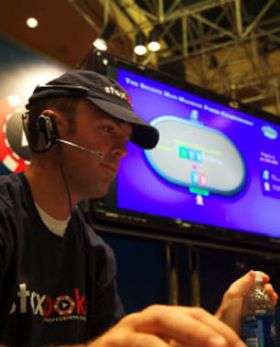
Last weekend, the best man at the table was a machine. Polaris, the University of Alberta poker playing computer program, took on professional players in Las Vegas and came out on top. Like last year's challenge, when the program was edged out in the final match, the final result came down to the wire.
"This year we were down with two matches to go," said Michael Bowling, leader of the university's computer poker research group. "We were just shaking our heads, wondering how we'd gotten so far down."
But when the numbers from the last matches were on the screen, it became clear that Polaris had caught up and was ensured a win.
"It's hard to describe how good that felt," said Bowling. "As a group, we may not all be great poker players, but all of us really, really want to win."
After last year's loss, the U of A team made some changes to bring their program up to snuff. Of course, when training for any competition, practice is the key. To get ready for the match, Polaris played eight billion games of poker-against itself.
"Polaris has a more sophisticated learning component this year," said Bowling. "It identifies a set of styles of playing that it thinks are effective poker strategies and it can decide which strategy will counter the styles of its opponent. As the games progressed, we were seeing different sides of Polaris. Players watching one match might assume that Polaris plays a certain way, and then they'd face a completely different strategy when they sat down to play."
Polaris faced a number of opponents, including Stoxpoker.com coaches Nick Grudzien and IJay Palansky, as well as contributor Matt Hawrilenko, each of whom can boast more than $1 million USD in lifetime winnings. This year's match ran concurrently with the 2008 World Series of Poker as part of the 2008 Gaming Life Expo at the Rio All-Suite Hotel & Casino.
The program played the professional players in a game of limit Texas Hold'em poker. Each match consisted of 500 hands, with the cards dealt in duplicate, meaning that Polaris received the same cards in one room that the professional received in the other room and vise versa. The duplicate system was employed to balance out the luck of the cards and emphasize the capabilities of the participants.
"It's possible, given enough computing power, for computers to play 'perfectly,' where over a long enough match, the program cannot lose money," said Bowling. "Humans will always make some mistakes, meaning the program will have an advantage."
The competition wasn't all fun and games, however. Progress in developing artificial intelligence that can excel at poker can lead to some real-world solutions, says Bowling.
"Other games that have been solved by computers, like checkers or chess, are 'perfect information' games, meaning there is a limited number of possible moves and outcomes to be calculated, and each opponent has the same amount of information about those possibilities," he said. "When you look at games where players are asked to make decisions with different amounts of information, missing information, poker is the quintessential game.
"In general, problems in the real world are going to be more like poker than chess. You're not always going to have all the information."
While they are taking time to savour the victory, Polaris' programmers aren't about to rest on their laurels.
"This was really the simplest form of poker," said Bowling. "There's a lot more we can look at, such as playing without betting limits, or playing with more than two opponents. One of the reasons I got excited about this line of research is that it's not just a one-off. It's a really challenging path of research."
The department of computing science at the University of Alberta is one of the foremost institutions in the world to study artificial intelligence. The university's computer poker research group consists of 15 researchers and graduate and undergraduate students whose primary focus is artificial intelligence.
Source: University of Alberta


