Ocean Wind Power Maps Reveal Possible Wind Energy Sources
July 9, 2008
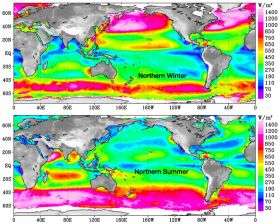
This is a portion of an image of QuikSCAT data that shows wind power density over global oceans for winter (top panel) and summer (lower panel) in the Northern Hemisphere. Red and white colors indicate high energy are available while blue color reflects lower energy. Image courtesy: NASAJPL
Efforts to harness the energy potential of Earth's ocean winds could soon gain an important new tool: global satellite maps from NASA. Scientists have been creating maps using nearly a decade of data from NASA's QuikSCAT satellite that reveal ocean areas where winds could produce wind energy.
The new maps have many potential uses including planning the location of offshore wind farms to convert wind energy into electric energy. The research, published this week in Geophysical Research Letters, was funded by NASA's Earth Science Division, which works to advance the frontiers of scientific discovery about Earth, its climate and its future.
"Wind energy is environmentally friendly. After the initial energy investment to build and install wind turbines, you don't burn fossil fuels that emit carbon," said study lead author Tim Liu, a senior research scientist and QuikSCAT science team leader at NASA's Jet Propulsion Laboratory in Pasadena, Calif. "Like solar power, wind energy is green energy."
QuikSCAT, launched in 1999, tracks the speed, direction and power of winds near the ocean surface. Data from QuikSCAT, collected continuously by a specialized microwave radar instrument named SeaWinds, also are used to predict storms and enhance the accuracy of weather forecasts.
Wind energy has the potential to provide 10 to 15 percent of future world energy requirements, according to Paul Dimotakis, chief technologist at JPL. If ocean areas with high winds were tapped for wind energy, they could potentially generate 500 to 800 watts of energy per square meter, according to Liu's research. Dimotakis notes that while this is slightly less than solar energy (which generates about one kilowatt of energy per square meter), wind power can be converted to electricity more efficiently than solar energy and at a lower cost per watt of electricity produced.
According to Liu, new technology has made floating wind farms in the open ocean possible. A number of wind farms are already in operation worldwide. Ocean wind farms have less environmental impact than onshore wind farms, whose noise tends to disturb sensitive wildlife in their immediate area. Also, winds are generally stronger over the ocean than on land because there is less friction over water to slow the winds down - there are no hills or mountains to block the wind's path.
Ideally, offshore wind farms should be located in areas where winds blow continuously at high speeds. The new research identifies such areas and offers explanations for the physical mechanisms that produce the high winds.
An example of one such high-wind mechanism is located off the coast of Northern California near Cape Mendocino. The protruding land mass of the cape deflects northerly winds along the California coast, creating a local wind jet that blows year-round. Similar jets are formed from westerly winds blowing around Tasmania, New Zealand, and Tierra del Fuego in South America, among other locations. Areas with large-scale, high wind power potential also can be found in regions of the mid-latitudes of the Atlantic and Pacific oceans, where winter storms normally track.
The new QuikSCAT maps, which add to previous generations of QuikSCAT wind atlases, also will be beneficial to the shipping industry by highlighting areas of the ocean where high winds could be hazardous to ships, allowing them to steer clear of these areas.
Scientists use the QuikSCAT data to examine how ocean winds affect weather and climate, by driving ocean currents, mixing ocean waters, and affecting the carbon, heat and water interaction between the ocean and the atmosphere.
Source: NASA
-
U.S. to lease waters off Mid-Atlantic for wind farms
Feb 07, 2012 |
1 / 5 (1) |
0
-
Study of Maryland demonstrates Mid-Atlantic offshore wind capacity
Jan 30, 2012 |
5 / 5 (3) |
7
-
NASA sees a weakening Cyclone Funso's 'closed eye'
Jan 28, 2012 |
not rated yet |
0
-
2011 a record-breaking year for extreme weather: US
Jan 19, 2012 |
3.7 / 5 (6) |
6
-
Surfboard-sized drones crossing pacific to monitor sea surface
Jan 18, 2012 |
4.8 / 5 (5) |
1
-
Engineers build first sub-10-nm carbon nanotube transistor
Feb 01, 2012 |
4.9 / 5 (33) |
30
-
Something old, something new: Evolution and the structural divergence of duplicate genes
Jan 31, 2012 |
4.6 / 5 (7) |
1
-
The hidden nanoworld of ice crystals: Revealing the dynamic behavior of quasi-liquid layers
Jan 30, 2012 |
5 / 5 (4) |
1
-
Stock market network reveals investor clustering
Jan 27, 2012 |
3.9 / 5 (23) |
8
-
Of microchemistry and molecules: Electronic microfluidic device synthesizes biocompatible probes
Jan 26, 2012 |
5 / 5 (2) |
0
-
Do some geologists actually act a lot like Randy Marsh?
Feb 11, 2012
-
Discrepancy between oxygen and carbon-dioxide levels
Feb 09, 2012
-
where gems are found in the world
Feb 09, 2012
-
Wind Waves in Reservoir ~ Wind run-up and Wind set-up
Feb 08, 2012
-
Balance of oxygen in the atmosphere
Feb 01, 2012
-
The case for a methanol-based economy
Jan 30, 2012
- More from Physics Forums - Earth
More news stories
Salvage workers begin pumping fuel from Italian shipwreck
Salvage workers Sunday began pumping fuel from the shipwrecked Italian cruise liner Costa Concordia, a day ahead of schedule, officials said.
5 hours ago |
not rated yet |
0
Latin America mining boom clashes with conservation
Latin America is experiencing a mining boom as prices rise fuelled by a hike in global demand, but the region is also being hit by a wave of violent protests, strikes and rallies by environmentalists.
13 hours ago |
5 / 5 (1) |
1
Political leaders play key role in how worried Americans are by climate change: study
More than extreme weather events and the work of scientists, it is national political leaders who influence how much Americans worry about the threat of climate change, new research finds.
Feb 06, 2012 |
5 / 5 (7) |
73
NASA budget will axe Mars deal with Europe: scientists
US President Barack Obama's budget proposal to be submitted next week for 2013 will cut NASA's budget by 20 percent and eliminate a major partnership with Europe on Mars exploration, scientists said Thursday.
Space & Earth / Space Exploration
Feb 10, 2012 |
5 / 5 (3) |
58
Humans may have helped the decline of African rainforests 3000 years ago
(PhysOrg.com) -- Large areas of rainforests in Central Africa mysteriously disappeared over three thousand years ago, to be replaced by savannas. The prevailing theory has been that the cause was a change ...
Declining health-care productivity in England: Who says so?
Reports that the National Health Service in England has been declining in productivity in the last decade appear to have been accepted as fact. However, a Viewpoint published Online First by The Lancet disputes this. The Vi ...
Scientists discover molecular secrets of 2,000-year-old Chinese herbal remedy
For roughly two thousand years, Chinese herbalists have treated Malaria using a root extract, commonly known as Chang Shan, from a type of hydrangea that grows in Tibet and Nepal. More recent studies suggest that halofuginone, ...
New method to examine batteries -- MRI from the inside
There is an ever-increasing need for advanced batteries for portable electronics, such as phones, cameras, and music players, but also to power electric vehicles and to facilitate the distribution and storage of energy derived ...
Overeating may double risk of memory loss
New research suggests that consuming between 2,100 and 6,000 calories per day may double the risk of memory loss, or mild cognitive impairment (MCI), among people age 70 and older. The study was released today and will be ...
A mitosis mystery solved: How chromosomes align perfectly in a dividing cell
Although the process of mitotic cell division has been studied intensely for more than 50 years, Whitehead Institute researchers have only now solved the mystery of how cells correctly align their chromosomes during symmetric ...
Lab study raises questions over nano-particle impact
Tests involving chickens have raised questions about the impact on health from engineered nano-particles, the ultra-fine grains commonly used in drugs and processed foods, scientists said on Sunday.
Jul 11, 2008
Rank: not rated yet