Orbiter's HiRISE Camera Saw Phoenix Heat Shield in Freefall on Landing Day
July 9, 2008 Orbiter's HiRISE Camera Saw Phoenix Heat Shield in Freefall on Landing Day

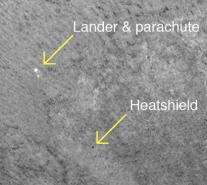
The HiRISE camera aboard NASA´s Mars Reconnaissance Orbiter captured the Phoenix Mars Lander, its parachute and heat shield in an image, all before Phoenix touched down on May 25, 2008. (NASA/JPL-Caltech/University of Arizona)

Scientists running the High Resolution Imaging Science Experiment, known as HiRISE, on NASA's Mars Reconnaissance Orbiter have processed more details in an amazing image their camera captured as the Phoenix spacecraft descended through Mars' atmosphere during its landing on May 25, 2008.

New analysis has turned up what likely is Phoenix's heat shield falling toward Mars' surface, they conclude.

HiRISE, run from The University of Arizona, made history by taking the first image of a spacecraft as it descended toward the surface of another planetary body.

The image shows NASA's Phoenix Mars Lander, also run from the UA, when the spacecraft was still tucked inside its aeroshell, suspended from its parachute, at 4:36 p.m. Pacific Daylight Time on landing day. Although Phoenix appears to be descending into an impressive impact crater, it actually landed 20 kilometers, or 12 miles, away.

Mars Reconnaissance Orbiter was about 760 kilometers, or 475 miles, away when it pointed the HiRISE camera obliquely toward the descending Phoenix lander. The camera viewed through the hazy Martian atmosphere at an angle 26 degrees above the horizon when it took the image. The 10-meter, or 30-foot, wide parachute was fully inflated. Even the lines connecting the parachute and aeroshell are visible, appearing bright against the darker, but fully illuminated Martian surface.

In further analyzing the image, the HiRISE team, supported by personnel from NASA's Jet Propulsion Laboratory and Lockheed Martin Space Systems Co., discovered a small, dark dot located below the lander.

Phoenix was equipped with a heat shield that protected the lander from burning up when it entered Mars' atmosphere and quickly decelerated because of friction. Phoenix discarded its heat shield after it deployed its parachute.

"Given the timing of the image and of the release of the heat shield, as well as the size and the darkness of the spot compared to any other dark spot in the vicinity, we conclude that HiRISE also captured Phoenix's heat shield in freefall," said HiRISE principal investigator Alfred McEwen of the UA's Lunar and Planetary Laboratory.

The multigigabyte HiRISE image also includes a portion recorded by red, blue-green and infrared detectors, and scientists have processed that color part of the image.

HiRISE's color bands missed the Phoenix spacecraft but do show frost or ice in the bowl of the relatively recent, 10-kilometer (6-mile) wide impact crater unofficially called "Heimdall." The frost shows up as blue in the false-color HiRISE data, and is visible on the right wall within the crater.

The HiRISE camera doesn't distinguish between carbon dioxide frost and water frost, but another instrument called CRISM on the Mars Reconnaissance Orbiter could.

Source: University of Arizona


print this article email this article download pdf blog this article bookmark this article     Stumble it Digg this share on Facebook retweet share on Reddit add to delicious
Rate this story - 3.7 /5 (9 votes)

Rank Filter

Move the slider to adjust rank threshold, so that you can hide some of the comments.


Display comments: newest first

  • deatopmg - Jul 09, 2008
    • Rank: 1 / 5 (1)
    Whoopee! great resolution.
    NOW, how about re-releasing in un-modified form, the hi-res. photos of Mars (and the moon) that have obviously been doctored by air brushing.
  • menkaur - Jul 10, 2008
    • Rank: not rated yet
    yeah... so many details from a single photo... the scientists really haven't much to do at nasa, do they?

July 9, 2008 all stories

Comments: 2

3.7 /5 (9 votes)
  • Stumble this up

  • Digg this

  • share this

  • hide
  • Related Stories

  • Frost-Covered Phoenix Lander Seen in Winter Images
    created Nov 05, 2009 | popularity not rated yet | comments 0
  • NASA Mars Lander Prepares to Move Arm
    created May 27, 2008 | popularity not rated yet | comments 0
  • Camera on Mars Orbiter Snaps Phoenix During Landing
    created May 27, 2008 | popularity not rated yet | comments 0
  • Phoenix mission to Mars will search for climate clues
    created May 22, 2008 | popularity not rated yet | comments 0
  • Undergraduate paves way for NASA Mars mission
    created Apr 16, 2007 | popularity not rated yet | comments 0


  • hide
  • Relevant PhysicsForums posts

  • Gravity on Mars
    created 9 hours ago
  • Question about the orbit between Mars and Earth
    created 17 hours ago
  • SIMBAD/NED help
    created 21 hours ago
  • Black hole confusion
    created Nov 14, 2009
  • More from Physics Forums - General Astronomy

Other News

Close-up movie shows hidden details in the birth of super-suns

Close-up movie shows hidden details in the birth of super-suns (w/ Video)

Space & Earth / Astronomy

created 8 hours ago | popularity 4.7 / 5 (3) | comments 0

(PhysOrg.com) -- The constellation of Orion is a hotbed of massive star formation, most prominently in the Great Nebula that sits in Orion's sword. The glowing gas of the Nebula is powered by a group of young ...


NASA 'Drops' Next Generation Robotic Lander During Autonomous Tests

NASA 'Drops' Next Generation Robotic Lander During Autonomous Tests

Space & Earth / Space Exploration

created 5 hours ago | popularity 4.7 / 5 (3) | comments 1

(PhysOrg.com) -- NASA has successfully completed a series of autonomous "drop" tests of a robotic lander test article - in a record 10 months - to demonstrate the ability to perform a controlled landing on ...


Ghostly 'Spokes' Puff Out From Saturn's Ring's

Ghostly 'Spokes' Puff Out From Saturn's Ring's (w/ Video)

Space & Earth / Space Exploration

created 4 hours ago | popularity 5 / 5 (1) | comments 0

(PhysOrg.com) -- Massive, bright clouds of tiny ice particles hover above the darkened rings of Saturn in an image captured by the Cassini spacecraft on Sept. 22, 2009, around the time of Saturn's equinox. ...


Space shuttle Atlantis lifts off on supply mission (AP)

Space shuttle Atlantis lifts off on supply mission

Space & Earth / Space Exploration

created 4 hours ago | popularity 3.5 / 5 (2) | comments 0

(AP) -- With 100 Internet-savvy NASA fans cheering on the shuttle and churning out constant Twitter updates, Atlantis sailed smoothly into orbit Monday with six astronauts and a full load of spare parts for ...


Ancient high-altitude trees grow faster as temperatures rise

Space & Earth / Earth Sciences

created 5 hours ago | popularity 3.8 / 5 (4) | comments 0

PIC=32536:left]Increasing temperatures at high altitudes are fueling the post-1950 growth spurt seen in bristlecone pines, the world's oldest trees, according to new research.