Seasonal programmed brain cell death foiled in living birds
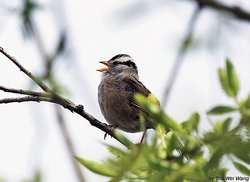
Neurons in brains of one songbird species equipped with a built-in suicide program that kicks in at the end of the breeding season have been kept alive for seven days in live birds by researchers trying to understand the role that steroid hormones play in the growth and maintenance of the neural song system.
It is the first time scientists have shown that inhibiting an enzyme involved in programmed cell death can protect a brain region in a living animal from neurodegeneration following the withdrawal of steroids.
In addition, the University of Washington research being published in tomorrow's edition of the Journal of Neuroscience reports that the infusion of this enzyme inhibitor into one brain region also kept another connected brain structure from degenerating.
The research has potential to help scientists develop clinical strategies for treating strokes and such human age-related degenerative diseases as Alzheimer's, Parkinson's and dementia, all of which may involve the death of brain cells.
Previous work by the co-authors Christopher Thompson and Eliot Brenowitz showed that neurons in a brain region called the HVC begin regressing within 12 hours after the withdrawal of the steroid hormone testosterone, followed soon thereafter by cell death. The new study indicates that enzymes called caspases, which play a key role in a cell suicide process called apoptosis, are involved in this process of neurodegeneration and that inactivation of caspases protects brain cells for at least a week.
Thompson, who just earned his doctorate in neurobiology and behavior at the UW and is now a postdoctoral researcher at the Freie Univeristät in Berlin, and Brenowitz, a UW professor of psychology and biology, study the brain regions controlling the singing behavior of a white-crowned sparrow.
"In the future, physicians might be able to stabilize people who have suffered a stroke using these inhibitors," said Brenowitz. "The basic mechanisms of cell death are the same in people and birds. With a stroke we often act as if it only affects the one area stricken by the loss of blood supply. But neuroscience has shown that different brain regions are connected in neural circuits. By using inhibitors like these to preserve neurons in the affected area, we might be able to preserve neurons in other connected brain areas."
The researchers received federal and state permits to capture 15 male sparrows in Eastern Washington after the breeding season as the birds were returning from Alaska to their winter home in California. The birds were housed indoors for 12 weeks under short-day lighting conditions to ensure their song and reproductive systems were regressed to a non-breeding state. Song-control regions in the brains of these sparrows and other songbirds naturally expand and shrink during the year depending on whether or not the birds are in a breeding state.
Next, the birds were exposed to 16 hours of light a day in long-day conditions, castrated and implanted with a high level of testosterone for 28 days to induce full growth of the song-control system. At that point, testosterone was withdrawn, the caspase inhibitors were infused near the HVC region on one side of the brain in 12 of the birds and the sparrows were returned to short-day lighting conditions. Three of the sparrows received a control substance that is chemically similar but did not have inhibitory properties. Groups of birds were euthanized after 1, 3 and 7 days. These procedures were done with the approval of the UW's Institutional Animal Care and Use Committee and the National Institute of Mental Health. The latter funded the research.
Examination of brain tissue showed that the caspase inhibitors prevented cell death in the HVC on the side of birds' brain that received these chemicals while this region began to degenerate on the opposite side of the brain. In addition, neurons in another connected song-control region called the RA on the side of the brain receiving the caspase inhibitors did not regress after seven days. Neurons in the HVC in the birds that did not get caspase inhibitors exhibited cell death, and RA neurons regressed.
"The normal role of hormones during the breeding season is to stimulate and maintain growth of these neural systems. We don't yet know all the ways in which hormones prevent brain cell death, but this study shows that hormones block caspases and so preserve neurons," said Brenowitz. "We are extending the life of these cells and halting the rapid degeneration of the song system."
Source: University of Washington


