Sewing DNA thread with lasers, hooks and microbobbins
July 10, 2008 Sewing DNA thread with lasers, hooks and microbobbins

Enlarge

(PhysOrg.com) -- Japanese scientists have made a micro-sized sewing machine to sew long threads of DNA into shape. The work published in the Royal Society of Chemistry journal Lab on a Chip demonstrates a unique way to manipulate delicate DNA chains without breaking them.

Scientists can diagnose genetic disorders such as Down’s syndrome by using gene markers, or “probes”, which bind to only highly similar chains of DNA. Once bound, the probe’s location can be easily detected by fluorescence, and this gives information about the gene problem.

Detecting these probes is often a slow and difficult process, however, as the chains become tightly coiled. The new method presented by Kyohei Terao from Kyoto University, and colleagues from The University of Tokyo, uses micron-sized hooks controlled by lasers to catch and straighten a DNA strand with excellent precision and care.

“When a DNA molecule is manipulated and straightened by microhooks and bobbins, the gene location can be determined easily with high-spatial resolution,” says Terao.

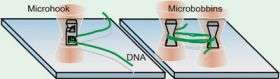
The team used optical tweezers – tightly focused laser beams – to control the Z-shaped micro hook and pick up a single DNA “thread”. The hook is barbed like an arrow, so the thread can’t escape. When caught on the hook, the DNA can be accurately moved around by refocusing the lasers to new positions.

But just like thread in a sewing machine, a long DNA chain can be unwieldy – so the researchers built micro “bobbins” to wind the chain around. The lasers move one bobbin around another, winding the DNA thread onto a manageable spindle.

It is “an excellent idea to fabricate unique microtools that enables us to manipulate a single giant DNA molecule”, says Yoshinobu Baba, who researches biologically useful microdevices at Nagoya University, Japan. The technology will also be useful for a number of other applications including DNA sequencing and molecular electronics, he adds.

Original article: Kyohei Terao, Lab Chip, 2008, DOI: 10.1039/b803753a

Source: Royal Society of Chemistry


print this article email this article download pdf blog this article bookmark this article     Stumble it Digg this share on Facebook retweet share on Reddit add to delicious
Rate this story - 4.9 /5 (19 votes)


July 10, 2008 all stories

Comments: 0

4.9 /5 (19 votes)
  • Stumble this up

  • Digg this

  • share this

  • hide
  • Related Stories


Other News

H1N1 Virus Can Be Killed by Acidic Ozone Water

H1N1 Virus Can Be Killed by Acidic Ozone Water

Chemistry / Biochemistry

created Nov 09, 2009 | popularity 4.8 / 5 (30) | comments 12

(PhysOrg.com) -- Scientists have found that acidic ozone water can deactivate H1N1 viruses very effectively, offering a promising disinfectant for the millions of people trying to avoid the disease. Acidic ...


New evidence that dark chocolate helps ease emotional stress

New evidence that dark chocolate helps ease emotional stress

Chemistry / Biochemistry

created Nov 11, 2009 | popularity 5 / 5 (3) | comments 2

The "chocolate cure" for emotional stress is getting new support from a clinical trial published online in ACS' Journal of Proteome Research.


Energy-saving powder

Energy-saving powder: Converting methane to methanol

Chemistry / Other

created Nov 11, 2009 | popularity 3.6 / 5 (5) | comments 2

It is currently estimated that natural gas resources will be exhausted in 130 years; however, those reserves where extraction is cost-effective will only flow for another 60 years or so.


Study reveals why certain drug combinations backfire

Chemistry / Biochemistry

created Nov 13, 2009 | popularity 4.5 / 5 (4) | comments 0

Combination drug therapy has become a staple for treating many infections. For instance, doctors treat extensively drug resistant forms of tuberculosis with one drug that breaks down the pathogen's protective barriers and ...


Vibrations key to efficiency of green fluorescent protein

Vibrations key to efficiency of green fluorescent protein

Chemistry / Biochemistry

created Nov 11, 2009 | popularity 4.8 / 5 (5) | comments 1

University of California, Berkeley, chemists have discovered the secret to the success of a jellyfish protein whose green glow has made it the darling of biologists and the subject of the 2008 Nobel Prize ...