River damming leads to dramatic decline in native fish numbers
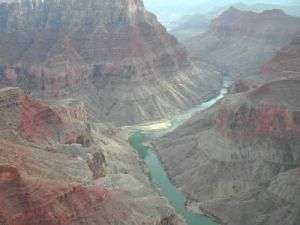
July 10, 2008 Colorado River in the Grand Canyon

Confluence of Little Colorado River and Colorado River in the Grand Canyon. Credit: David Ward, Arizona Game and Fish

Damming of the Colorado River over the last century, alongside introduction of game fish species, has led to an extensive decline in numbers of native fish whilst introduced species have flourished. Scientists have found that physical changes which occur to a river when it is dammed have had an adverse effect only on native fish, due to differences in their life histories.

Armed with this knowledge, they have made proposals to management agencies, which, if implemented, could reverse the loss of native species not only in the Colorado but on a country or even world-wide scale. Dr Alice Gibb from Northern Arizona University will be presenting her research on Thursday 10th July at the Society for Experimental Biology's Annual Meeting in Marseille.

Dr Gibb and her colleagues believe that differences in the early life of native and introduced species can account for the recent changes in population dynamics. They measured 'escape responses' of both native and introduced species to predators under laboratory conditions. "Our studies have shown that the larvae of native fish, which are usually less developed when they hatch, have a poorer escape response, due to their lack of adult swimming appendages. In contrast, many introduced species can prey upon the native species, and produce larvae that are more morphologically mature at hatching and thus may themselves be better equipped to escape predation," she explains.

Changes that damming has imposed on the Colorado River environment have amplified the disadvantage that native species face, according to Dr Gibb. "Historically, the less-developed native larvae had a natural refuge from predators due to sediment suspended in the water, and water turbulence increased the ability of larvae to encounter the plankton that they feed on. Fish also rapidly outgrew their period of high-vulnerability to predation due to higher water temperatures," she declares. "Damming the Colorado River has brought about the replacement of streams and rivers with large, still lakes, which has led to a decrease in sediment, turbulence and temperature, leaving the native larvae at a grave disadvantage."

Using all of the data they have gathered, the scientists have put forward proposals for how to reverse the decline in native fish numbers. "We suggest to management agencies that, in addition to removing introduced predators of native fishes from key river reaches, efforts must be undertaken to recreate the high-flow, sediment-rich, warm waters that gave the Colorado its name," Dr Gibb reports. "What is more, this advice is also relevant on a much wider scale: recent work in both Texas and the Pacific Northwest suggests that increased suspended sediment favours native fish larvae in these areas. Thus, dam removal may be critical for rehabilitating fish populations across the US, and almost certainly in other, less studied, areas of the world as well," she concludes.

Source: Society for Experimental Biology


print this article email this article download pdf blog this article bookmark this article     Stumble it Digg this share on Facebook retweet share on Reddit add to delicious
Rate this story - 3.8 /5 (4 votes)


July 10, 2008 all stories

Comments: 0

3.8 /5 (4 votes)
  • Stumble this up

  • Digg this

  • share this

  • hide
  • Related Stories

  • California Academy of Sciences becomes first aquarium in US to breed dwarf cuttlefish
    created Nov 12, 2009 | popularity not rated yet | comments 0
  • Studies show marine reserves can be an effective tool for managing fisheries
    created Nov 09, 2009 | popularity not rated yet | comments 0
  • 15,000 reasons to worry about invasive species
    created Nov 09, 2009 | popularity not rated yet | comments 0
  • Florida grapples slippery giant snake invasion
    created Nov 06, 2009 | popularity not rated yet | comments 0
  • Over 17,000 species threatened by extinction
    created Nov 02, 2009 | popularity not rated yet | comments 0


  • hide
  • Relevant PhysicsForums posts

Other News

MIT scientists pinpoint origin of dissolved arsenic in Bangladesh drinking water

Scientists pinpoint origin of dissolved arsenic in Bangladesh drinking water

Space & Earth / Environment

created 21 hours ago | popularity 4.9 / 5 (14) | comments 0

Researchers in MIT's Department of Civil and Environmental Engineering believe they have pinpointed a pathway by which arsenic may be contaminating the drinking water in Bangladesh, a phenomenon that has puzzled ...


NASA fuels space shuttle Atlantis for liftoff (AP)

NASA fuels space shuttle Atlantis for liftoff

Space & Earth / Space Exploration

created 5 hours ago | popularity not rated yet | comments 0

(AP) -- NASA is fueling space shuttle Atlantis for its afternoon liftoff.


Warmer means windier on world's biggest lake

Space & Earth / Earth Sciences

created 21 hours ago | popularity 3.8 / 5 (5) | comments 0

Rising water temperatures are kicking up more powerful winds on Lake Superior, with consequences for currents, biological cycles, pollution and more on the world's largest lake and its smaller brethren.


Geeky 'tweeters' to report on space shuttle launch (AP)

Geeky 'tweeters' to report on space shuttle launch

Space & Earth / Space Exploration

created 20 hours ago | popularity not rated yet | comments 0

(AP) -- Fingers will be flying when space shuttle Atlantis blasts off Monday: About 100 of NASA's geekiest fans will be on hand, pecking away at iPhones, BlackBerrys, laptops and other Twittering gadgets.


Controversial new climate change results

Controversial new climate change results

Space & Earth / Environment

created Nov 10, 2009 | popularity 4.1 / 5 (44) | comments 90

(PhysOrg.com) -- New data show that the balance between the airborne and the absorbed fraction of CO2 has stayed approximately constant since 1850, despite emissions of CO2 having risen from about 2 billion ...