Wilkins Ice Shelf hanging by its last thread
July 10, 2008 Wilkins Ice Shelf hanging by its last thread

Enlarge

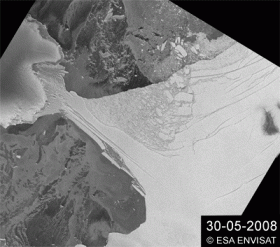
The Wilkins Ice Shelf is experiencing further disintegration. This animation, comprised of images acquired by Envisat’s Advanced Synthetic Aperture Radar (ASAR) between 30 May and 9 July 2008, shows the break-up event which began on 28 June on the east (right) rather than the on west (left) like the previous event that occurred last month. By 8 July, a fracture that could open the ice bridge was visible. Credits: ESA

The Wilkins Ice Shelf is experiencing further disintegration that is threatening the collapse of the ice bridge connecting the shelf to Charcot Island. Since the connection to the island in the image centre helps to stabilise the ice shelf, it is likely the break-up of the bridge will put the remainder of the ice shelf at risk.

This animation, comprised of images acquired by Envisat's Advanced Synthetic Aperture Radar (ASAR) between 30 May and 9 July 2008, shows the break-up event which began on the east (right) rather than the on west (left) like the previous event that occurred last month. By 8 July, a fracture that could open the ice bridge was visible.

This break-up is puzzling to scientists because it has occurred in the Southern Hemispheric winter and does not have characteristics similar to two earlier events that occurred in 2008, which were comparable to the break-up of the Larsen-A and -B ice shelves.

"The scale of rifting in the newly-removed areas seems larger, and the pieces are moving out as large bergs and not toppled, finely-divided ice melange," said Ted Scambos from the National Snow and Ice Data Center who uses ASAR images to track the area.

"The persistently low sea ice cover in the area and data from some interesting sources, electronic seal hats [caps worn by seals that provide temperature, depth and position data] seems to suggest that warm water beneath the halocline may be reaching the underside of the Wilkins Ice Shelf and thinning it rapidly - and perhaps reaching the surface, or at least mixing with surface waters."

Prof. David Vaughan of the British Antarctic Survey (BAS) said: "Wilkins Ice Shelf is the most recent in a long, and growing, list of ice shelves on the Antarctic Peninsula that are responding to the rapid warming that has occurred in this area over the last fifty years.

"Current events are showing that we were being too conservative, when we made the prediction in the early 1990s that Wilkins Ice Shelf would be lost within thirty years - the truth is it is going more quickly than we guessed."

The Wilkins Ice Shelf, a broad plate of floating ice south of South America on the Antarctic Peninsula that is connected to Charcot and Latady Islands, had been stable for most of the last century before it began retreating in the 1990s.

By studying ESA ERS SAR satellite images since the 1990s, Braun and his colleague Dr Angelika Humbert from the Institute of Geophysics, Münster University, have found the Wilkins Ice Shelf has break-up events with loss of large areas rather than underlying ordinary, continuous calving.

For instance, in February 2008 an area of about 400 km² broke off from the Wilkins Ice Shelf, narrowing the ice bridge that connects it to Charcot and Latady Islands down to a 6 km strip. From 30 to 31 May 2008 it experienced further break-up with an area of about 160 km² breaking off, reducing the ice bridge to just 2.7 km.

Braun and Humbert are monitoring the ice sheet daily via Envisat acquisitions as part of their contribution to the International Polar Year (IPY) 2007-2008, a large worldwide science programme focused on the Arctic and Antarctic.

Satellite data are essential for observing polar regions. Envisat's ASAR instrument is able to produce high-quality images, even through clouds and darkness. Therefore, it is particularly suited to acquire images over Antarctica during the local winter period where hours of daylight are limited and cloud cover is quite frequent.

"ESA provides daily ASAR images that are easily accessible to scientists. It is particularly rewarding for us to see that the Envisat data are essential for scientists to quickly and easily observe these ice-shelf phenomena – a luxury that was not available to the scientific community a few years ago," ESA Envisat Mission Manager Henri Laur said.

"ESA is committed to continue monitoring the polar areas with Envisat and in the future with the GMES Sentinel-1 satellite."

In an effort to ensure as much SAR data as possible is made available to scientists and polar region projects during IPY, ESA is coordinating with other space agencies worldwide, such as Japan's JAXA, the Canadian Space Agency and the German and Italian space agencies, to acquire additional SAR data over these areas with their own satellites.

Source: European Space Agency


print this article email this article download pdf blog this article bookmark this article     Stumble it Digg this share on Facebook retweet share on Reddit add to delicious
Rate this story - 3.3 /5 (27 votes)

Rank Filter

Move the slider to adjust rank threshold, so that you can hide some of the comments.


Display comments: newest first

  • zevkirsh - Jul 10, 2008
    • Rank: 3 / 5 (13)
    al gore did it.
  • agg - Jul 10, 2008
    • Rank: 2.6 / 5 (11)
    now man-bear-pig can't threaten us from his island cave.
  • googleplex - Jul 10, 2008
    • Rank: 3.3 / 5 (13)
    If you look at the enlarged image and watch the slide show take a look at the dates. If you watch carefully you can see dramatic changes in the shelf over a period of only 1 month. It is day to day changes not year to year.
    This is during the Winter at the coldest place on earth, Antarctica. Clearly there has been a significant shift in the ocean currents. The power of the oceans (75% of earth surface) to influence weather is probably under estimated. It might even be the primary factor affecting climate change.
  • wfl - Jul 10, 2008
    • Rank: 2.5 / 5 (15)
    Why should anyone care if the ice shelf breaks off? What makes this event newsworthy other than to provide a false basis for alarm about climate change?
  • Mercury_01 - Jul 10, 2008
    • Rank: 2 / 5 (8)
    Wow.
  • MikeB - Jul 10, 2008
    • Rank: 3.3 / 5 (7)
    Meanwhile, sea ice remains at average levels. Ice melts and ice also forms. It's been happening for millenia. This is ALMOST as exciting as watching paint dry.
  • Enthalpy - Jul 11, 2008
    • Rank: 2.3 / 5 (6)
    I can't imagine any other reason than propaganda for comments against man-made climate change due to burning fossil energies.

    Evidence tells it. Scientists agree. Any individual can search for measurements, make his own computation, and come to the right conclusion.

    As for the size of ice shelves, the Northwest Passage opened in 2007 for the first time - both in recorded History and by archaeological evidence. Right now in 2008, the Arctic ice shelf is smaller than 365 days ago.

    And by the way: Southeast Australia, which produces most crop of this third worldwide exporter, is in complete draught for the third year. This explains the price of food - not the negligible conversion of crop to biofuels.
  • Enthalpy - Jul 11, 2008
    • Rank: 3.8 / 5 (5)
    Changes in ocean current?

    The Tara sailship let catch itself in the Arctic iceshelf near Eastern Siberia and had planned to stay caught for a nearly 3 years campain, based on previous drift speed data. It got in the ice-free ocean near Spitzbergen after 1 year - a very bad surprise.

    In this case, the current's direction hadn't changed, but the speed had.
  • googleplex - Jul 11, 2008
    • Rank: 4.8 / 5 (4)
    Meanwhile, sea ice remains at average levels. Ice melts and ice also forms. It's been happening for millenia. This is ALMOST as exciting as watching paint dry.


    Data source?
  • MikeB - Jul 13, 2008
    • Rank: 5 / 5 (1)
    Googleplex look at the sea ice extent anomoly (combined arctic and antarctic). It is very close to zero. http://arctic.atm...rend.jpg
  • googleplex - Jul 15, 2008
    • Rank: 5 / 5 (1)
    Googleplex look at the sea ice extent anomoly (combined arctic and antarctic). It is very close to zero. http://arctic.atm...rend.jpg

    Thank you.
    I wonder how the see ice area has maintained the same even though surface temperatures have risen significantly. Contradictory data?
    Interestingly all of the action occurs in the Summer. Could the link you provided be winter readings? I would also like to see some error bars. Surely there was some significant in-accuracey in the data for the 1900s.
    http://arctic.atm...2007.jpg
    General observation: I learned in stastistics that data has no credibility without an error estimate. I wish they included some error bars.
  • snwboardn - Jul 15, 2008
    • Rank: 5 / 5 (3)
    I am by far not a scientist or meteorologist, all I have to go by are my 26 years of experiencing weather. It would be my guess that glaciers and heavy pack ice would be more influenced by precipitation than just heating and cooling 1 or 2 degrees. In every model I have seen advertised, warmer ocean temperatures equal more precipitation, for places cooler in the winter time that equals snow. Now in my, very uneducated guess, heavy amounts of dilution from ice thawing at the poles would expediate the process of the evaporation. Creating more ice at the poles (snowfall in the winter would outpace melting in the summer). It is my personal belief that we are at or are about to climb over the apex and start noticing more glaciers start to grow. Over a long period of time it wouldn't surprise me to see this process go from a warm soggy climate to a dry cool climate. That is my theory, could be right could be wrong, I am sure I will live long enough to find out.

July 10, 2008 all stories

Comments: 12

3.3 /5 (27 votes)
  • Stumble this up

  • Digg this

  • share this

  • hide
  • Related Stories

  • Icebergs break away from Antarctic iceshelf
    created Apr 28, 2009 | popularity not rated yet | comments 0
  • Catastrophic sea levels 'distinct possibility' this century: study
    created Apr 15, 2009 | popularity not rated yet | comments 0
  • Ice Bridge Supporting Wilkins Ice Shelf Collapses
    created Apr 08, 2009 | popularity not rated yet | comments 0
  • Blubbery 'researchers' lend fin to climate science
    created Apr 06, 2009 | popularity not rated yet | comments 0
  • Collapse of the ice bridge supporting Wilkins Ice Shelf appears imminent
    created Apr 03, 2009 | popularity not rated yet | comments 0


  • hide
  • Relevant PhysicsForums posts

Other News

Astronauts finish another spacewalk, still no baby (AP)

Astronauts finish another spacewalk, still no baby

Space & Earth / Space Exploration

created 8 hours ago | popularity 3 / 5 (2) | comments 0

(AP) -- A spacewalking astronaut put aside the impending birth of his daughter and blazed through his first-ever venture outside the International Space Station on Saturday.


Unseasonably hot and dry weather combined with strong winds to fan scores of blazes in the country's southeastern states

Australia issues 'catastrophic' alerts as fires rage

Space & Earth / Environment

created 14 hours ago | popularity 4.5 / 5 (2) | comments 0

Australia has issued "catastrophic" alerts after record-breaking temperatures and wild lightning storms sparked more than 100 fires across the country, officials said Saturday.


Commuters wait on the platform shrouded by fog in London

Climate change not man-made, say majority of Britons: poll

Space & Earth / Environment

created Nov 15, 2009 | popularity 3.3 / 5 (15) | comments 46

Less than half of Britons believes that human activity is to blame for global warming, according to a poll carried out for The Times newspaper and published on Saturday.


Mysteriously warm times in Antarctica

Mysteriously warm times in Antarctica

Space & Earth / Earth Sciences

created Nov 18, 2009 | popularity 4.2 / 5 (21) | comments 28

(PhysOrg.com) -- A new study of Antarctica's past climate reveals that temperatures during the warm periods between ice ages (interglacials) may have been higher than previously thought. The latest analysis ...


UN: Fight climate change with free condoms (AP)

UN: Fight climate change with free condoms

Space & Earth / Environment

created Nov 18, 2009 | popularity 3.1 / 5 (11) | comments 24

(AP) -- The battle against global warming could be helped if the world slowed population growth by making free condoms and family planning advice more widely available, the U.N. Population Fund said Wednesday.