What's My Age? Mystery Star Cluster Has 3 Different Birthdays
July 10, 2008 White Dwarf Stars in Open Cluster NGC 6791

Enlarge

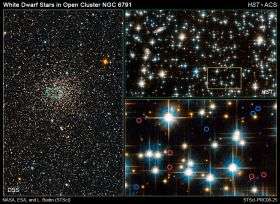
In studying the dimmest burned-out stars in globular star cluster NGC 6791, NASA's Hubble Space Telescope has uncovered a paradox: three different populations of stars exist in an object where all the stars should have formed at the same time out of an interstellar cloud of gas and dust. [Left] — This is a ground-based telescopic view of NGC 6791, located 13,300 light-years away in the constellation Lyra. The green inset box shows the view with Hubble's Advanced Camera for Surveys. [Top right] — The full Hubble Advanced Camera for Surveys field is full of stars estimated to be 8 billion years old. Two background galaxies can be seen at upper left. [Bottom right] — A blow up of view of a small region of the Advanced Camera for Surveys field reveals very faint white dwarfs. The blue circles identify hotter dwarfs that are 4 billion years old. The red circles identify cooler dwarfs that are 6 billion years old. Credit: NASA, ESA, and L. Bedin (STScI)

Imagine having three clocks in your house, each chiming at a different time. Astronomers have found the equivalent of three out-of-sync "clocks" in the ancient open star cluster NGC 6791. The dilemma may fundamentally challenge the way astronomers estimate cluster ages, researchers said.

Using NASA's Hubble Space Telescope to study the dimmest stars in the cluster, astronomers uncovered three different age groups. Two of the populations are burned-out stars called white dwarfs. One group of these low-wattage stellar remnants appears to be 6 billion years old, another appears to be 4 billion years old. The ages are out of sync with those of the cluster's normal stars, which are 8 billion years old.

"The age discrepancy is a problem because stars in an open cluster should be the same age. They form at the same time within a large cloud of interstellar dust and gas. So we were really puzzled about what was going on," explained astronomer Luigi Bedin, who works at the Space Telescope Science Institute in Baltimore, Md.

Ivan King of the University of Washington and leader of the Hubble study said: "This finding means that there is something about white dwarf evolution that we don't understand."

After extensive analysis, members of the research team realized how the two groups of white dwarfs can look different and yet have the same age. It is possible that the younger- looking group consists of the same type of stars, but the stars are paired off in binary-star systems, where two stars orbit each other. Because of the cluster's great distance, astronomers see the paired stars as a brighter single star.

"It is their brightness that makes them look younger," said team member Maurizio Salaris of Liverpool John Moores University in the United Kingdom.

Binary systems are also a significant fraction of the normal stellar population in NGC 6791, and are also observed in many other clusters. This would be the first time they have been found in a white-dwarf population.

"Our demonstration that binaries are the cause of the anomaly is an elegant resolution of a seemingly inexplicable enigma," said team member Giampaolo Piotto the University of Padova in Italy.

Bedin and his colleagues are relieved that they now have only two ages to reconcile: an 8- billion-year age of the normal stellar population and a 6-billion-year age for the white dwarfs. All that is needed is a process that slows down white-dwarf evolution, the researchers said.

Hubble's Advanced Camera for Surveys analyzed the cooling rate of the entire population of white dwarfs in NGC 6791, from brightest to dimmest. Most star clusters are too far away and the white dwarfs are too faint to be seen by ground-based telescopes, but Hubble's powerful vision sees many of them.

White dwarfs are the smoldering embers of Sun-like stars that no longer generate nuclear energy and have burned out. Their hot remaining cores radiate heat for billions of years as they slowly fade into darkness. Astronomers have used white dwarfs as a reliable measure of the ages of star clusters, because they are the relics of the first cluster stars that exhausted their nuclear fuel.

White dwarfs have long been considered dependable because they cool down at a predictable rate-the older the dwarf, the cooler it is, making it a seemingly perfect clock that has been ticking for almost as long as the cluster has existed.

NGC 6791 is one of the oldest and largest open clusters known, about 10 times larger than most open clusters and containing roughly 10,000 stars. The cluster is located in the constellation Lyra.

The first results appeared in the May 10 issue of The Astrophysical Journal, and the clarification about binaries was in the May 20 issue of The Astrophysical Journal Letters.

Other members of the research team are Santi Cassisi of the Collurania Astronomical Observatory in Italy, and Jay Anderson, of the Space Telescope Science Institute.

Source: Hubble Center / PhysOrg.com


print this article email this article download pdf blog this article bookmark this article     Stumble it Digg this share on Facebook retweet share on Reddit add to delicious
Rate this story - 4 /5 (11 votes)

Rank Filter

Move the slider to adjust rank threshold, so that you can hide some of the comments.


Display comments: newest first

  • MGraser - Jul 10, 2008
    • Rank: not rated yet
    Uneducated question - Would it make sense that some of the original stars pulled into to one another and went supernova, scattering matter that formed into brand new lower mass stars that would go to the white dwarf stage sooner than their medium-sized contemporaries?
  • deatopmg - Jul 11, 2008
    • Rank: not rated yet
    What are the redshifts in each of classes of objects?? That defines age...not distance.

July 10, 2008 all stories

Comments: 2

4 /5 (11 votes)
  • Stumble this up

  • Digg this

  • share this

  • hide
  • Related Stories

  • Galactic X-ray emissions originate from stars
    created May 05, 2009 | popularity not rated yet | comments 0
  • Oddball stars discovered in new Hubble images
    created Apr 27, 2009 | popularity not rated yet | comments 0
  • Largest collection of anomalous white dwarfs observed by Hubble
    created Apr 23, 2009 | popularity not rated yet | comments 0
  • A curious pair of galaxies
    created Mar 16, 2009 | popularity not rated yet | comments 0
  • Hubble provides new evidence for dark matter around small galaxies
    created Mar 12, 2009 | popularity not rated yet | comments 0


  • hide
  • Relevant PhysicsForums posts

  • Some help with a X-Ray astronomy question please!
    created Nov 27, 2009
  • Help with Images and Optical Instrument Question..
    created Nov 26, 2009
  • Redshift as a distance indicator
    created Nov 26, 2009
  • Question about 2-body gravity
    created Nov 24, 2009
  • More from Physics Forums - General Astronomy

Other News

Fermi Telescope Peers Deep into Microquasar

Fermi Telescope Peers Deep into Microquasar (w/ Video)

Space & Earth / Astronomy

created 18 hours ago | popularity 4.7 / 5 (10) | comments 0

(PhysOrg.com) -- NASA's Fermi Gamma-ray Space Telescope has made the first unambiguous detection of high-energy gamma-rays from an enigmatic binary system known as Cygnus X-3. The system pairs a hot, massive ...


The Energy Sources of Ultraluminous Galaxies

The Energy Sources of Ultraluminous Galaxies

Space & Earth / Astronomy

created 18 hours ago | popularity 4.5 / 5 (13) | comments 1

(PhysOrg.com) -- Ultraluminous infrared galaxies ((ULIRGs) are galaxies whose luminosity exceeds that of a trillion suns; for comparison, the Milky Way galaxy has a typical (and much more modest) luminosity ...


New climate targets may not change daily life much (AP)

New climate targets may not change daily life much

Space & Earth / Environment

created 22 hours ago | popularity 3.8 / 5 (13) | comments 9

(AP) -- Americans' day-to-day lives won't change noticeably if President Barack Obama achieves his newly announced goal of slashing carbon dioxide pollution by one-sixth in the next decade, experts say.


Space shuttle Atlantis, 7 astronauts back on Earth (AP)

Space shuttle Atlantis, 7 astronauts back on Earth

Space & Earth / Space Exploration

created 19 hours ago | popularity not rated yet | comments 0

(AP) -- Space shuttle Atlantis and its seven astronauts returned to Earth with a smooth touchdown Friday to end an 11-day flight that resupplied the International Space Station.


China is set to launch its second moon orbiter next October, state media have reported

China to launch second lunar probe: state media

Space & Earth / Space Exploration

created 23 hours ago | popularity 5 / 5 (5) | comments 0

China will launch its second moon orbiter next October, state media reported Friday, as it powers ahead with a space programme that has sparked concerns abroad.