Software Helps Developers Get Started with PIV Cards
July 10, 2008 Software Helps Developers Get Started with PIV Cards

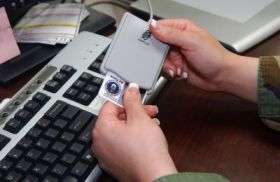
The NIST demonstration software provides examples of incorporating Personal Identity Verification cards to control access to government computers. As shown, an employee will have to swipe her PIV card that holds her unique identifying information before she can access her computer. Credit: Department of Defense

The National Institute of Standards and Technology has developed two demonstration software packages that show how Personal Identity Verification (PIV) cards can be used with Windows and Linux systems to perform logon, digital signing and verification, and other services. The demonstration software, written in C++, will assist software developers, system integrators and computer security professionals as they develop products and solutions in response to Homeland Security Presidential Directive 12 and the FIPS 201-1 standard.

"We wanted to provide IT professionals with a model of one way that PIV cards can be used to support authentication to federal information systems," explains Donna Dodson, deputy director of the NIST Computer Security Division. "Our objective was not to say 'do the steps this way,' but to show an example of how you might proceed."

Homeland Security Presidential Directive 12 calls for government employees and contractors to use secure identity credentials to access federal facilities and computers. NIST worked with industry to develop the standards for the PIV cards that will be used for those purposes. Each card contains a unique number, two of the employee's biometric fingerprint templates, and cryptographic keys stored on an electronic chip embedded in the card's plastic body.

While each federal agency will implement the use of PIV cards on its own schedule, NIST computer scientists developed the software to demonstrate that PIV cards can work with common computer activities such as system logon. The typical process of keying in user name and password will be replaced with the user inserting his/her PIV card in a reader and entering a personal identification number (PIN). This secure logon could eliminate the need for passwords for other applications and could provide access to secure databases to which the user is authorized.

The PIV Crypto Service Provider (CSP) demonstrates Windows XP Logon with PIV cards. The Public Key Cryptography Standard #11 module was developed to operate in the Fedora Core 5 environment and to implement Linux Logon, signing and encrypting email (following the S/MIME standard) and Web site authentication (following the SSL/TLS standard), configured in Linux OS, Thunderbird and Firefox applications.

The software is available at http://csrc.nist.gov/groups/SNS/piv/download.html

Source: National Institute of Standards and Technology


print this article email this article download pdf blog this article bookmark this article     Stumble it Digg this share on Facebook retweet share on Reddit add to delicious
Rate this story - 5 /5 (1 vote)


July 10, 2008 all stories

Comments: 0

5 /5 (1 vote)
  • Stumble this up

  • Digg this

  • share this

  • hide
  • Related Stories

  • NIST shows on-card fingerprint match is secure, speedy
    created Apr 02, 2008 | popularity not rated yet | comments 0
  • From aircraft aerodynamics to improved heart implants
    created Sep 27, 2005 | popularity not rated yet | comments 0
  • By Simulating Gullies, Geographers Discover Ways to Tame Soil Erosion
    created Oct 12, 2009 | popularity not rated yet | comments 0


  • hide
  • Relevant PhysicsForums posts

  • Achromat lens - magnifying LCD
    created 15 hours ago
  • Control System
    created Nov 24, 2009
  • Base Isolation Systems in Skyscrapers?
    created Nov 23, 2009
  • Need to interview a Computer Hardware Engineer for school project
    created Nov 23, 2009
  • More from Physics Forums - General Engineering

Other News

The goal of robot hockey: to become better engineers

The goal of robot hockey: to become better engineers (w/ Video)

Technology / Engineering

created 1hour ago | popularity not rated yet | comments 0

(PhysOrg.com) -- It may be a long time before we see robots shooting pucks and making saves in professional hockey, but second-year mechanical engineering students at the University of Alberta put some pretty ...


Should I buy a PC or Mac?

Technology / Software

created 14 hours ago | popularity 4.2 / 5 (5) | comments 9

Q. Our 6-year-old PC computer is dying a slow death and we are considering moving to a new iMac but have a few concerns. First, of all, we have several Word documents on our disk drive now that we want to keep and add to ...


Sony optimistic on 3-D TVs, in-house display (AP)

Sony optimistic on 3-D TVs, in-house display

Technology / Hi Tech

created 3 hours ago | popularity not rated yet | comments 0

(AP) -- A third to a half of the Sony Corp. TV sets sold annually will be packed with 3-D features by the year ending March 2013, a senior executive said Thursday.


Post Office card error leaves Italians in the red: report

Technology / Other

created 3 hours ago | popularity 4 / 5 (1) | comments 0

A computer glitch left Italian Post Office customers in the red by processing card transactions at 100 times their value, Italian press reported Thursday.


Time Inc., Conde Nast and Hearst are preparing to launch an online newsstand described as an "iTunes for magazines"

Magazine publishers creating 'iTunes for magazines': reports

Technology / Internet

created 16 hours ago | popularity 5 / 5 (1) | comments 1

US magazine publishers Time Inc., Conde Nast and Hearst are preparing to launch an online newsstand described as an "iTunes for magazines," according to published reports.