A Telescope Made of Moondust
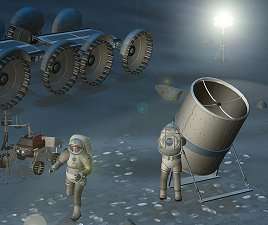
A gigantic telescope on the Moon has been a dream of astronomers since the dawn of the space age. A lunar telescope the same size as Hubble (2.4 meters across) would be a major astronomical research tool. One as big as the largest telescope on Earth—10.4 meters across—would see far more than any Earth-based telescope because the Moon has no atmosphere. But why stop there? In the Moon's weak gravity, it might be possible to build a telescope with a mirror as large as 50 meters across, half the length of a football field—big enough to analyze the chemistry on planets around other stars for signs of life.
That's the dream of Peter C. Chen, astrophysicist at NASA Goddard Space Flight Center. And he wants to build it using lunar dust—because that might just be the most economical approach.
"If we lift all materials from Earth, we're limited by what a rocket can carry to the Moon," Chen explains. "But on the Moon, you're absolutely surrounded by lunar dust"—a prized natural resource in the eyes of Chen, an expert in composite materials.
Composite materials are synthetic materials made by mixing fibers or granules of various materials into epoxy and letting the mixture harden. Composites combine two valuable properties: ultralight weight and extraordinary strength. On Earth, for example, bicycle frames made of a composite of carbon fibers and epoxy are favorites of racing cyclists.
"Why not make a composite using lunar dust?" asks Chen, who is also adjunct research professor at the Catholic University of America in Washington, D.C. So in his laboratory, he mixed NASA's simulated lunar dust called JSC-1A Coarse Lunar Regolith Simulant with epoxy and a small quantity of carbon nanotubes, a relatively recently discovered form of carbon that has many unusual and useful properties. The result? "It came out as hard, dense, and strong as concrete."
Excited, Chen made a small telescope mirror using a long-known technique called spin-casting. First he formed a 12-inch (30-cm) diameter disk of lunar-simulant/epoxy composite. Then he poured a thin layer of straight epoxy on top, and spun the mirror at a constant speed while the epoxy hardened. The top surface of the epoxy assumed a parabolic shape—just the shape needed to focus an image. When the epoxy hardened, Chen inserted it into a vacuum chamber to deposit a thin layer of reflective aluminum onto the parabolic surface to create a 12-inch telescope mirror.
The carbon nanotubes make the composite a conductor. Conductivity would allow a large lunar telescope mirror to reach thermal equilibrium quickly with the monthly cycle of lunar night and day. Conductivity would also allow astronomers to apply an electric current as needed through electrodes attached to the back of the mirror, to maintain the mirror's parabolic shape against the pull of lunar gravity as the large telescope was tilted from one part of the sky to another.
To make a Hubble-sized moondust mirror, Chen calculates that astronauts would need to transport only 130 pounds (60 kg) of epoxy to the Moon along with 3 pounds (1.3 kg) of carbon nanotubes and less than 1 gram of aluminum. The bulk of the composite material—some 1,300 pounds (600 kilograms) of lunar dust—would be lying around on the Moon for free.
"I think we've discovered a simple method of making big astronomical telescopes on the Moon at 'non-astronomical' prices," Chen declares. "Building a large space-based astronomical observatory using locally available material is something that is possible only on the Moon. That capability can be a major scientific justification for a return to the Moon."
"It’s a great idea in principle, but nothing is simple on the Moon," cautions physicist James F. Spann, who leads the Space and Exploration Research Office at Marshall Space Flight Center. "Launching a big spinning table to the Moon would be a challenge. If we got the machine spinning in the Moon's dusty environment, how long would it take the dust to settle?" he asks.
Sputtering aluminum vapor onto a large mirror in the presence of ambient dust would be another challenge, because "coating mirrors on Earth is done in a clean environment. There are practical issues about manufacturability that must be resolved."
Despite his concerns, Spann sees real promise in Chen's work and he's enthusiastic about starting out to make simple composite structures on the Moon, such as casting basic blocks from epoxy and lunar dust. "The blocks could be useful for building igloos or habitats for the lunar astronauts," he points out. Then astronauts could work up to making rods, tubes, and other composite structures, to learn how epoxy cures in the Moon's vacuum, and how robust the composites are under solar ultraviolet light. In the end, telescopes might prove practical. "We have a lot of work to do to find out what's possible," he says.
One thing is clear: The sky's the limit, especially when you have so much moondust to work with.
Source: by Trudy E. Bell, Science@NASA


