Genes could solve pollution mysteries
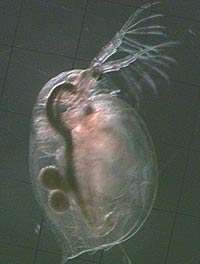
(PhysOrg.com) -- Researchers at the University of California, Berkeley, have for the first time identified environmental pollutants by looking at the genes of a small, freshwater crustacean. This new gene-based technique could lead to better and faster lab tests for pinpointing pollutants in contaminated ecosystems.
In a study published online today in the journal Environmental Science & Technology, scientists measured changes in gene expression in the genome of Daphnia magna, the tiny transparent water flea commonly used for lab studies, to track down poisons in two polluted rivers in California. This is the first time gene expression has been used to identify an environmental pollutant - in this case, copper from nearby mines.
"It's almost like a tool for having the water flea talk to us," said Helen Poynton, former UC Berkeley graduate student in nutritional sciences and toxicology and first author on the study. "We're speaking the language of the water flea, and it's telling us that this is what's hurting it, this is what is in the water, and this is what it's being exposed to."
The genomic technique has the potential to be faster, cheaper and more informative than current water toxicity assays, said the study's senior author, Chris Vulpe, UC Berkeley associate professor in nutritional sciences and toxicology.
There are two kinds of tests currently used to identify pollutants in aquatic ecosystems, Vulpe said. In what researchers call the "kill 'em and count 'em" assay, water is brought from a potentially contaminated site into the lab and tested to see how many organisms live or die in that water. This technique doesn't tell you what is in the water, Vulpe said, only whether it's poisonous or not. It also doesn't reveal harmful effects that aren't lethal, such as damage to immune systems.
The other commonly used test is a chemical assay that looks for a specific substance, so the scientists must first make their best guess as to the pollutant's identity. This process can be lengthy and expensive, Vulpe said. "There are thousands of possible contaminants for every site," he said. "You have to guess what you think is there and then run extensive tests."
The new tool developed by Vulpe's group relies on the fact that organisms turn genes on and off in response to pollutants in their environment. In previous studies, the scientists identified the water flea's gene response "fingerprints" to different metals commonly found in polluted waterways. Water fleas will turn on or off unique genes depending on the specific contaminant in the water sample. Vulpe's group has developed fingerprints for copper, cadmium and zinc - three common metal contaminants found in polluted waterways.
For the current study, Vulpe's group collected water from two creeks in Northern California near abandoned mines. Back in the lab, the researchers exposed water fleas to the creek water and looked at gene expression changes. They found that the gene expression changes from the creek water matched the fingerprint for copper exposure.
Traditional chemical analyses of the creek water revealed high levels of both copper and zinc. But the group's genomic assays found a fingerprint nearly identical to the response to copper alone, indicating that the zinc in the water wasn't causing harm to the water fleas. "If we had gone in and just measured it, we would have said, 'Well, there's copper here and there's zinc here,' but that doesn't tell you what the organism is upset about," Vulpe said.
Poynton, who is currently an Oak Ridge Institute for Science Education postdoctoral fellow at the U.S. Environmental Protection Agency (EPA), envisions the genomic tool being used to screen sites for water quality measurements. Poynton and Vulpe hope their technique could eventually prove useful to regulatory agencies.
In the future, Vulpe plans to expand the tool for use with other organisms besides the water flea. He hopes it can be used to directly address mysterious declines of plants and animals in polluted areas. For example, populations of delta smelt have been crashing in California for reasons unknown.
"That is the real excitement in the field, that we can really look at the organisms we care about," Vulpe said. "That's where we're hoping to be."
Co-authors of the study are Rick Zuzow and Alexandre Loguinov of UC Berkeley and Edward Perkins of the U.S. Army Engineer Research and Development Center.
Source: University of California, Berkeley


