Rare 'Star-Making Machine' Found in Distant Universe
July 10th, 2008 Rare 'Star-Making Machine' Found in Distant Universe

Enlarge

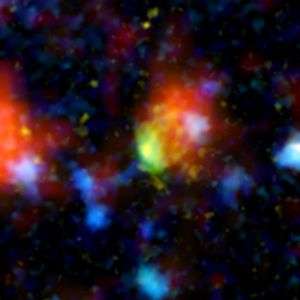
The green and red splotch in this image is the most active star-making galaxy in the very distant universe. Credit: NASA

Astronomers have uncovered an extreme stellar machine -- a galaxy in the very remote universe pumping out stars at a surprising rate of up to 4,000 per year. In comparison, our own Milky Way galaxy turns out an average of just 10 stars per year.

The discovery, made possible by several telescopes including NASA's Spitzer Space Telescope, goes against the most common theory of galaxy formation. According to the theory, called the Hierarchical Model, galaxies slowly bulk up their stars over time by absorbing tiny pieces of galaxies -- and not in one big burst as observed in the newfound "Baby Boom" galaxy.

"This galaxy is undergoing a major baby boom, producing most of its stars all at once," said Peter Capak of NASA's Spitzer Science Center at the California Institute of Technology, Pasadena. "If our human population was produced in a similar boom, then almost all of the people alive today would be the same age." Capak is lead author of a new report detailing the discovery in the July 10th issue of Astrophysical Journal Letters.

The Baby Boom galaxy, which belongs to a class of galaxies called starbursts, is the new record holder for the brightest starburst galaxy in the very distant universe, with brightness being a measure of its extreme star-formation rate. It was discovered and characterized using a suite of telescopes operating at different wavelengths. NASA's Hubble Space Telescope and Japan's Subaru Telescope, atop Mauna Kea in Hawaii, first spotted the galaxy in visible-light images, where it appeared as an inconspicuous smudge due to is great distance.

It wasn't until Spitzer and the James Clerk Maxwell Telescope, also on Mauna Kea in Hawaii, observed the galaxy at infrared and submillimeter wavelengths, respectively, that the galaxy stood out as the brightest of the bunch. This is because it has a huge number of youthful stars. When stars are born, they shine with a lot of ultraviolet light and produce a lot of dust. The dust absorbs the ultraviolet light but, like a car sitting in the sun, it warms up and re-emits light at infrared and submillimeter wavelengths, making the galaxy unusually bright to Spitzer and the James Clerk Maxwell Telescope.

To learn more about this galaxy's unique youthful glow, Capak and his team followed up with a number of telescopes. They used optical measurements from Keck to determine the exact distance to the galaxy -- a whopping12.3 billion light-years. That's looking back to a time when the universe was 1.3 billion years old (the universe is approximately 13.7 billion years old today).

"If the universe was a human reaching retirement age, it would have been about 6 years old at the time we are seeing this galaxy," said Capak.

The astronomers made measurements at radio wavelengths with the National Science Foundation's Very Large Array in New Mexico. Together with Spitzer and James Clerk Maxwell data, these observations allowed the astronomers to calculate a star-forming rate of about 1,000 to 4,000 stars per year. At that rate, the galaxy needs only 50 million years, not very long on cosmic timescales, to grow into a galaxy equivalent to the most massive ones we see today.

While galaxies in our nearby universe can produce stars at similarly high rates, the farthest one known before now was about 11.7 billion light-years away, or a time when the universe was 1.9 billion years old.

"Before now, we had only seen galaxies form stars like this in the teenaged universe, but this galaxy is forming when the universe was only a child," said Capak. "The question now is whether the majority of the very most massive galaxies form very early in the universe like the Baby Boom galaxy, or whether this is an exceptional case. Answering this question will help us determine to what degree the Hierarchical Model of galaxy formation still holds true."

"The incredible star-formation activity we have observed suggests that we may be witnessing, for the first time, the formation of one of the most massive elliptical galaxies in the universe," said co-author Nick Scoville of Caltech, the principal investigator of the Cosmic Evolution Survey, also known as Cosmos. The Cosmos program is an extensive survey of a large patch of distant galaxies across the full spectrum of light.

"The immediate identification of this galaxy with its extraordinary properties would not have been possible without the full range of observations in this survey," said Scoville.

Source: NASA


print this article email this article download pdf blog this article bookmark this article     Digg this Stumble it share on Facebook share on Reddit add to delicious save to Yahoo! bookmarks
4.5/5 after 26 votes

Rank Filter

Move the slider to adjust rank threshold, so that you can hide some of the comments.


Display comments: newest first

  • brant - Jul 10, 2008
    • Rank: 3.2 / 5 (5)
    "identification of this galaxy with its extraordinary properties"

    How about this galaxy is normal, just your model is broken.
  • Modernmystic - Jul 11, 2008
    • Rank: 1 / 5 (1)
    Is it really surprising that star formation was higher in the past when there was more hydrogen and it was all closer together?
  • seanpu - Jul 14, 2008
    • Rank: not rated yet
    lovely picture, which it means zilch without a description.

    Brant, indeed, if we ignore the beginning of the universe bit, then the galaxy is a teenager and not at all surprising. and if we assume, as we can, that this small piece of sky of not special, then there are many many more of these galaxies at such assumed distances, they just need to look more.

    Rare? unlikely.

July 10th, 2008 all stories
Space & Earth / Astronomy

Comments: 3
Rank: 4.5/5 after 26 votes

  • Stumble this up

  • Digg this

  • Share it:
  • share on Facebook
  • share on MySpace
  • share on Slashdot
  • rss-newsfeed
  • share on Google
  • share on Reddit
  • add to delicious
  • save to Yahoo! bookmarks
  • share on Windows Live
  • Add to Mixx!
Rating: 4.5/5 after 26 votes


  • Physicists Demonstrate Quantum Memory with Matter Qubits
    Physicists Demonstrate Quantum Memory with Matter Qubits
    Physics / General Physics
    created Jul 03, 2009 | popularity 4.4 / 5 (17) | comments 1
  • 'Holey' Nanosheets for Wastewater Dye Removal
    Nanotechnology / Nanomaterials
    created Jul 01, 2009 | popularity 5 / 5 (5) | comments 1
  • Jellyfish Robot Swims Like its Biological Counterpart
    Jellyfish Robot Swims Like its Biological Counterpart
    Electronics / Robotics
    created Jun 26, 2009 | popularity 4.4 / 5 (8) | comments 1
  • Could Maxwell's Demon Exist in Nanoscale Systems?
    Could Maxwell's Demon Exist in Nanoscale Systems?
    Physics / General Physics
    created Jun 24, 2009 | popularity 4.4 / 5 (18) | comments 29
  • Living Safely with Robots, Beyond Asimov's Laws
    Living Safely with Robots, Beyond Asimov's Laws
    Electronics / Robotics
    created Jun 22, 2009 | popularity 4.6 / 5 (52) | comments 40
  • Other News

    Forty years ago man first walked on the moon

    Space & Earth / Space Exploration

    created 19 hours ago | popularity 4.3 / 5 (4) | comments 2

    Forty years ago on July 20, 1969, American astronaut Neil Armstrong realized the oldest dream of human civilizations when he became the first man to walk on the moon.


    The least sea ice in 800 years

    The least sea ice in 800 years

    Space & Earth / Earth Sciences

    created Jul 01, 2009 | popularity 4.1 / 5 (63) | comments 59

    New research, which reconstructs the extent of ice in the sea between Greenland and Svalbard from the 13th century to the present indicates that there has never been so little sea ice as there is now. The ...


    Gas around young galaxy

    Intense heat killed the Universe's would-be galaxies, researchers say

    Space & Earth / Astronomy

    created Jul 01, 2009 | popularity 3.4 / 5 (21) | comments 27

    (PhysOrg.com) -- Our Milky Way galaxy only survived because it was already immersed in a large clump of dark matter which trapped gases inside it, scientists led by Durham University's Institute for Computational ...


    Scientists' Drill Hits Magma: Only Third Time on Record

    Scientists' Drill Hits Magma: Only Third Time on Record

    Space & Earth / Earth Sciences

    created Jun 29, 2009 | popularity 4.7 / 5 (22) | comments 19

    (PhysOrg.com) -- Scientists drilling a borehole deep into Iceland’s rocky crust to explore new methods of using geothermal energy hit a major roadblock on Thursday: Their drill ran into molten rock at a depth ...


    NASA manager pitches a cheaper return-to-moon plan

    Space & Earth / Space Exploration

    created Jun 30, 2009 | popularity 4.1 / 5 (8) | comments 18

    (AP) -- Like a car salesman pushing a luxury vehicle that the customer no longer can afford, NASA has pulled out of its back pocket a deal for a cheaper ride to the moon.