Station Crew Begins Spacewalk to Retrieve Soyuz Pyro Bolt
July 10, 2008
Station Crew Begins Spacewalk to Retrieve Soyuz Pyro Bolt

Enlarge

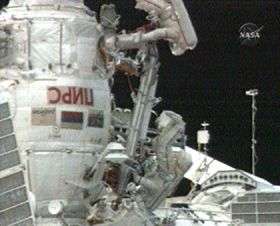
A view of Expedition 17 Commander Sergei Volkov and Flight Engineer Oleg Kononenko as they conduct a spacewalk outside the International Space Station. Credit: NASA TV

International Space Station Commander Sergei Volkov and Flight Engineer Oleg Kononenko began a spacewalk at 2:48 p.m. EDT Thursday to inspect and retrieve an explosive bolt from their Soyuz TMA-12. The bolt will be returned to Earth for examination.

The spacewalk comes in the wake of two consecutive ballistic entries by the previous Soyuz spacecraft, entries that resulted in high-G rides for the crews and landings hundreds of miles short of the planned recovery area. Russian engineers say they have evidence that failed explosive bolts that help separate two modules likely are responsible.

The spacewalk is expected to last about six hours. It focuses on the area between the Soyuz return and propulsion modules.

Volkov and Kononenko leave the Pirs docking compartment and move to the Strela hand-powered crane mounted nearby. Volkov, wearing the red-striped Orlan spacesuit and designated EV1, and Kononenko mount a foot restraint on the end of Strela.

Kononenko, EV2 in the blue-striped suit, gets into the foot restraint and Volkov maneuvers him to the Soyuz, docked to the Earth-facing port on Pirs.

After installing covers to protect nearby thrusters, Kononenko cuts and secures insulation and inspects and photographs the area. Then Volkov moves along the Strela to join Kononenko, who installs a handrail on the Soyuz and a cover to protect fluid lines.

Volkov cuts a wire tie between adjacent pyrotechnic bolts in the suspect position and demates an electrical connector. Next he unscrews and retrieves the pyro bolt and stows it in a protective cylindrical case. He reinstalls the insulation cover and removes the thruster covers, taking photos after each step.

Kononenko and Volkov move back to the Strela controls and both maneuver the crane back to its stowage position on Pirs. They stow a bag with the blast-proof container holding the pyro bolt in the airlock.

If time permits, they install a docking target on the space-facing side of the Zvezda service module. It will help with the docking of a Russian mini-research module atop Zvezda. The module will be delivered on a future mission.

The cosmonauts return to Pirs, enter the airlock and close the hatch.

Flight Engineer Greg Chamitoff remains in the Soyuz during the spacewalk, part of contingency preparations for the unlikely event the Pirs airlock cannot be repressurized.

Volkov and Kononenko will conduct another spacewalk July 15 to outfit the Russian segment's exterior and install a scientific experiment and retrieve another.

Source: NASA

3.5 /5 (2 votes)  

Rank 3.5 /5 (2 votes)
Tags

Related Stories
Relevant PhysicsForums posts
  • Is Venus Slowing Down?
    created43 minutes ago
  • Never ending outer space.....
    createdFeb 11, 2012
  • Neutron Star fragments?
    createdFeb 11, 2012
  • stationary or not?
    createdFeb 11, 2012
  • Scale of the Universe
    createdFeb 10, 2012
  • Titan's lack of impact craters
    createdFeb 09, 2012
  • More from Physics Forums - General Astronomy

More news stories

Alien matter in the solar system: A galactic mismatch

This just in: The Solar System is different from the space just outside it.

Space & Earth / Space Exploration

created 52 minutes ago | popularity 3.7 / 5 (3) | comments 3 | with audio podcast

Transforming galaxies

(PhysOrg.com) -- Many of the Universe's galaxies are like our own, displaying beautiful spiral arms wrapping around a bright nucleus. Examples in this stunning image, taken with the Wide Field Camera 3 on ...

Space & Earth / Astronomy

created 18 minutes ago | popularity 5 / 5 (1) | comments 0 | with audio podcast

A continent ablaze in auroral and manmade light

The North American continent is literally set ablaze in a confluence of Auroral and Manmade light captured in spectacular new videos snapped by the astronauts serving aboard the International Space Station ...

Space & Earth / Space Exploration

created 11 minutes ago | popularity not rated yet | comments 0

A better picture of clouds

Some of us look at clouds and see animal shapes. Scientists are looking beyond. For the first time, a team of scientists led by Pacific Northwest National Laboratory used actual measurements of clouds and ...

Space & Earth / Earth Sciences

created 13 minutes ago | popularity not rated yet | comments 0

Scientists drill two miles down to ancient Lake Vostok

(PhysOrg.com) -- Russian scientists last week finished penetrating more than two miles through the Antarctic ice sheet to Lake Vostok, a huge freshwater lake that has been buried under the ice for millions ...

Space & Earth / Earth Sciences

created 2 minutes ago | popularity not rated yet | comments 0


Manipulating genes with hidden TALENs

(PhysOrg.com) -- A better understanding of gene function in model plant and animal systems could be used to develop useful traits in livestock and crop plants, and might someday lead to developments in stem ...

'Smart' microcapsules in a single step

(PhysOrg.com) -- A new, single-step method of fabricating microcapsules, which have potential commercial applications in industries including medicine, agriculture and diagnostics, has been developed by researchers ...

Tenofovir, leading HIV medication, linked with risk of kidney damage

(Medical Xpress) -- Tenofovir, one of the most effective and commonly prescribed antiretroviral medications for HIV/AIDS, is associated with a significant risk of kidney damage and chronic kidney disease that increases over ...

Building a 'blind-friendly' Internet

Rakesh Babu demonstrates how a blind person uses the Internet.

Ethanol mandate not the best option

Many people are willing to pay a premium for ethanol, but not enough to justify the government mandate for the corn-based fuel, a Michigan State University economist argues.

Nanostructured electrodes for rechargeable sodium-Ion batteries

Highly efficient 3V cathodes for rechargeable sodium-ion batteries have been developed by users from Argonne National Laboratory's Materials Science, Chemical Sciences & Engineering, and X-ray Sciences Divisions, ...