Nano-sized electronic circuit promises bright view of early universe
July 10, 2008 Nano-Sized Infrared Detector

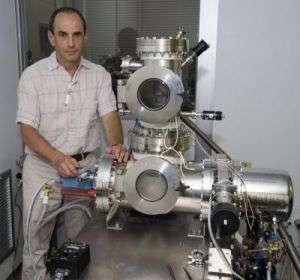
Physics Professor Michael Gershenson with laboratory equipment used to fabricate ultra-sensitive, nano-sized infrared light detector. Credit: Carl Blesch, Rutgers University

A newly developed nano-sized electronic device is an important step toward helping astronomers see invisible light dating from the creation of the universe. This invisible light makes up 98% of the light emitted since the "big bang," and may provide insights into the earliest stages of star and galaxy formation almost 14 billion years ago.

The tiny, new circuit, developed by physicsts at Rutgers University, NASA's Jet Propulsion Laboratory in Pasadena, Calif., and the State University of New York at Buffalo, is 100 times smaller than the thickness of a human hair. It is sensitive to faint traces of light in the far-infrared spectrum (longest of the infrared wavelengths), well beyond the colors humans see.

"In the expanding universe, the earliest stars move away from us at a speed approaching the speed of light," said Michael Gershenson, professor of physics at Rutgers and one of the lead investigators. "As a result, their light is strongly red-shifted when it reaches us, appearing infrared."

Because the Earth's atmosphere strongly absorbs far-infrared light, Earth-based radiotelescopes cannot detect the very faint light emitted by these stars. So scientists are proposing a new generation of space telescopes to gather this light. Yet to take full advantage of space-borne telescopes, detectors that capture the light will have to be far more sensitive than any that exist today.

Detectors of infrared and submillimeter waves, known as bolometers, measure the heat generated when they absorb photons, or units of light. Today's infrared bolometer technology is mature and has reached the limit of its performance.

"The device we built, which we call a hot-electron nanobolometer, is potentially 100 times more sensitive than existing bolometers," Gershenson said. "It is also faster to react to the light that hits it."

The research team is publishing a description of the experimental device in an upcoming issue of the journal Nature Nanotechnology. The journal's website posted an electronic copy of the paper this week at: http://dx.doi.org/10.1038/nnano.2008.173. The team is led by Gershenson and Boris Karasik of the Jet Propulsion Laboratory (JPL), a NASA center managed by the California Institute of Technology (CalTech). Most of the fabrication and measurement work was done at Rutgers by graduate student Jian Wei, now a post-doctoral associate at the Northwestern University; postdoctoral researcher David Olaya, now with the National Institute of Standards and Technology; and postdoctoral researcher Sergey Pereverzev, now with JPL and CalTech. The theoretical support for this research was provided by Andrei Sergeev of the State University of New York at Buffalo.

Made of titanium and niobium metals, the novel device is about 500 nanometers long and 100 nanometers wide. The physicists built it using thin-film and nanolithography techniques similar to those used in computer chip fabrication. The device operates at very cold temperatures – about 459 degrees below zero Fahrenheit, or one-tenth of one degree above absolute zero on the Kelvin scale.

Photons striking the nanodetector heat electrons in the titanium section, which is thermally isolated from the environment by superconducting niobium leads. By detecting the infinitesimal amount of heat generated in the titanium section, one can measure the light energy absorbed by the detector. The device can detect as little as a single photon of far infrared light.

"With this single detector, we have demonstrated a proof of concept," said Gershenson. "The final goal is to build and test an array of 100 by 100 photodetectors, which is a very difficult engineering job." Rutgers took the lead on fabrication and electrical characterization of the single detector, and JPL will take the lead on the optical characterization of the detector and developing detector arrays.

Gershenson expects the detector technology to be useful for exploring the early universe when satellite-based far-infrared telescopes start flying 10 to 20 years from now. "That will make our new technology useful for examining stars and star clusters at the farthest reaches of the universe," he said.

Source: Rutgers University


print this article email this article download pdf blog this article bookmark this article     Stumble it Digg this share on Facebook retweet share on Reddit add to delicious
Rate this story - 4.4 /5 (21 votes)

Rank Filter

Move the slider to adjust rank threshold, so that you can hide some of the comments.


Display comments: newest first

  • NeilFarbstein - Jul 10, 2008
    • Rank: not rated yet
    Why not an array with millions of photodetectors?
  • timmyeatchips - Jul 11, 2008
    • Rank: not rated yet
    I think that's the idea, that each one of these would make up a pixel in an IR/THz imaging sensor.
  • Enthalpy - Jul 11, 2008
    • Rank: 5 / 5 (1)
    100*100 instead of millions because they lack a Farbstein there. They must ignore the name of such a big number.

    Similar detectors already exist, so I wish the paper would tell more precisely what is better or different here. The ones I've read about use an ultrathin superconducting wire; individual photons heat it enough to let it lose briefly its superconductivity.

    And how are large photons concentrated to 500nm*100nm? Also an interesting engineering question.

July 10, 2008 all stories

Comments: 3

4.4 /5 (21 votes)
  • Stumble this up

  • Digg this

  • share this

  • hide
  • Related Stories

  • 'Rationalizer' bracelet tells traders when they're stressed
    created Nov 17, 2009 | popularity not rated yet | comments 0
  • New nano color sorters from Molecular Foundry
    created Nov 12, 2009 | popularity not rated yet | comments 0
  • Designer molecule detects tiny amounts of cyanide, then glows
    created Oct 21, 2009 | popularity not rated yet | comments 0
  • Scientists take step toward simple and portable tuberculosis tests for developing world
    created Oct 08, 2009 | popularity not rated yet | comments 0
  • Filming photons, one million times a second
    created Oct 05, 2009 | popularity not rated yet | comments 0


  • hide
  • Relevant PhysicsForums posts

  • Speed of light : missing energy
    created 4 hours ago
  • Can light produce darkness and can noise procude quiteness 4
    created 6 hours ago
  • Magnetic Oscillation Equations
    created 13 hours ago
  • US Physics Test Eligibility
    created 14 hours ago
  • Are Active Noise Control Stereo Possible?
    created 18 hours ago
  • New Supercomputer at Brown University
    created Nov 20, 2009
  • More from Physics Forums - General Physics

Other News

Using superconducting probes to get a picture of what it's like inside CNTs

Nanotechnology / Nanophysics

created Nov 20, 2009 | popularity 4.9 / 5 (7) | comments 0

(PhysOrg.com) -- "Carbon nanotubes are exciting for fundamental physics, and for potential technological applications," Nadya Mason tells PhysOrg.com. "However, we are generally limited in the way that we can study them. ...


Nanoparticles used in common household items caused genetic damage in mice

Nanotechnology / Bio & Medicine

created Nov 16, 2009 | popularity 4.7 / 5 (22) | comments 11

Titanium dioxide (TiO2) nanoparticles, found in everything from cosmetics to sunscreen to paint to vitamins, caused systemic genetic damage in mice, according to a comprehensive study conducted by researchers at UCLA's Jonsson ...


Nanotube defects equal better energy and storage systems

Nanotube defects equal better energy and storage systems

Nanotechnology / Nanomaterials

created Nov 19, 2009 | popularity 4.4 / 5 (9) | comments 2

(PhysOrg.com) -- Most people would like to be able to charge their cell phones and other personal electronics quickly and not too often. A recent discovery made by UC San Diego engineers could lead to carbon ...


When It Comes to Drug Delivery, Size Matters

Nanotechnology / Bio & Medicine

created Nov 20, 2009 | popularity 5 / 5 (1) | comments 0

(PhysOrg.com) -- One of the great promises of nanotechnologies lies in its ability to create drug-containing nanoparticles decorated with targeting molecules that recognize and bind to cancer cells, providing drug delivery ...


Scientists synthesize graphene-like material: Polymer with honeycomb structure

Scientists synthesize graphene-like material: Polymer with honeycomb structure

Nanotechnology / Nanomaterials

created Nov 19, 2009 | popularity 4.5 / 5 (6) | comments 1

Two-dimensional carbon layers, so-called graphenes, are regarded as a possible substitute for silicon in the semiconductor industry. The electronic properties of these layers can be varied by "building in" ...