Methane Formation in the Oceans: New Pathway Discovered
July 10, 2008
Methane Formation in the Oceans: New Pathway Discovered

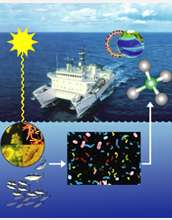
A conceptual view of a new pathway for methane production in the oceans. Credit: C-MORE

(PhysOrg.com) -- A new pathway for methane formation in the oceans has been discovered, with significant potential for advancing our understanding of greenhouse gas production on Earth, scientists believe.

A paper on the findings, published in the July 2008, issue of the journal Nature Geoscience, reveals that decomposition of a phosphorus-containing compound called methylphosphonate may be responsible for an unexpected supersaturation of methane in the oceans' oxygen-rich surface waters.

Through the National Science Foundation (NSF) Center for Microbial Oceanography: Research and Education (C-MORE), oceanographer David Karl of the University of Hawaii and microbiologist Edward DeLong of the Massachusetts Institute of Technology, co-authors of the Nature Geoscience paper, are working to learn how and when microbes turn on and off their methane production genes in response to methane precursors like methylphosphonate.

"This newly recognized pathway of methane formation needs to be incorporated into our thinking about global climate change," says Karl.

Methane is a more potent greenhouse gas than carbon dioxide on a per weight basis. Although the volume of methane in the atmosphere is less than carbon dioxide, methane is much more efficient at trapping the long wavelength radiation that keeps our planet habitable. It's also responsible, therefore, for increased greenhouse warming.

"This remarkable discovery about methane production where we thought there was none is a harbinger of the ocean's changing biogeochemical nature," says Philip Taylor, program director in NSF's Division of Ocean Sciences.

Land-based sources of methane production are well known (including extraction from natural gas deposits and fermentation of organic matter), but those sources did not account for the levels of methane observed in the atmosphere, says Karl.

Karl and colleagues became interested in the "methane enigma" and why the surface ocean was loaded with methane, well above levels found in the atmosphere.

They found a possible solution in the compound methylphosphonate, an unusual organic compound discovered in the 1960s.

Enter C-MORE.

"NSF funded C-MORE so scientists could make new discoveries about the vast genomic diversity and complexity in the microbial world, and its impacts from cellular to global scales," says Matt Kane, program director in NSF's Division of Environmental Biology. "These findings are an example of the results."

In the laboratory, the growth of certain bacteria on methylphosphonate can lead to the production of methane, but until now the process of methylphosphonate degradation in the oceans had not been suggested as a possible pathway for the production of methane in the sea.

"When people began measuring methane in the ocean, they found that methane concentrations varied with geographical location and with water depth," says Karl. "The big surprise was that near-surface concentrations were higher than in the atmosphere above--which indicated a local production of methane in the sea. Because methane is produced only in regions devoid of oxygen, and the surface ocean contains high oxygen levels, this was perplexing."

Karl was able to combine 20 years of ocean observing data at the Hawaii Ocean Time Series (HOTS) site called Station Aloha, with new technology that DeLong developed to produce methane in oxygenated/aerobic marine environments.

"This demonstrates the complementarity of different methods and approaches, including oceanography, microbial ecology and genomics techniques," says DeLong. "The growing databases of marine microbial genomic and metagenomic information have great potential to help us link which organisms, and which genes, are responsible for driving important nutrient and other cycles in the sea, such as aerobic methane generation."

The research also was supported by the Gordon and Betty Moore Foundation.

Source: NSF

4.5 /5 (10 votes)  

Rank 4.5 /5 (10 votes)
Relevant PhysicsForums posts
  • Do some geologists actually act a lot like Randy Marsh?
    created16 hours ago
  • Discrepancy between oxygen and carbon-dioxide levels
    createdFeb 09, 2012
  • where gems are found in the world
    createdFeb 09, 2012
  • Wind Waves in Reservoir ~ Wind run-up and Wind set-up
    createdFeb 08, 2012
  • Balance of oxygen in the atmosphere
    createdFeb 01, 2012
  • The case for a methanol-based economy
    createdJan 30, 2012
  • More from Physics Forums - Earth

More news stories

Europe stakes billion-dollar bet on new rocket

A pencil-slim rocket is scheduled to lift into space from South America on Monday, carrying a billion-dollar bet that Europe can grab a juicy slice of the market to place satellites in low orbit.

Space & Earth / Space Exploration

created 14 hours ago | popularity 3.5 / 5 (2) | comments 0

Political leaders play key role in how worried Americans are by climate change: study

More than extreme weather events and the work of scientists, it is national political leaders who influence how much Americans worry about the threat of climate change, new research finds.

Space & Earth / Environment

created Feb 06, 2012 | popularity 5 / 5 (6) | comments 72

NASA budget will axe Mars deal with Europe: scientists

US President Barack Obama's budget proposal to be submitted next week for 2013 will cut NASA's budget by 20 percent and eliminate a major partnership with Europe on Mars exploration, scientists said Thursday.

Space & Earth / Space Exploration

created Feb 10, 2012 | popularity 5 / 5 (3) | comments 47

Humans may have helped the decline of African rainforests 3000 years ago

(PhysOrg.com) -- Large areas of rainforests in Central Africa mysteriously disappeared over three thousand years ago, to be replaced by savannas. The prevailing theory has been that the cause was a change ...

Space & Earth / Environment

created Feb 10, 2012 | popularity 4.1 / 5 (14) | comments 19 | with audio podcast report

Could Venus be shifting gear?

(PhysOrg.com) -- ESA’s Venus Express spacecraft has discovered that our cloud-covered neighbour spins a little slower than previously measured. Peering through the dense atmosphere in the infrared, the ...

Space & Earth / Space Exploration

created Feb 10, 2012 | popularity 5 / 5 (8) | comments 10 | with audio podcast


Walney offshore wind farm is world's biggest (for now)

(PhysOrg.com) -- The Walney wind farm on the Irish Sea--characterized by high tides, waves and windy weather--officially opened this week. The farm is treated in the press as a very big deal as the Walney ...

GPS court ruling leaves US phone tracking unclear

A US Supreme Court decision requiring a warrant to place a GPS device on the car of a criminal suspect leaves unresolved the bigger issue of police tracking using mobile phones, legal experts say.

Europeans protest controversial Internet pact

Tens of thousands of people marched in protests in more than a dozen European cities Saturday against a controversial anti-online piracy pact that critics say could curtail Internet freedom.

Study finds that anti-diabetic medication can prevent the long-term effects of maternal obesity

In a study to be presented today at the Society for Maternal-Fetal Medicine's annual meeting, The Pregnancy Meeting, in Dallas, Texas, researchers will report findings that show that short therapy with the anti-diabetic medication ...

Netflix settlement trims 14 pct off 4Q earnings

(AP) -- Netflix pressed the rewind button on its fourth-quarter earnings after settling allegations that the video subscription service violated a consumer-privacy law.

Steroid injections prove effective in treatment of lumbar disc herniations

The use of epidural steroid injections may be a more efficient treatment option for lumbar disc herniations, according to research presented today at the American Orthopaedic Society for Sports Medicine's Specialty Day in ...