Researchers Engineer Self-Destructing Virus
July 10, 2008
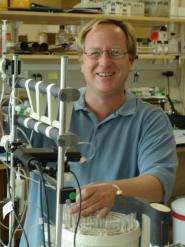
Bentley Fane

Bentley Fane

University of Arizona researchers have sown the seeds of a virus' destruction in its own genetic code – or rather, in the genetic code of the organisms it seeks to infect. Their work could improve both the understanding of how viruses work as well as the ability to make plants and animals more virus-resistant.

Working with a virus that infects bacteria, Bentley Fane, a professor of veterinary sciences and microbiology and a member of the BIO5 Institute, and James Cherwa, a graduate student in Fane's lab, pinpointed a region of a protein that's crucial to building the virus' structure, designed a modified version of that protein, and engineered the bacteria's cells to produce the modified protein.

When the virus infected cells of the bacteria, it "recognized" the modified protein and, following the instructions encoded in its own DNA, the virus tried to incorporate the altered protein into copies of itself. Instead the protein gummed up the works of the replication process, causing the virus to die without producing any offspring. "We were shocked by just how potent the inhibitory protein was," Fane said.

The research casts light on the biology of how viruses work and how the proteins they create interact with one another. It was recently highlighted in the “Spotlight” section of the Journal of Virology.

“We all have an interest in better understanding both how viruses work and how to stop them from working,” Fane explained.

Viruses are little more than strands of DNA or RNA surrounded by a protein coat; they can't reproduce on their own. Instead they invade the cells of more complex host organisms – everything from bacteria to plants and animals – and hijack the machinery inside those host cells in order to replicate.

Along the way, viruses can cause any number of diseases, including blights in plants and colds, flu and HIV in humans. Fane hopes to begin using what he's learned to engineer virus-resistant plants. While similar work has been done with plant viruses before, none of those viruses had the icosahedral shape and structure that is the focus of Fane and Cherwa's research.

The virus they're working with also reproduces quickly – a generation lasts all of about 20 minutes – which means their research provides an up-close view of evolution in action. Over the course of 200 generations, Fane and Cherwa have watched the virus evolve a mutant strain that not only can replicate in spite of the inhibitory protein, but that may also, according to some very preliminary research, be somewhat dependent on the protein. In other words, the original strain's inhibitory protein poison just may be the resistant strain's medicine.

That resistant strain would have a hard time surviving outside the lab, because its resistance is pretty much the only thing it has going for it – it is otherwise less healthy than the original virus. "When something mutates, it does so at a cost to its usefulness," Fane said. "It's always illuminating to see how a virus adapts to something like this, though, because it always manages to. That's the power of evolution and selection."

Source: University of Arizona


Rank 5 /5 (4 votes)
Relevant PhysicsForums posts

More news stories

A mitosis mystery solved: How chromosomes align perfectly in a dividing cell

Although the process of mitotic cell division has been studied intensely for more than 50 years, Whitehead Institute researchers have only now solved the mystery of how cells correctly align their chromosomes during symmetric ...

Biology / Cell & Microbiology

created 7 hours ago | popularity 4.5 / 5 (12) | comments 0 | with audio podcast

Researchers find extensive RNA editing in human transcriptome

In a new study published online in Nature Biotechnology, researchers from BGI, the world's largest genomics organization, reported the evidence of extensive RNA editing in a human cell line by analysis of RNA-seq data, demons ...

Biology / Biotechnology

created 7 hours ago | popularity 5 / 5 (4) | comments 0 | with audio podcast

The proteins ensuring genome protection

Researchers from the University of Geneva (UNIGE), Switzerland, have discovered the crucial role of two proteins in developing a cell 'anti-enzyme shield'. This protection system, which operates at the level of molecular ...

Biology / Cell & Microbiology

created 7 hours ago | popularity 5 / 5 (3) | comments 0 | with audio podcast

Entire genome of extinct human decoded from fossil

(PhysOrg.com) -- In 2010, Svante Pääbo and his colleagues presented a draft version of the genome from a small fragment of a human finger bone discovered in Denisova Cave in southern Siberia. The ...

Biology / Biotechnology

created Feb 07, 2012 | popularity 4.7 / 5 (60) | comments 51 | with audio podcast

Why are there so few fish in the Earth's oceans?

(PhysOrg.com) -- A Stony Brook University researcher has found that, contrary to popular belief, there are not plenty of fish in the sea.

Biology / Plants & Animals

created Feb 08, 2012 | popularity 4.2 / 5 (18) | comments 27 | with audio podcast


Scientists discover molecular secrets of 2,000-year-old Chinese herbal remedy

For roughly two thousand years, Chinese herbalists have treated Malaria using a root extract, commonly known as Chang Shan, from a type of hydrangea that grows in Tibet and Nepal. More recent studies suggest that halofuginone, ...

New method to examine batteries -- MRI from the inside

There is an ever-increasing need for advanced batteries for portable electronics, such as phones, cameras, and music players, but also to power electric vehicles and to facilitate the distribution and storage of energy derived ...

Google might launch Drive for cloud storage soon

(PhysOrg.com) -- Google's next big move, according to the Wall Street Journal, is a cloud storage service called Drive. Hardly first to the plate, Google is simply catching up to introducing its cloud reposi ...

Lab study raises questions over nano-particle impact

Tests involving chickens have raised questions about the impact on health from engineered nano-particles, the ultra-fine grains commonly used in drugs and processed foods, scientists said on Sunday.

Overeating may double risk of memory loss

New research suggests that consuming between 2,100 and 6,000 calories per day may double the risk of memory loss, or mild cognitive impairment (MCI), among people age 70 and older. The study was released today and will be ...

Starve a virus, feed a cure? Findings show how some cells protect themselves against HIV

A protein that protects some of our immune cells from the most common and virulent form of HIV works by starving the virus of the molecular building blocks that it needs to replicate, according to research published online ...