Wasps and bumble bees heat up, fly faster with protein-rich food
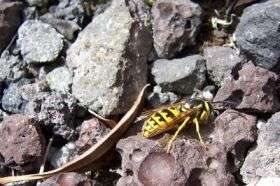
Good pollen makes bees hot, biologists at UC San Diego have found. Wasps warm up too when they find protein-rich meat, a separate experiment has shown.
In both cases warmer flight muscles likely speed the insects' trips home, allowing them to quickly exploit a valuable resource before competitors arrive, the researchers report in separate studies, published this month in two scientific journals.
Because foragers of neither species eat the protein they collect, feeding it instead to their larvae, their warming must be a behavioral rather than a metabolic response to nutritious food, both research teams conclude.
Such similar responses found in two distantly related species – a bumble bee and a yellowjacket wasp whose ancestral lines diverged millions of years ago – suggest that the behavior is an ancestral trait. Bumble bees, but not yellowjackets, recruit fellow foragers to help gather good food; and they are still extra warm when they return to the hive.
"This is information that other bees could potentially use," said associate professor of biology James Nieh who leads the research group that published both papers. Their elevated body heat could be a signal to other bees that has acquired a meaning beyond its original physiological function.
Warm wasps
Western yellowjackets (Vespula pensylvanica) invaded Hawaii on a shipment of Christmas trees in the late 1970s. "Wasps forage on any kind of meat they can find: animal carcasses, other insects," said UCSD doctoral student Megan Eckles. Their appetite for protein and efficient foraging are harming Hawaiian spider and insect populations.
Eckles and biology graduate student Erin Wilson traveled to Hawaii to see if behavioral heating increased the wasps' predatory prowess. "The warmer a wasp's body is, the faster it can fly," Eckles said, and the more efficiently it can harvest its prey.
Eckles found four colonies of these wasps in Volcanoes National Park on the Big Island of Hawaii and set plates of canned chicken 20 meters away from the centers of their nests. She measured the temperatures of 134 foragers using a small pointer-like thermometer that aimed an infrared beam at their thoraxes while they were busy collecting the bait.
Wasps that found the most nutritious bait were hottest. "If they encounter a very high-protein source, such as pure chicken meat, their thoracic temperatures are dramatically higher than when they encounter a poor food source," Eckles said. "You can see their wings quivering after they take a chunk of meat. While they cut it into a nice little aerodynamic ball, they're vibrating their flight muscles to generate heat."
When offered a plate of pulverized chicken, the wasps raised the temperature of their thoraxes a mean of 1.7 degrees Celsius (3.1 degrees Fahrenheit) compared to foragers who were kept from the bait by a mesh dome. Chicken mixed with an equal volume of nutritionless cellulose got a cooler response, an elevation of just 1.1 degrees Celsius (2.0 degrees Fahrenheit), and the wasps tarried longer possibly looking for a better source of food. Eckles, Wilson and Nieh, along with associate professor of biology David Holway report online (http://www-biology.ucsd.edu/labs/nieh/papers/Eckles_et_al_2008.pdf).
Balmy bees
In a separate experiment Nieh and students Katherine Mapalad and Daniel Leu established colonies of bumble bees (Bombus impatiens) in a cool room at UCSD where they offered the insects pure pollen or pollen that had been cut to 75, 50 or 25 percent by weight with indigestible cellulose.
Using a thermal imager, the researchers measured the temperatures of 94 foraging bees just after they collected pollen and again later, right after the bees returned to the nest.
The more protein, the hotter the bees, the team reports (http://ucsdnews.ucsd.edu/PDF/07-08HotBees.pdf in the July 15 issue of the Journal of Experimental Biology. For each additional 25 percent measure of pollen, the bees raised their temperature by 0.4 degrees Celsius (0.7 degrees Fahrenheit) relative to the temperature of the room. They stayed nearly as warm on their return to the nest.
"That is information other bees could potentially use," said Nieh. "Bees are very sensitive to hot spots in the colony."
Bumble bees, but not wasps, will recruit other foragers to help exploit a valuable find; bees in the nest may judge the temperature of returning foragers, which they jostle, perhaps to determine whether they should seek the same source of pollen.
"It may be that a thermal signal has evolved. For that they would first need the basic phenomenon of heating up," said Nieh, who studies the evolution of communication in bees. "Over evolutionary time, it could become a signal that bees recognize."
Source: University of California - San Diego


