Big predatory mammals such as felines need between 5 and 7 different types of prey to meet their dietary needs
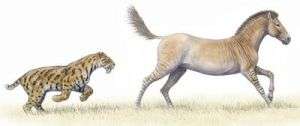
Faced with earlier studies stating that the big predators such as tigers, lions, and lynxes fulfil their dietary needs by eating one or two types of prey, scientists from the University of Malaga assure us now that felines need from 5 to 7 different types of prey to fulfil their dietary needs, although they may be more specialised anatomically than the canines (wolves, dogs?) who can obtain 100% ingested biomass by eating three types of prey. This study brings new keys to the paleoecology of the big predators from the past, such as sabre-toothed tigers.
The main aim of this study, set up by Juan Antonio Pérez-Claros and Paul Palmqvist, both researchers from the University of Malaga, has been to quantify an average of the number of preys necessary to fulfil the dietary needs of a big predatory mammal. "Although the big predators (basically feline and canine predators) have been the subject of numerous studies, to date, in this respect, there have been no actual figures to pin this down," Pérez-Claros explains to SINC.
Macroecological studies had reached the consensus that the number of types of prey for these predators would not be very high. However, the study, which appeared recently in the Journal of Zoology, shows that only the hypercarnivorous canines (wolves and other species related to dogs) have a diet containing three types of prey.
The novelty of the study lies in the confirmation that the large felines, such as lions and leopards, need "from 5 to 7 preys to fulfil their nutritional requirements," the researcher points out. For Pérez-Claros and his colleague it was a surprise to discover that "only in the case of the hypercarnivorous canines three types of prey were ingested to complete almost the total of what these mammals eat."
According to what is published in the study, the dietary contribution of the canines prey, in terms of biomass, is equal to or higher than 55% for the first prey, 20% for the second and 10% for the third. On the other hand, the felines need more prey, although there are exceptions with the cheetah and the Iberian lynx, who concentrate a lot of ingested biomass in a few types of prey.
A scientific paradox
This leads to a paradox: in spite of the fact that canines have cranial and dental skeletal characteristics that are less specialised compared to those of the felines, their populations are more specialised ecologically than the felines.
The canines are more omnivorous (they can eat more invertebrate prey and fruit) than the felines, since, even the hypercarnivorous still have a carnivorous set of teeth containing 42 permanent teeth, and molars, that make it possible for them to eat a greater variety of food.
The felines, for their part, have a smaller set of teeth of 30 permanent teeth and it is much more specialised than that of the canines so they can kill with their canines and cut meat with their flesh-eating teeth. The study compares the morphological specialisation of the felines with a marked ecological specialisation in the canines.
In order to reach these conclusions, the researchers have analysed hundreds of publications where the biomass taken by different predators from different prey (tiger, lion, leopard, snow leopard, cheetah, puma, jaguar, European and Iberian lynx, wolf, African wild dog, Asian wild dog, bush dog or Ethiopian fox) can be calculated.
"In general the biomass has been quantified by analysing the remains of the fur or bones in the faeces since these give more precise results than those based on observations from the hunts," the scientist points out.
Biological analysis of the diet
The researchers' final aim was to quantify the contribution of different sources to the diet of an organism using stable isotopes applied to the paleoecology. In the case of a predator, those sources are the prey, given that the bodies of the organisms are built from what they eat. "Because each prey generally has a particular isotopic composition it is possible to determine how they contribute to a predator's diet. To do this, we analysed the stable carbon and nitrogen isotopes in the predators' and preys' bones that were preserved in the same deposits," Pérez-Claros points out.
However, just two isotopes determine the contribution of three preys to the diet of a predator. For this reason, the scientists had to confirm that in the present canines and felines the difference between the number of prey that contributes to their diet was "a reasonable hypothesis."
Moreover, the results make it possible to conclude that the extinct felines probably needed a higher number of prey to eat, since the fossil records show a greater diversity of potential prey from which to choose during the Plio-Pleistocene era.
Citation: Pérez-Claros JA; Palmqvist P. How many potential prey species account for
the bulk of the diet of mammalian predators? Implications for stable isotope
paleodietary analyses. Journal of Zoology 275(1): 9-17 MAYO 2008
Source: University of Malaga


