Swiss nano-microscope delivers first images recorded on Mars
July 11th, 2008 Swiss nano-microscope delivers first images recorded on Mars

Enlarge

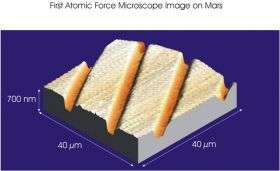
The first image recorded by an atomic force microscope on another planet. On July 9, Mars day 44 of the Phoenix Mars Mission, the atomic force microscope on the Mars Lander recorded an image of a test grid, which serves as a calibration for the microscope. This image was successfully transmitted to Earth by the Phoenix Mars probe, and demonstrates full functionality of the nano-imaging device under the harsh Martian conditions, satisfying the NASA Phoenix team as well as the Swiss scientific team responsible for the development of the microscope. The area imaged by the microscope is 40 microns by 40 microns, small enough to fit on an eyelash. The grooves in this substrate are 14 microns (0.00055 inch) apart, from center to center. The vertical dimension is exaggerated in the image to make surface details more visible. The grooves are 300 nanometers (0.00001 inch) deep. Credit: NASA / JPL-Caltech / University of Arizona / University of Neuchatel

(PhysOrg.com) -- For the first time ever, nanostructures have been measured on another planet. On July 9, the NASA "Phoenix" Mars Probe recorded images with nanometer resolution (one nanometer roughly corresponds to 0.00000004 inch) using its onboard Swiss-made atomic force microscope, and successfully transmitted these images back to Earth.

The first images of the microscope — which was developed by the universities of Neuchâtel and Basel, and by the Swiss company Nanosurf — show the surface of a test grid with unprecedented detail. The successful imaging of this test grid serves as a calibration for the nano-microscope and documents full functionality of the instrument, which is an absolute prerequisite for the scheduled microscopy measurements on Mars.

Nanosurf Mars project leader Dominik Braendlin says: "The operation of our atomic force microscope under these harsh conditions demonstrates the suitability for daily use of such nano-imaging devices. We are now anxiously awaiting the upcoming images of Mars surface particles".

The Phoenix Mars probe is scheduled to investigate the shape and structure of Mars dust and soil particles. Their surface — when documented with the proper resolution — harbors a wealth of scientific data. Erosion and scratch marks on these particles, for instance, can give crucial clues as to whether the particles were ever transported by liquid water on Mars.

The resolution required for this task is only attained by the atomic force microscope. In contrast to optical microscopes, this nano-imaging device touches the surface of the particles to be analyzed with a very sharp tip, recording surface height information in a scanning-type motion. The Nanosurf atomic force microscope is part of the MECA unit, which has been providing NASA with scientific data from the very start of its deployment.

This unit — one of seven on the Phoenix Mars probe — is responsible for the Microscopy, Electrochemistry, and Conductivity Analysis of the Martian soil. The MECA unit was developed under the supervision of the Jet Propulsion Laboratory of the California Institute of Technology.

Goal of the Phoenix Mars mission is to answer three important questions: (1) can the Martian arctic support life, (2) what is the history of water at the landing site, and (3) how is the Martian climate affected by polar dynamics?

The atomic force microscope of the MECA unit was developed by a Swiss consortium, consisting of the Institute of Microtechnology of the University of Neuchâtel, the Institute of Physics of the University of Basel, and the Swiss company Nanosurf. The consortium is lead by Urs Staufer (University of Neuchatel; currently at the Technical University of Delft), in collaboration with Dominik Braendlin (Nanosurf), Sebastian Gautsch (University of Neuchatel), Hans-Rudolf Hidber (University of Basel), Tom W. Pike (Imperial College London), Andreas Tonin (University of Basel), and Daniel Parrat (University of Neuchatel).

Source: Nanosurf


print this article email this article download pdf blog this article bookmark this article     Digg this Stumble it share on Facebook share on Reddit add to delicious save to Yahoo! bookmarks
4.5/5 after 16 votes


July 11th, 2008 all stories
Nanotechnology / Nanophysics

Comments: 0
Rank: 4.5/5 after 16 votes

  • Stumble this up

  • Digg this

  • Share it:
  • share on Facebook
  • share on MySpace
  • share on Slashdot
  • rss-newsfeed
  • share on Google
  • share on Reddit
  • add to delicious
  • save to Yahoo! bookmarks
  • share on Windows Live
  • Add to Mixx!
Rating: 4.5/5 after 16 votes

  • Related Stories

  • Mars explorer says we'll find life on other planets within 10 years
    created Apr 21, 2009 | popularity not rated yet | comments 0
  • Liquid saltwater is likely present on Mars, new analysis shows
    created Mar 17, 2009 | popularity not rated yet | comments 0
  • Phoenix Lander Winds Up Its Astonishing Summer On Mars
    created Nov 25, 2008 | popularity not rated yet | comments 0
  • NASA says Phoenix Mars mission has ended (Update 2)
    created Nov 10, 2008 | popularity not rated yet | comments 0
  • Could life have started in a lump of ice?
    created Nov 05, 2008 | popularity not rated yet | comments 0


  • Physicists Demonstrate Quantum Memory with Matter Qubits
    Physicists Demonstrate Quantum Memory with Matter Qubits
    Physics / General Physics
    created Jul 03, 2009 | popularity 4.4 / 5 (17) | comments 1
  • 'Holey' Nanosheets for Wastewater Dye Removal
    Nanotechnology / Nanomaterials
    created Jul 01, 2009 | popularity 5 / 5 (5) | comments 1
  • Jellyfish Robot Swims Like its Biological Counterpart
    Jellyfish Robot Swims Like its Biological Counterpart
    Electronics / Robotics
    created Jun 26, 2009 | popularity 4.4 / 5 (8) | comments 1
  • Could Maxwell's Demon Exist in Nanoscale Systems?
    Could Maxwell's Demon Exist in Nanoscale Systems?
    Physics / General Physics
    created Jun 24, 2009 | popularity 4.4 / 5 (18) | comments 29
  • Living Safely with Robots, Beyond Asimov's Laws
    Living Safely with Robots, Beyond Asimov's Laws
    Electronics / Robotics
    created Jun 22, 2009 | popularity 4.6 / 5 (52) | comments 40
  • Other News

    A 'quantum of sol' -- how nanotechnology could hold the key to a solar-powered future

    A 'quantum of sol' -- how nanotechnology could hold the key to a solar-powered future

    Nanotechnology / Nanomaterials

    created Jun 30, 2009 | popularity 3.9 / 5 (16) | comments 17

    (PhysOrg.com) -- A new generation of 'nano-structured' millimetre-sized solar cells that could convert the sun's energy to electricity more than twice as efficiently as current technology, is the subject of ...


    Australian researchers are set to begin human trials of a tiny nano-cell that acts as a "Trojan horse" against cancer

    Hi-tech 'Trojan horse' can kill cancer cells: researchers

    Nanotechnology / Bio & Medicine

    created Jun 29, 2009 | popularity 4.7 / 5 (12) | comments 7

    Australian researchers are set to begin human trials of a tiny nano-cell that acts as a "Trojan horse" against cancer cells, a breakthrough they say may curb the need for debilitating chemotherapy.


    'Holey' Nanosheets for Wastewater Dye Removal

    Nanotechnology / Nanomaterials

    created Jul 01, 2009 | popularity 5 / 5 (5) | comments 1

    (PhysOrg.com) -- Researchers have discovered that extremely thin sheets of nickel oxide with hexagonally shaped holes can absorb hazardous dyes from wastewater nearly as well as the best traditional methods, but are recyclable. ...


    Harnessing Nanoparticles To Track Cancer Cell Changes

    Nanotechnology / Bio & Medicine

    created Jul 03, 2009 | popularity not rated yet | comments 1

    The more dots there are, the more accurate a picture you get when you connect them. Cancer researchers adopting that philosophy have developed a new imaging technology that could give scientists the ability to simultaneously ...


    Computer-Guided Nanoparticle Therapy Destroys Tumors

    Nanotechnology / Bio & Medicine

    created Jun 29, 2009 | popularity 4.9 / 5 (12) | comments 0

    Gold nanoshells are among the most promising new nanoscale therapeutics being developed to kill tumors, acting as antennas that turn light energy into heat that cooks cancer to death. Now, a multi-institutional research team ...