Loss of Wolves Causes Major Ecosystem Disruption at Olympic National Park
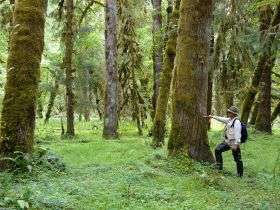
(PhysOrg.com) -- Olympic National Park was created in 1938, in part “to preserve the finest sample of primeval forests in the entire United States” – but a new study at Oregon State University suggests that this preservation goal has failed, as a result of the elimination of wolves and subsequent domination of the temperate rainforests by herds of browsing elk.
The park, with streamside ecosystems that have been largely denuded of the young trees needed to replace the old ones, and stream systems that bear little resemblance to the narrower and vegetation-lined rivers of the past, is now anything but “primeval” and a very different place than it was 70 years ago, researchers say.
The extermination of wolves in the early 1900s set off a “trophic cascade” of changes that appear to have affected forest vegetation and stream dynamics, with possible impacts on everything from fisheries to birds and insects, the scientists wrote in their report, just published in the journal Ecohydrology.
Members of the Press Expedition, hiking in 1890 through what is now Olympic National Park, found the banks of the upper Quinault River “so dense with underbrush as to be almost impenetrable,” they wrote at the time. Logs jammed the rivers, dense tree canopies shaded and cooled the streams, and trout and salmon thrived along with hundreds of species of plants and animals.
“Today, you go through the same area and instead of dense vegetation that you have to fight through, it’s a park-like stand of predominantly big trees,” said Bill Ripple, a co-author of the study and forestry professor at Oregon State University. “It’s just a different world.”
That world may still be quite beautiful with its jagged, glacier-covered peaks and towering old-growth trees. But it’s not the same one that so impressed President Theodore Roosevelt in 1909 that he created Mount Olympus National Monument – in large part to help protect elk herds that had been decimated by hunting. The Roosevelt elk, a massive animal that now bears his name, can weigh more than 1,000 pounds.
With protection from hunters and extermination of wolves not long after that, elk populations surged, and OSU researchers say that in the intervening decades the very nature of Olympic National Park has changed dramatically.
“Our study shows that there has been almost no recruitment of new cottonwood and bigleaf maple trees since the wolves disappeared, and also likely impacts on streamside shrubs, which are very important for river stability,” said Robert Beschta, lead author of the study and professor emeritus of forest hydrology at OSU. “Decreases in woody plant communities allow river banks to rapidly erode and river channels to widen.”
“Tree and shrub species along stream banks and floodplains started crashing first,” Beschta said. “Then, apparently, the rivers began to unravel. Now we have large areas where the forest understory vegetation is mostly just grasses and ferns.”
The study showed that river dynamics are quite different than they were historically. Streams that once were held together in tight channels by heavy bank vegetation are now wider and braided, with exposed gravel bars a common feature. The water is open to the warming sun and less enriched by plants and insects. Nearly half of the terraces along the Queets River have disappeared because of accelerated erosion over a period of multiple decades.
“We’ve seen the impact of wolves on the ecosystem in Yellowstone, the effect of cougars in Yosemite National Park, the same basic story about the importance of key predators being played out in many different places,” Ripple said. “What’s so surprising here is that it’s happening in a temperate rainforest, which is hugely productive and has such high levels of vegetation growth. But even there, when the ecosystem gets overwhelmed with many large herbivores, the vegetation just can’t keep up.”
In an area outside Olympic National Park where little foraging by elk occurred, tree recruitment has been normal and healthy in recent decades.
Since the Olympic National Park ecosystem bears some similarity to much of the temperate rainforests in the Coast Range of Oregon, Washington and British Columbia – with a mild climate and heavy levels of rainfall – it’s reasonable to believe similar forces are at work elsewhere when historic predators have been removed, the scientists said.
“Unlike some of the studies we’ve done in the Rocky Mountains, arid desert or canyon ecosystems, for us this one is hitting a little closer to home,” said Beschta, a forest hydrologist who has studied Pacific Northwest streams for more than 30 years. “These processes are at work right in our backyard.”
In multiple studies in the U.S. and Canada, usually in national parks where supposedly “pristine” ecosystems are still available, the OSU scientists in recent years have documented the critical impacts on ecosystems when key predators disappear – usually wolves or cougars. It has been shown that such predators help control the grazing impacts of elk and deer on several levels, by keeping their population levels down, but also in changing their patterns of behavior – a process that has been called “the ecology of fear.”
In the most classic case where these predators have been brought back into the ecosystem – wolves in Yellowstone National Park – OSU scientists have found that some stream ecosystems are now starting to recover where they had been in serious decline for more than half a century. Streamside trees and shrubs, beaver dams, and native plants, animals and fisheries are being restored.
An effort was considered to restore wolves to the Olympic National Park ecosystem in recent years, but no decision or actions have been undertaken to accomplish that, the OSU scientists said.
Source: OSU


