Passive learning imprints on the brain just like active learning
July 14, 2008 Passive learning imprints on the brain just like active learning

Enlarge

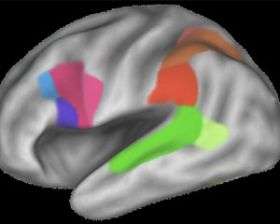
A view of the left hemisphere of the brain (with the left part of the image being the forward part of the brain) illustrating the Action Observance Network regions. (image courtesy Emily Cross)

It's conventional wisdom that practice makes perfect. But if practicing only consists of watching, rather than doing, does that advance proficiency? Yes, according to a study by Dartmouth researchers.

In a study titled "Sensitivity of the Action Observation Network to Physical and Observational Learning" published in the journal Cerebral Cortex in May 2008, Dartmouth researchers determined that people can acquire motor skills through the "seeing" as well as the "doing" form of learning.

"It's been established in previous research that there are correlations in behavioral performance between active and passive learning, but in this study we were surprised by the remarkable similarity in brain activation when our research participants observed dance sequences that were actively or passively experienced," says Emily Cross, the principal investigator and PhD student at Dartmouth. Cross, who earned her degree in June, is currently a post-doctoral fellow at the Max Planck Institute for Cognitive and Brain Sciences in Leipzig, Germany.

Cross and her collaborators used a video game where players have to move in a particular sequence to match the position of arrows on the screen, similar to the popular Dance Dance Revolution game. The researchers measured the skill level of participants for sequences that were actively rehearsed daily, and a different set of sequences that were passively observed for an equivalent amount of time. Brain activity when watching both kinds of sequences (as well as a third set of sequences that were entirely unfamiliar) was captured using fMRI, functional magnetic resonance imaging. The study focused on the Action Observance Network (AON) in the brain, a group of neural regions found mostly in the inferior parietal and premotor cortices of the brain (near the top of the head) responsible for motor skills and some memory functions.

"We collected fMRI data before and after five days of both visual and physical training," says Cross, "and there was common AON activity when watching the practiced and observed dance sequences."

This research contributes to a growing body of study about how people learn and how best to help people with brain injuries. Cross explains that future studies might consider how such overlap between physical and observational learning at the brain level can improve upon rehabilitation therapies for individuals affected by physical or neurological injury.

Source: Dartmouth College


print this article email this article download pdf blog this article bookmark this article     Stumble it Digg this share on Facebook retweet share on Reddit add to delicious
Rate this story - 4.6 /5 (27 votes)

Rank Filter

Move the slider to adjust rank threshold, so that you can hide some of the comments.


Display comments: newest first

  • menkaur - Jul 15, 2008
    • Rank: not rated yet
    for me it looks like a variation of already known facts (like if you look as someone doing something, the activation pattern in your brain is the same as if you were doing it)

July 14, 2008 all stories

Comments: 1

4.6 /5 (27 votes)
  • Stumble this up

  • Digg this

  • share this

  • hide
  • Related Stories

  • Professor finds that iconic Oswald photo was not faked (w/ Video)
    created Nov 05, 2009 | popularity not rated yet | comments 0
  • Video camera that records at the speed of thought
    created Oct 12, 2009 | popularity not rated yet | comments 0
  • National trial to test new treatment for chronic, severe indigestion
    created Sep 17, 2009 | popularity not rated yet | comments 0
  • Better care, pay less: Some communities find a way
    created Sep 07, 2009 | popularity not rated yet | comments 0
  • Computational process zeroes in on top genetic cancer suspects
    created Sep 01, 2009 | popularity not rated yet | comments 0


  • hide
  • Relevant PhysicsForums posts

  • How to prevent another stroke?
    created 16 hours ago
  • Swine flu vaccination
    created Nov 10, 2009
  • Improving the brain through chemistry
    created Nov 07, 2009
  • Sleep / REM Sleep and homeostasis
    created Nov 07, 2009
  • More from Physics Forums - Medical Sciences

Other News

baby mice

Early life stress has effects at the molecular level

Medicine & Health / Neuroscience

created 1hour ago | popularity 5 / 5 (1) | comments 0

(PhysOrg.com) -- A new study of mice suggests that stress and trauma in early life can have an impact on the genes and result in behavioral problems later in life.


High fat diet increases inflammation in the mouse colon

Medicine & Health / Health

created 1hour ago | popularity not rated yet | comments 0

(PhysOrg.com) -- In mice fed a diet high in fat and low in fiber, vitamin D and calcium -- the so-called Western diet -- expression of a series of genes collectively associated with immune and inflammatory responses was altered. ...


'Nature or nurture' study reveals 'musical genes' (w/ Video)

Medicine & Health / Genetics

created 1hour ago | popularity not rated yet | comments 0

(PhysOrg.com) -- If you've ever wondered why a close group of friends might like completely different types of music, blame their genes. A study by Nokia and Kings' College London into the musical tastes of nearly 4,000 twins ...


Australian bid to 'regrow' breasts after cancer surgery

Medicine & Health / Cancer

created 2 hours ago | popularity not rated yet | comments 0

Australian scientists said Thursday they were to trial a revolutionary treatment which would allow women to regrow their breasts after cancer surgery.


Walking, talking and memory

Walking, talking and memory

Medicine & Health / Psychology & Psychiatry

created 1hour ago | popularity not rated yet | comments 0

(PhysOrg.com) -- How easy is it to walk, talk and remember what was said? Dr Dee Way studied how actors learn a script and whether walking affects their memory performance.